
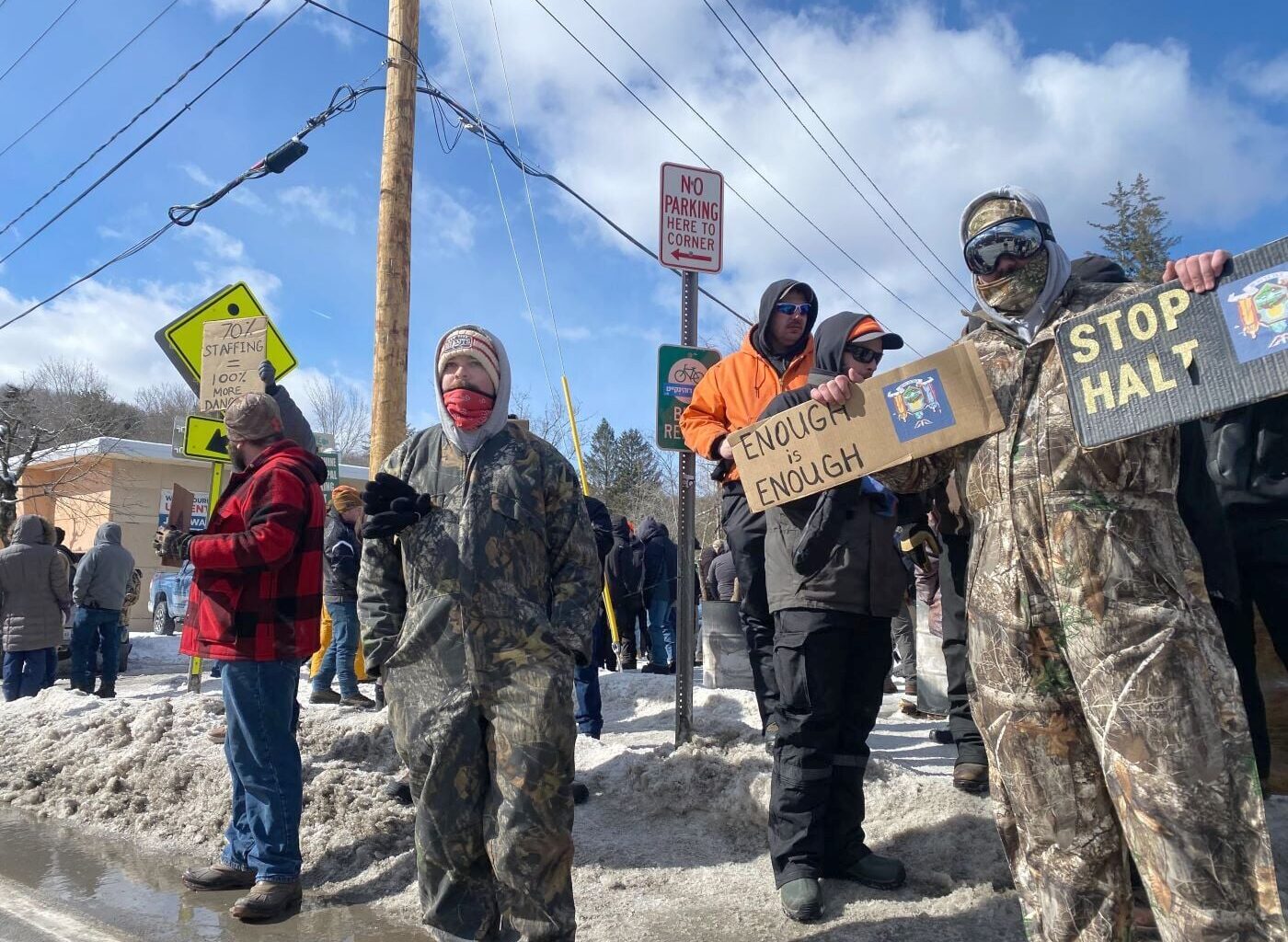
One year ago, New York State officials were reaching a deal with the union that represents prison guards to end their weeks-long wildcat strike. Despite reaching a deal, thousands of guards refused to return to work on Mar. 10, 2025, and were later fired and many prisons are still understaffed today.
Low staffing levels continue to have a ripple effect on incarcerated people, some of whom have had their release dates delayed or even been denied parole because there isn’t enough staffing for certain programs. Rebecca McCray reported on the strike and its impact for Hell Gate, The Marshall Project, and New York Focus.
Emily RussellOne year later, New York’s prison strike continues to impact incarcerated people

People protesting outside of Woodbourne Correctional in Sullivan County. Photo provided by Patricio Robayo, WJFF Radio Catskill
EMILY RUSSELL: Let’s start with the strike. Officers were demanding safer working conditions and a solution to low staff levels. What were you hearing from incarcerated people while the prisons were on lockdown?
REBECCA MCCRAY: So during the lockdown, I was hearing from people in prisons throughout the state pretty much every day and the problems they reported really varied in severity.
I was hearing everything from programs were being cancelled to insulin and other critical medication weren’t being administered or being administered late. Meals were being served late. In a few cases, meals weren’t being served at all and people were stuck in their cells for 24 hours a day at worst.
Lawyers who had scheduled visits also were getting those visits canceled and legal calls were getting canceled and a lot of people couldn’t reach their families by phone. Those last two impacts really touch on a bigger theme that I just kept hearing, which was that there was a huge lack of information about what was actually happening throughout the system. Over the course of the strike, nine incarcerated people died, including Messiah Nantwi, who was beaten to death by corrections officers.
So, that lack of information, coupled with that kind of information circulating throughout the system, was just provoking a lot of fear and anxiety for people inside.
RUSSELL: So, the strike ended when the union struck a deal with the state. Lockdowns were lifted, but life for a lot of incarcerated people didn’t just go back to normal. Why has recovery been so slow behind bars?
MCCRAY: So even though one agency runs the state’s prison system, there are 42 different correctional facilities throughout the state. And some of those were less affected by the strike. So maybe fewer corrections officers participated in the strike or maybe more or fewer were fired from one place or another. So the issues are really unevenly felt throughout the state. Prisons downstate, for example, were for the most part less affected.
And even though thousands of National Guard members were deployed to support the staff, many of whom are still working in prisons, they can’t legally perform all the same duties of corrections officers, so things are still not back to normal.
RUSSELL: Staffing levels are as low today as they were before the strike. How has that impacted the daily lives of incarcerated people?
MCCRAY: I think one of the biggest issues impacting incarcerated people right now is limited family visits. So, visitation is allowed fewer days a week than before the strike almost everywhere, and wait times for entering facilities are longer because people are all crammed into one day for visits, one or two days, and there are new screening procedures at some of the prisons as well.
So, for example, a guy at Attica who I spoke to last week, told me that after his family came up all the way from New York City to visit a couple of times and weren’t even able to get in, he just told them to stop coming until the issue was resolved because he felt bad that they were waiting. So, he hasn’t seen his family in eight or nine months now.
RUSSELL: You spoke with another man who’s incarcerated at Franklin Correctional Facility in Malone and found that he was seriously impacted by the lack of programming. What did you hear from him? ,
MCCRAY: Yeah, so John Luke Papadopoulos is in a tricky catch-22. He was recently denied early release by the parole board in part because he hadn’t completed substance use and anger management programs that are required.
But the reason he hasn’t participated in those programs is because they weren’t running for the majority of the time that he’s been in prison. And even when they resumed, they only resumed part-time. So as recently as last week, he’s still on the wait list. There are a lot of other people in this position, from what I understand, who are just waiting and waiting for these programs that they are required to take, which means they ultimately might serve more time than they otherwise would have.
RUSSELL: What has the State Department of Corrections said about all these impacts?
MCCRAY: The prison agency definitely acknowledges that the system is not operating normally and the recovery process is ongoing and understaffing persists, but in the context of programming, public information officers have told me that no facility is operating without programs. They say that college and substance use programs are running in the majority of prisons that offer them.
That doesn’t mean that programs are running the way they’re supposed to. So, for example, someone I talked to recently who’s incarcerated said that he used to take college classes four nights a week and now they’re only offered two times a week during the day. So, he was looking forward to finishing a degree and now that’s going to take much longer, and a lot of other folks are just waiting to even get into those programs.
RUSSELL: There are 10 state prisons here in the North Country. They incarcerated about 7,000 people. Why do you think it’s important that the general public understands how a strike a year ago is still impacting incarcerated people today?
MCCRAY: I think it’s easy to think of prisons as entirely walled off from the communities that they’re in, but prisons are actually porous, and staff move in and out of them every day. Also, many incarcerated people who are serving time return to the community, most of them actually.
So the conditions in the state’s prisons really impact the safety and well-being of incarcerated people, of people who work in prisons, and the loved ones and family members of both of those groups. So the harm that’s being felt after the strike is really something that flows in and out of surrounding communities.
Something I often hear from advocates is that the punishment for which people are sentenced in New York is to be confined and removed from their communities. That punishment doesn’t include the kinds of harms and deprivations that we’re seeing persist as a result of the strike.
Then, on a fiscal level, this is all just incredibly expensive. So Gothamist recently reported that Governor Hochul’s budget this year includes an ask for $535 million to keep the National Guard stationed in prisons, and the state has already spent $700 million to keep them there through the end of March. So all of that is happening in the context of our state reeling from federal funding cuts and a growing budget deficit.