
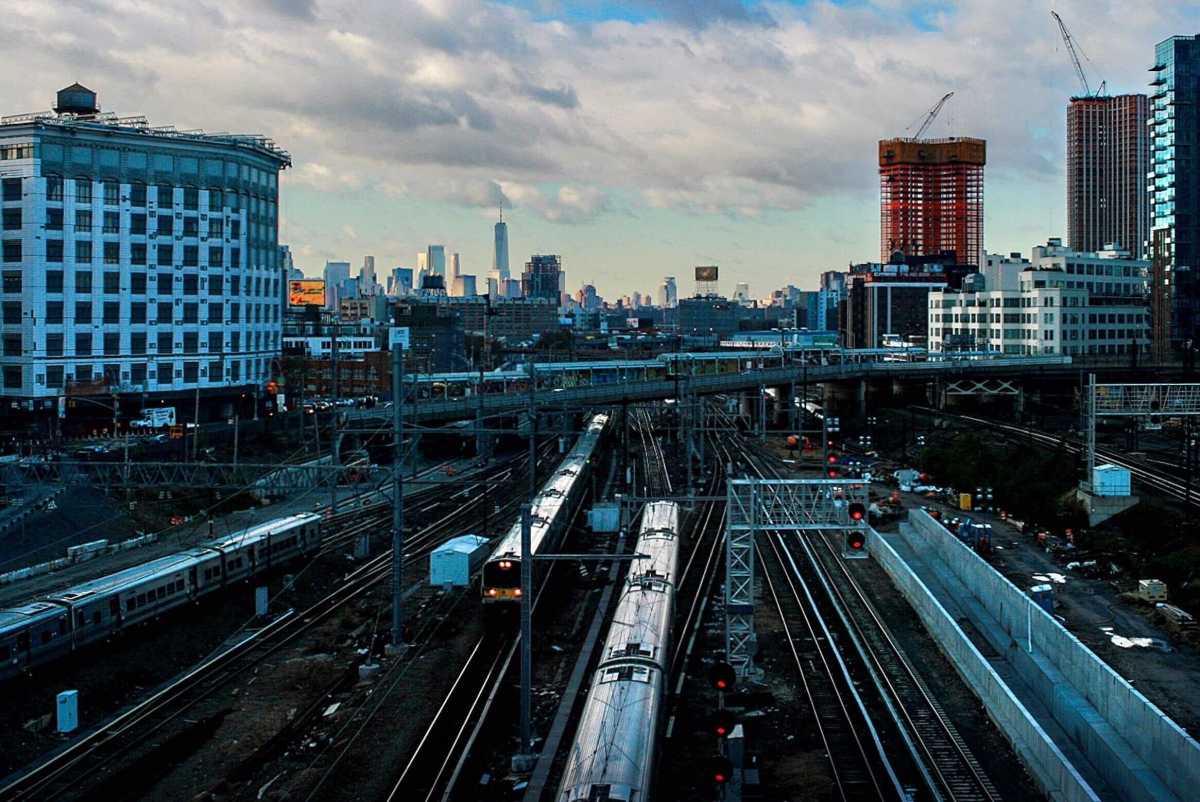
Sunnyside Yards. (Photo by Mark Hallum)
When the Mayor of New York City and the President of the United States sit down to discuss building 12,000 new homes in Queens, it is more than a policy conversation – it is a defining moment.
Mayor Mamdani’s decision to prioritize Sunnyside Yards in his meeting with President Trump signals that this long-envisioned project is no longer theoretical. It is now a serious, national-level conversation about how to confront New York’s housing crisis while creating thousands of union careers and strengthening our local economy. In a period often marked by political division, the willingness to engage across the aisle and across levels of government on a transformative project of this scale is both significant and necessary.
Sunnyside Yards is one of the largest untapped development opportunities in the country – a plan to deck over an active rail yard and create a new, transit-oriented neighborhood in the heart of Queens, bordered by Long Island City, Astoria and Sunnyside. For decades, it has been described as a once-in-a-generation opportunity. Today, amid record high rents and a severe housing shortage, it has become an economic imperative.
From the business and labor community’s perspective, the connection is direct. Affordability is a competitiveness issue.
Queens is home to tens of thousands of small businesses – restaurants, contractors, healthcare providers, retailers and tech startups that power our borough’s economy. But the housing shortage is constraining the very workforce that keeps these businesses and New York running. They need access to a skilled workforce, yet too many of those middle-income workers cannot afford to live anywhere near their workplaces.
As a result, commutes lengthen and costs rise. And as local businesses struggle to hire and retain talent, the middle class shrinks. This only slows, and in some cases, completely stifles key economic growth.
Sunnyside Yards offers a chance to address that challenge at scale.
The site sits atop one of the most transit-rich corridors in North America. It is exactly where dense housing should be built – on top of existing infrastructure and within walking distance of vibrant commercial corridors.
Developing 12,000 new homes here would bring thousands of New Yorkers closer to jobs and services and drive economic stimulus back into our communities. It would add new customers and increased foot traffic for the small businesses of western Queens. And it would demonstrate that New York is willing to build smartly and strategically to meet demand.
The economic benefits begin long before the first resident moves in.
A project of this magnitude would generate thousands of union construction careers over many years. These opportunities will provide more workers with the stability needed to raise families in the city and significantly bolster the middle class. The men and women of the Building and Construction Trades Council of Greater New York’s unions would help build an entirely new neighborhood. The ripple effects would extend to suppliers, design firms, manufacturers and small businesses throughout the region.
Importantly, building over a rail yard allows the city to add housing without displacing existing residents and businesses – a crucial distinction in a city where many development debates center on fears of upheaval. This is growth done responsibly, in a location designed for density.
But we must be clear: a project of this magnitude will require significant federal financial investment. Decking over active rail infrastructure is enormously complex and expensive. It involves coordination with Amtrak and the MTA, major structural engineering, and billions of dollars in upfront capital before a single housing unit can rise. The city and state cannot shoulder that burden alone.
That is precisely why the Mayor’s conversation with the President matters so much. Federal partnership will be essential to unlocking this site.
New York has always defined itself by its ambition. Getting grand infrastructure projects, from our bridges to our transit system, across the finish line has never been easy. It requires bold leadership, serious public investment and cooperation across different levels of government.
Sunnyside Yards belongs in that tradition.
If we are serious about tackling affordability, supporting small businesses and keeping skilled workers in our city, we must be equally serious about building at scale — and funding it accordingly. The Mayor has elevated this project to the national stage. Now leaders at every level must match that vision with resources and resolve.
Twelve thousand homes. Thousands of family-sustaining careers. A bolstered middle class that uplifts a stronger Queens and a more competitive New York.
A generational opportunity is in front of us. We cannot afford to let it pass.
Grech is the President and CEO of the Queens Chamber of Commerce; LaBarbera is the President of the Building and Construction Trades Council of Greater New York.