
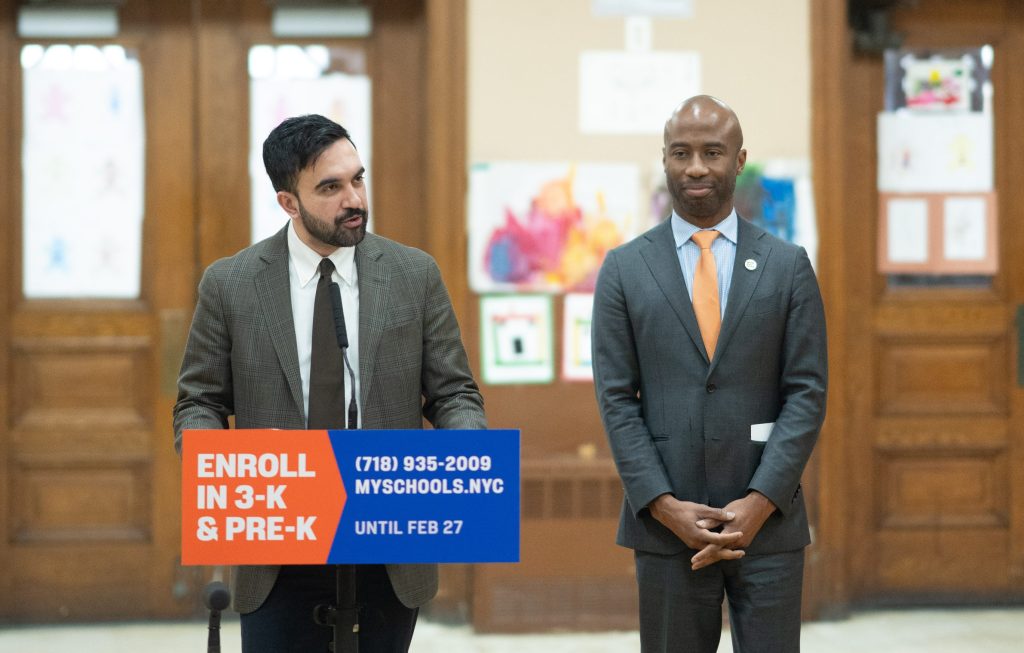
Mayor Mamdani on Tuesday announced 1,000 new free preschool seats for 3-year-olds in neighborhoods with unmet demand, including in some of New York City’s wealthiest zip codes — an expansion that he said would make the program truly universal for the first time.
The 56 zip codes span Manhattan’s Greenwich Village, SoHo, West Village, Chelsea and Gramercy, as well as the Upper East Side and Upper West Side. The new seats, part of a $100-million investment from Gov. Hochul to stabilize 3-K, are also coming to Boerum Hill, Park Slope and Prospect Heights, as well as other well-off nabes in “Brownstone Brooklyn.”
They also touch several working-class neighborhoods, such as Parkchester, Canarsie and Corona, as well as all five boroughs, including Staten Island — which was left out of Mamdani’s recent launch of free child care for 2-year-olds.
“Someday, many years from now, a new generation of New Yorkers will raise their children here in our city,” Mamdani said during a news conference at The Richmond Pre-K Center on Staten Island after last week’s omission.
“They will worry about all the things that new parents worry about: If they will ever get another good night of sleep, whether their child will learn to share with their sibling,” he added. “But they won’t ever worry — not for a moment — about whether their family will be able to access quality child care, or whether they will be able to afford it.”
Tuesday’s expansion is aimed at addressing a paradox that has long vexed the city’s early childhood system.
In some neighborhoods, families have been shut out of local 3-K programs and been forced instead to shell out more than $20,000 annually.
In other areas, though, thousands of 3-K seats are empty every year.
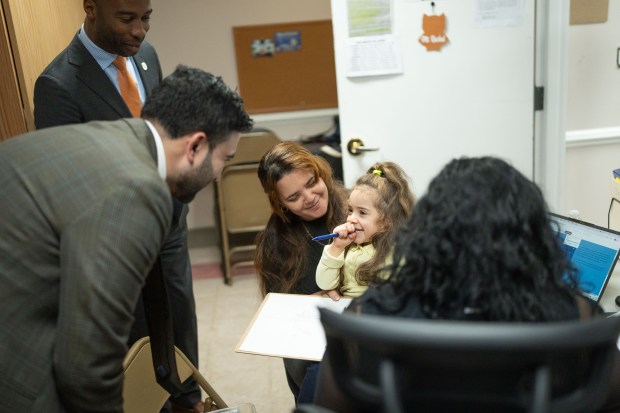 New York City Mayor Zohran Mamdani and New York City Public Schools Chancellor Kamar Samuels celebrate the opening day of 3-K and Pre-K applications with a visit to a 3-K and Pre-K child care center in Cypress Hills on Wednesday, Jan. 14, 2026. (Michael Appleton / Mayoral Photography Office)
The zip codes — selected based on historical enrollment data, early application data and provider capacity — underscore a tension in the late phase of 3-K’s rollout: Many neighborhoods with unmet demand are in wealthier parts of the city and stand to meaningfully benefit from the governor’s election-year investment.
But it also calls attention to a recent trend: As the city grapples with an affordability crisis that helped elect Mamdani as mayor, even upper and middle class New York families are struggling to pay for child care.
A family would have to make more than $300,000 each year to meet the federal standard for child care affordability in the city, with low-income families disproportionately burdened, according to a report from Columbia University.
Asked about the number of tony neighborhoods receiving new seats, Mamdani said the city previously relied on a “technicality” to claim that all families who applied to 3-K were offered a seat — placing children in programs on the opposite side of their local school district, or even one or two boroughs away from home.
“What it comes to is that we are sincere in our desire to deliver universal 3-K,” the mayor said.
“What we want is to actually meet the demand, such that we’re not asking a 3-year-old to get on the train themselves to go to what should be something that their family can be able to drop them off at in their own neighborhood.”
After the news conference, Emmy Liss, Mamdani’s child care czar, declined to say how many families submitted applications for 3-K and pre-K last month, telling the Daily News they were “still working through that data.”
But she said the city would continue to reach out to young families in zip codes with empty seats and make changes to existing programs as needed.
“We know families are out there, families who could benefit from 3-K and pre-K, but haven’t necessarily been engaged by the city,” Liss told The News. “Then we’ll, of course, continue to look at where our supply and demand match and mismatch, and adjust that as we go.”