
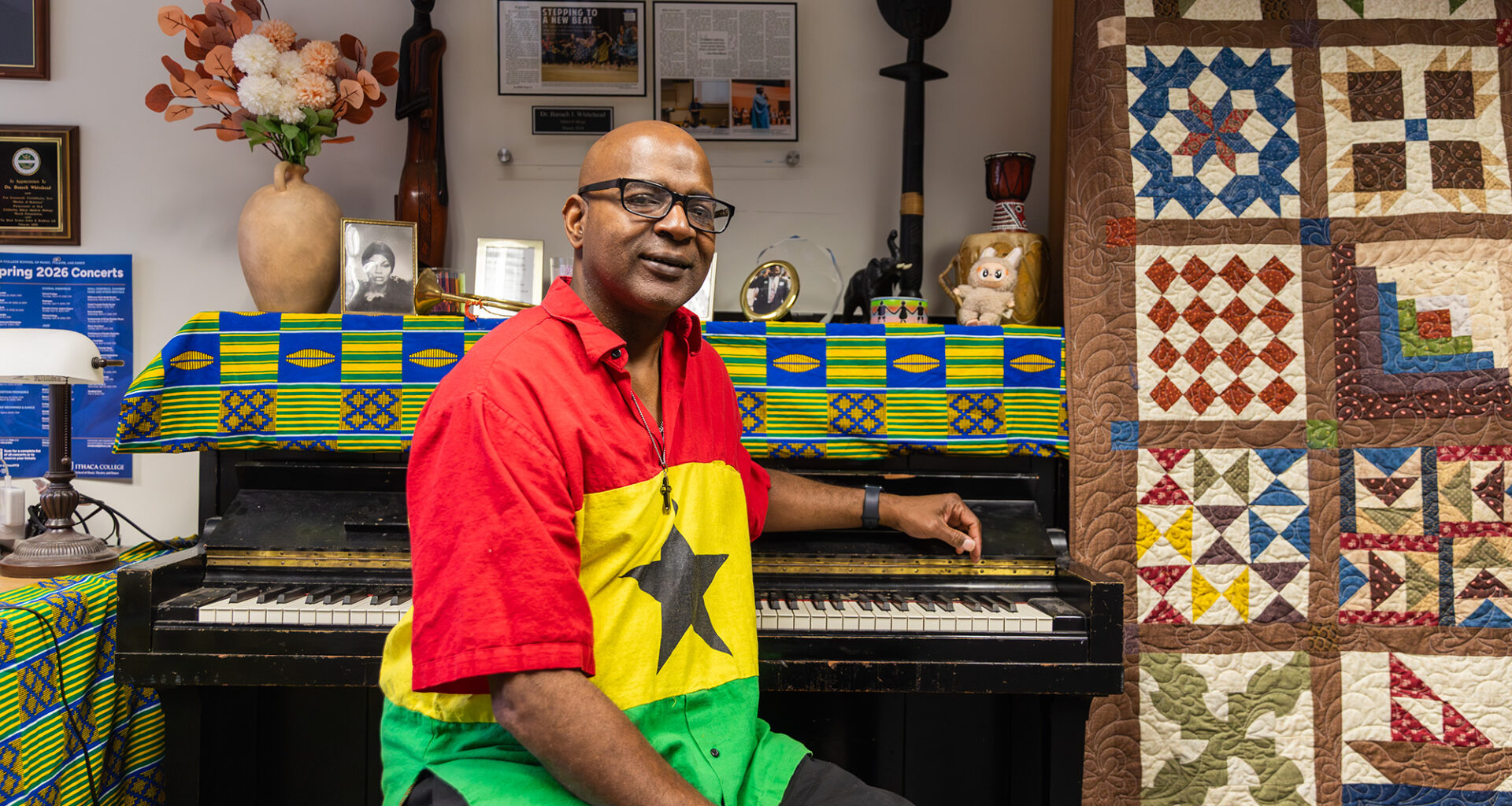
Baruch Whitehead, a professor of music education in the School of Music, Theatre and Dance, was presented with a New York State Senate Commendation award from Sen. Lea Webb’s office Feb. 19. The awards, given in honor of Black History Month, celebrated the work of five local community leaders from the Southern Tier. Whitehead was honored for his work with the Dorothy Cotton Jubilee Singers, a choir named after civil rights activist Dorothy Cotton. Assistant News Editor Sydney Martin sat down with Whitehead to discuss the award, the choir and how his work combines social justice with music education.
This interview has been edited for length and clarity.
Sydney Martin: Could you speak a little bit about what winning the award from Senator Lea Webb’s office means to you, especially with it being during Black History Month?
Baruch Whitehead: I was absolutely humbled by the award from Senator Webb’s office. I was really thrilled, because you just never know the kind of impact one has on the community. I think the kind of work that I do is just something that I don’t really think about. It just pours out of me in terms of equitable access to good music and community building, social justice and human rights. Those are all part of my being. They’re part of my fabric. So when people notice it, I’m happy, but it’s not necessary that I get an award for it. I don’t do it for the recognition. I do it because it needs to be done.
SM: How do you link your work in music education with your work in diversity and social justice?
BW: I try to, through the music, tell the stories of the enslaved people and how they overcame insurmountable odds. They did not see what they prayed and hoped for. I’m the beneficiary of that hope. I think with the music and the community building, mostly being at a predominantly White college, it’s challenging in the sense that I think students, White students in particular, have never experienced how it feels to be a minority, and they’ve never experienced how history has treated certain people. But we can all relate on a human level, so that puts us in the same playing field, if you will. If I have a lot and you have nothing, it [would] be very selfish of me not to share what I have with you. I think it just becomes a natural part of how I teach and how I interact with people and how I try to get people to understand what this is all about, that we’re not alone.
SM: You spoke a little bit about your work with the Dorothy Cotton Jubilee Singers. Could you elaborate on what you do with that group?
BW: We use our music to try to bring people together, to heal those dividing walls, to bring joy to people, to talk about our humanity. We do all of that through the music and through the building of community. We perform at the college, and we also do community activities. Our namesake, Dorothy Cotton, worked very closely with Dr. Martin Luther King Jr. and was a good friend of mine. She passed away in 2018, but we spent many hours talking about the music of the Civil Rights Movement, and it was interesting to me that the music that they used was these spirituals, but they changed the lyrics to make it applicable to what they were dealing with in the Civil Rights Movement. They use those same songs that my ancestors and their ancestors used to combat and put courage into people, because when they went into the church, they would always sing. She told me that music was the movement. She said, “Without the music, there would not have been the movement.”
SM: You speak a lot about the work with the community and bringing people together. What do you really hope that, not just students, but also the community members get out of it?
BW: My hope is that people who attend our concerts will come away encouraged. They heard something they connected to, something that made them reflect on their own lives and what they can do to help other people. It’s kind of like running a marathon where you have the baton; you have a candle, but then you’re going to light somebody else’s candle. But in lighting that candle, it’s more than just symbolic. What can you do to help other people? And I reflect on Renee Good and Alex Pretti. They were interrupting injustices. My hope is that when we interrupt injustices, we can go home at night and not to a funeral home; we can go to our own home. So we need to stay alive to be able to combat all the things that are bombarding us each and every day.
SM: You mentioned how music can be a movement; it’s not just a soundtrack to a movement. How do you think that music can function as this connection to your ancestors and this cultural preservation tool for both now and further down the line for future generations?
BW: Well, music has been around since the beginning of time. I think there’s just been music. Music has the power to really prick the conscience of humans. One of the things that we do is that we usually close our concerts with this song called ”Anticipation,” and it talks about loved ones who have gone before us and the hope that we will reconnect with them on the other side. Every time we sing that song, people are crying in the audience. Because I think we all know the sting of death, and I think that’s the power of music, to really bring people a shared experience.