
As New York City housing costs continue to outpace incomes, the pressure ricochets through commercial corridors, pushing out some of the very businesses that define them.
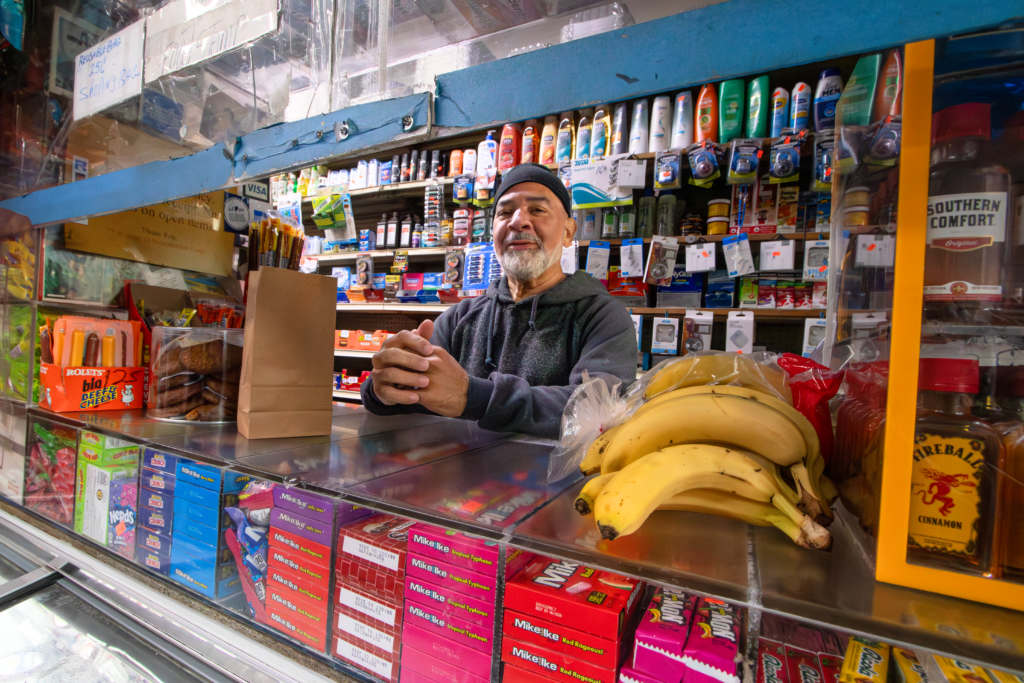
 Juan Dela Cruz, owner of 77 Ave D Deli on the Lower East Side. (Photo by Brewer Roberts)
This story was produced as part of a capstone reporting project at NYU’s Arthur L. Carter Journalism Institute, with editing by Professor Donna Borak.
For decades, the 77 Ave D Deli has been one of the few constants on a block in the Lower East Side where almost everything else has turned over. Regulars call out to the owner, Juan Dela Cruz, before they even reach the counter on his tiny bodega, slipping into the familiar banter he’s traded with his neighbors for 30 years.
But today, the chime of the register also masks a different rhythm: the slow squeeze that has him questioning how much longer he can hang on. His monthly rent has climbed to more than $11,000 a month, from roughly $2,000 when he first opened. Produce costs have spiked under new tariffs. Utilities and fees keep rising. And customers already drained by soaring housing costs are buying less.
Cruz’s struggle is no longer an outlier—it’s the new normal for New York’s small businesses. As housing costs continue to outpace incomes, the pressure ricochets through commercial corridors, pushing out some of the very businesses that define them.
The citywide storefront vacancy rate was 11.4 percent in March 2025, Department of Small Business Services officials testified to the City Council at the time, similar to pre-pandemic levels. Manhattan had the highest vacancy rate, at 14.2 percent, followed by Brooklyn at 11.9 percent, Queens at 8.7 percent, Staten Island at 8.6 percent and 8.2 percent in the Bronx.
That’s up from just a 4 percent citywide storefront vacancy rate back in 2004, according to the State Legislature, where lawmakers reintroduced a bill last month that would establish commercial rent control in the city, creating a board to vote on annual rent adjustments for small business owner-renters.
“As commercial rents have skyrocketed, unrestrained by any forces besides market demand, the landscape of New York City, defined so much by small businesses, has slowly been reshaped in favor of chains, eroding the character of the city in the process,” reads the legislation, sponsored by Brooklyn State Sen. Julia Salazar.
The problem can disproportionately impact low-income communities and immigrant-owned businesses, the bill says. But previous proposals to regulate commercials rents have failed to pass, and faced opposition from the real estate sector.
Cruz has no plan if he’s priced out. He cannot retreat to another borough or another neighborhood, because the same economic forces are at work there, too. “This is a Black and Latino community,” he said, “where we are ‘unseen’ and much goes unchanged.”
Housing costs and commercial pressure move in lockstep
The forces pushing Cruz out mirror the same ones reshaping his customer base.
The median gross rent citywide has grown 21 percentage points faster than median renter income since 2006, according to the NYU Furman Center. Nearly a quarter of Manhattan renters are now severely-rent burdened, spending more than half their income on housing. Once, merchants priced out of Manhattan would move to the next affordable borough, but those escape routes have closed for many due to the continuation and increase of high prices.
 Source: American Community Survey, NYU Furman Center
The result: displacement radiates outward, sending longtime residents deeper into Brooklyn, into Queens, or across the river to New Jersey.
“My own family started being pushed out of Brooklyn in 2005,” said Celestina León, district manager for Brooklyn Community District 4 in Bushwick. “Very few of my family members still live in the city because they didn’t have stable, secure housing.”
The trend can be seen in commercial rents, too. In Brooklyn’s most desirable corridors, asking rents for retail space are as high as $245 per square foot, according to the 2024 Brooklyn Retail Report. That’s up 40 percent from a year earlier. Even modest commercial stretches saw double-digit increases.
Commercial landlords, facing the chance to attract wealthier tenants, often wait out the market. That logic fuels a growing phenomenon: storefronts held intentionally vacant while owners wait for the highest bidder.
“If a bar can offer $10,000 in rent and the current bodega can only pay $5,000, the landlord will likely choose the higher payer,” said León. “It’s simple economics.”
And for the stores still operating, a tactic known as commercial tenant harassment—cutting heat, ignoring repairs, sudden demands—can be used to push out longtime businesses to make way for a higher-paying chain or trendy bar.
New York technically outlawed this practice in 2016 under Local Law 77. But the law is largely symbolic: fewer than 30 cases have ever reached the New York Supreme Court, as small merchants lack the money, time, or legal support to sue.
“Politicians who say they will do something, but they have been saying that before I got my store,” Cruz said. “And things are still getting worse, so you do the math.”
On Bedford Avenue in Brooklyn, the same pattern is unfolding. Demetrios Siafakas, whose family runs the Peter Pan Donut & Pastry Shop, says they’ve survived only because the landlord worked with them and their customers stayed loyal even after moving away.
“We got lucky,” he said. “Many shops around us have not.”
One of their regular customers, who overheard Siafakas’ conversation with a reporter, chimed in to share that he was among those forced to move out of the neighborhood due to rising prices. “It would be nice, but no way I have this kind of money anymore,” the man said, motioning to the coffee and doughnut in his hand.
As rents rise, the character of streets shifts. Boutiques replace bodegas. Upscale cocktail bars take over former family-owned eateries. Many neighborhoods lose the businesses that kept them grounded—and in turn, the residents who depended on them—often replaced by national or global chains. Last year, apparel company Carhartt bought a 4,000 square-foot space for $11 million on 132 Bedford Ave.
Casa Adela in December. (Photo by Brewer Roberts)
On Manhattan’s Avenue C, Casa Adela, a beloved Puerto Rican restaurant operating for 50 years, is bracing for another rent hike. Owner Maritza Lopez was forced to raise her prices, again, this past September due to rising food and utility costs—one she fears will price out her remaining regulars since the last increase.
Across the street, Lopez has watched long-term tenants disappear virtually overnight. One building was sold before it even hit the market. Around the corner, another restaurant, Rossy’s Bakery, shuttered after 15 years last spring with a “For Sale” on its front door.
Sink or swim
If COVID underscored anything, it was that neighborhood survival depends on its small businesses. “The lesson for us is that mixed-use communities are inherently more resilient,” said Charles Yu, vice president of economic development at the Long Island City Partnership. “When one part of the economy slows, others can help stabilize local activity.”
The bodegas became a lifeline. The hardware store stayed open. The laundromat kept the block functional. These businesses weren’t luxuries—they were infrastructure.
“When people started moving back and began working from home, more of daily life shifted closer to home as well, and that created a foundation for recovery,” Yu said.
City Hall has tried to ease some of the pressure. The previous administration passed the City of Yes for Economic Opportunity, which modernized zoning to allow a broader mix of businesses. Those changes helped reopen 8,850 new storefronts, including 500 that might have stayed vacant under old zoning rules, officials said last year.
When running for office, Mamdani said he would fix systematic flaws that drive up costs for small businesses, including rapidly rising utility rates. Since being in office, he signed an executive order to ease rules and fees for small business owners.
“You cannot tell the story of New York without our small businesses,” Mamdani said at the time.
But on the ground, the limits of the current policies are plain.
“There is really nothing we can do about commercial rents directly,” said Susan Stetzer, district manager for Manhattan Community Board 3, which spans the Lower East Side and part of Chinatown. “The city has regulations for affordable housing tied to tax benefits, but nothing equivalent for commercial spaces.”
To reach the editor, contact [email protected]
Want to republish this story? Find City Limits’ reprint policy here.