
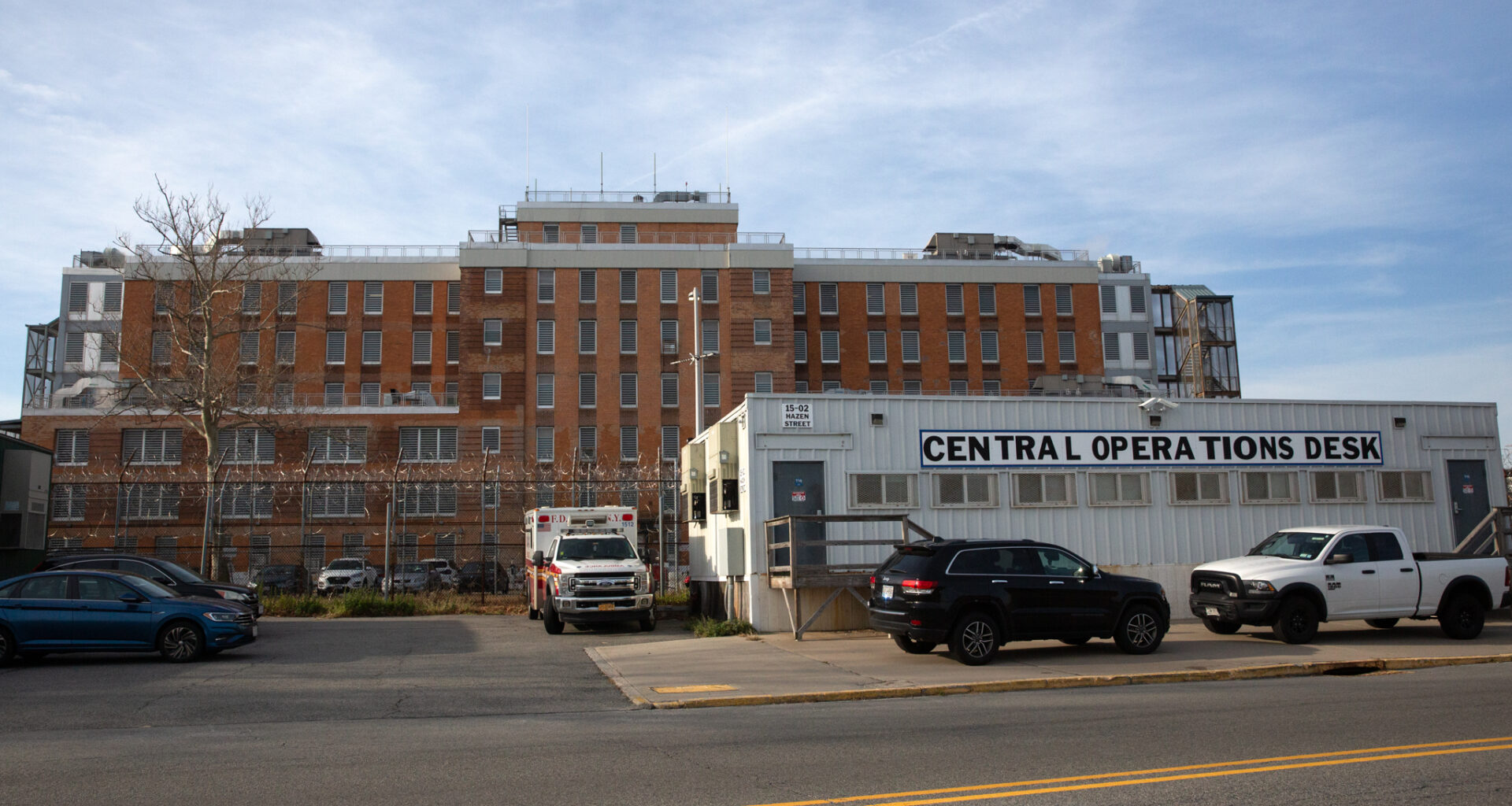
For detainees on Rikers Island spiraling into a psychiatric crisis, a trip from the troubled jail complex to one of the city’s public hospitals can serve as a medical lifeline.
But that relief is often short-lived.
In around half the cases, detainees are returned to Rikers within hours after what critics describe as cursory hospital checks, landing them back in the same environment that jail clinicians initially deemed unsafe for their mental health.
This cycle surfaced publicly during a Board of Correction oversight hearing last month.
“While we do refer many patients to the hospital when we feel that it’s clinically appropriate, it’s ultimately the decision of clinical staff working at these hospitals as to whether or not patients are admitted,” testified Joseph Otonichar, who oversees mental health care for detainees on Rikers.
“So a very large number of our patients who we believe may meet hospital criteria are ultimately not admitted to the hospital,” he added.
After the hearing, a veteran jail supervisor was more blunt.
“I’m not a doctor, but I’ve been doing this for many years, and I can see when a person is decompensated,” said the jail official, who spoke on condition of anonymity. “And some of these guys get sent right back. And it’s like, ‘How’s that possible?’”
Detainees can be forced to take medication only while at the hospital. Back at Rikers, even those in the midst of a serious mental health breakdown have the right to decline.
The hospital back-and-forth is particularly notable because medical care at both Rikers and the hospitals is overseen by the same public system, NYC Health + Hospitals.
The revolving door underscores one of the persistent dysfunctions inside the scandal-scarred jail system, even as it enters a new chapter under recently installed remediation manager Nicholas Deml and Correction Commissioner Stanley Richards. Both began their tenures earlier this month with promises of reform.
Steve Martin, a court-appointed monitor overseeing the department for nearly a decade, has never made the hospital rapid returns an issue.
After the hearing, city health officials pushed back on the notion that referrals are routinely dismissed.
According to the city’s Correctional Health Services — the division of NYC Health + Hospitals that provides care in the jails — clinicians consider a broad range of factors when deciding to send someone experiencing a mental health crisis to a hospital. That includes if a detainee presents an imminent danger to themselves or others or cannot meet basic needs because of psychiatric symptoms.
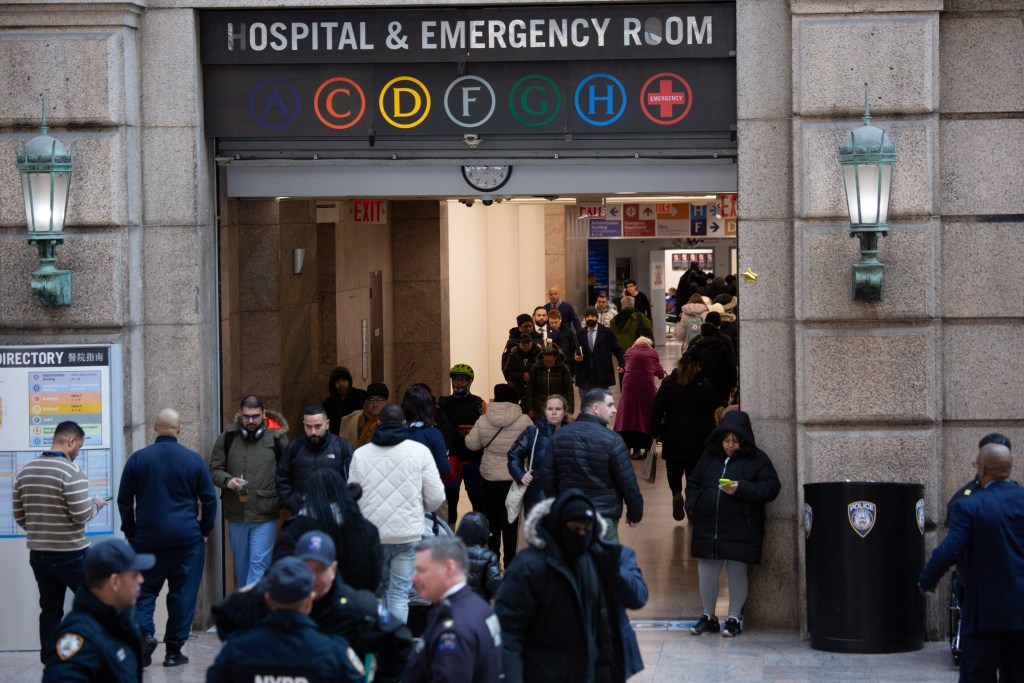 People enter and exit Bellevue Hospital’s main entrance, Feb. 18, 2025. Credit: Ben Fractenberg/THE CITY
Detainees are typically referred to Bellevue or Elmhurst hospitals for evaluation for possible inpatient psychiatric admission. Hospital clinicians then conduct their own independent assessments to determine whether hospitalization is warranted.
Data provided by the city shows that about half of referrals result in admission.
At Bellevue, there were 650 mental health related referrals in 2024, with 364 admissions, a 56% admission rate. In 2025, admissions ticked up slightly to 410 out of 713 referrals, or 57.5%.
Elmhurst saw lower numbers and a sharper drop: 55 admissions out of 108 referrals in 2024, about 51%. The number fell to 40 admissions out of 102 referrals in 2025 — just under 40%.
By contrast, the national average of people admitted from an emergency room into the hospital for all conditions including mental health crises hovers around 20%, according to studies.
At Rikers, medical staff sometimes send the detainees right back to the hospitals if they can’t be safely managed behind bars, Otonichar testified before the Board of Correction.
“These are very challenging situations to navigate,” he added.
Board Vice Chair Helen Skipper, who was released from Rikers in 2017, questioned why medical staff on Rikers wasn’t better at communicating with doctors in the hospital.
They are all employed by the city’s public Health and Hospitals Corp., she noted.
“Does CHS not work with these hospitals and their clinical team? Do you not talk about how you refer patients back and forth and come to a happy medium?” she asked.
“I understand, you guys are clinicians, how does the hospital deny?”
Otonichar called it a “very good question” but said the issue is complicated.
“I wish I had a simple answer,” he said, adding that Correctional Health Services works closely with hospital leadership to address challenging cases.
Patsy Yang, Senior Vice President Correctional Health Services at NYC Health + Hospitals, noted that during the early days of the de Blasio administration, the city took over medical care for people locked up on Rikers.
The move came after years of poor treatment and high-profile deaths due poor medical care under Corizon, a private for-profit provider. It was done in part to improve communication between medical staff at Rikers and in city hospitals, she said.
Still, Rikers clinicians sometimes believe that detainees may be better off getting admitted to the hospital because sending them back to jail poses a health risk that others who have a traditional home setting don’t have, Yang said.
“There may be patients who do not meet the traditional community criteria for inpatient hospital admission but in our case, may be best cared for in a hospital setting rather than in jail, and those are the conversations that occur, case by case,” she testified before the board.
In response, BOC Board Chair Dwayne Sampson asked for a summary of recent hospital referral cases “so that we have a better understanding of the hospitalizations and the issues going on with it.”
Board Member Dr. Lauren Stossel, who previously worked at Rikers as a supervising psychiatrist, said she believed there’s been “enormous progress in recent years” for patients CHS believes should be admitted but are being blocked by ER staff.
Yang told the board that space at Bellevue and Elmhurst wasn’t an issue.
But in an interview, Dr. Luis Marcos, who headed the public hospital system during the Giuliani administration, said space is always the prevailing factor.
“The question is: do we have a bed or don’t we have a bed? That tends to be the issue at Bellevue,” Dr. Marcos told THE CITY.
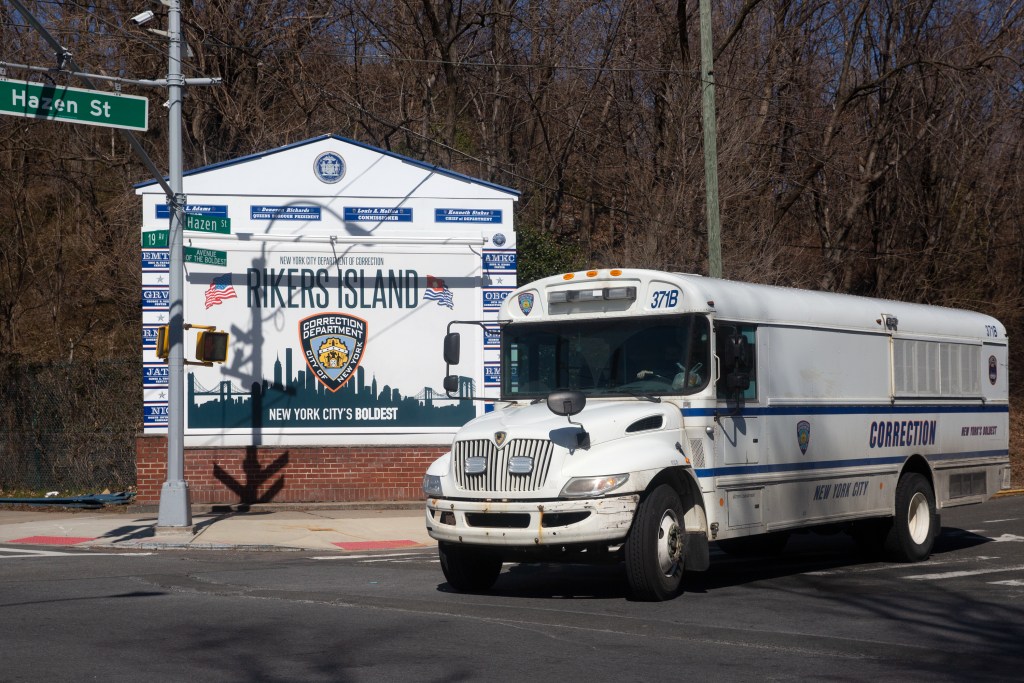 A Department of Correction bus leaves Rikers Island, Feb. 28, 2022. Credit: Ben Fractenberg/THE CITY
In 2014, two senior doctors at Rikers told front-line clinicians that Bellevue Hospital had no available space and instructed them to keep patients in jail unless the situation was dire.
Last week, the senior jail official who spoke on the condition of anonymity said available space does exist both at city hospitals and inside specialized mental health units on Rikers.
In Bellevue Hospital, one psychiatric ward had room for 29 patients but held about 15 people on Friday morning, while another unit with space for 39 had roughly 23 detainees, the official said.
The jail system’s specialized mental health housing on Rikers also has empty beds, the official added. As of a recent morning census, the so-called PACE units — designed for detainees with serious mental illness — had about 290 people in a system built to hold 334, leaving roughly 40 vacancies.
A spokesperson for Correctional Health Services said the PACE units are designed to operate below full capacity to maintain a therapeutic environment. Filling every bed, the spokesperson said, would undermine the units’ ability to function as intended.
Still, some detainees on Rikers are dealing with mental health issues so serious that they cover themselves with feces.
“There are definitely people on Rikers right now who could benefit from being in the hospital,” the official said. “But the determination about who gets admitted or moved to those units is made by mental health staff.”
Jeanette Merrill, a spokesperson for CHS, declined to detail how many hospital beds for detainees are currently available. Stephanie Buhle, a representative for HHC, did not respond to THE CITY’s request to speak with ER staff at Elmhurst or Bellevue.
Buhle said people referred from jail undergo comprehensive psychiatric assessments. In some cases, the acute distress that prompted the referral may resolve by the time the person is evaluated in the emergency department or may not meet the legal criteria for inpatient hospitalization.
She also noted that Bellevue Hospital maintains a 55-bed psychiatric unit for people coming from the jail system, which averaged about 76% occupancy in 2025.
The conflict between Rikers medical staff and ER doctors has existed for decades, according to multiple former jail medical staff. The hospitals have long believed Rikers detainees with serious mental health needs are being “dumped” on them, said one doctor who asked to remain anonymous.
The hospital ping-pong isn’t unique to New York City, said Dr. Marc Stern, a former regional director for the state prison system in the early 2000s, who also headed medical services for the Washington prison system.
“All around the country, there’s very often a disconnect between the ER and the correctional facility,” he told THE CITY. “The person in the ER just doesn’t understand what the capabilities are, and they’re so varied from jail to jail and prison to prison.”
Related