
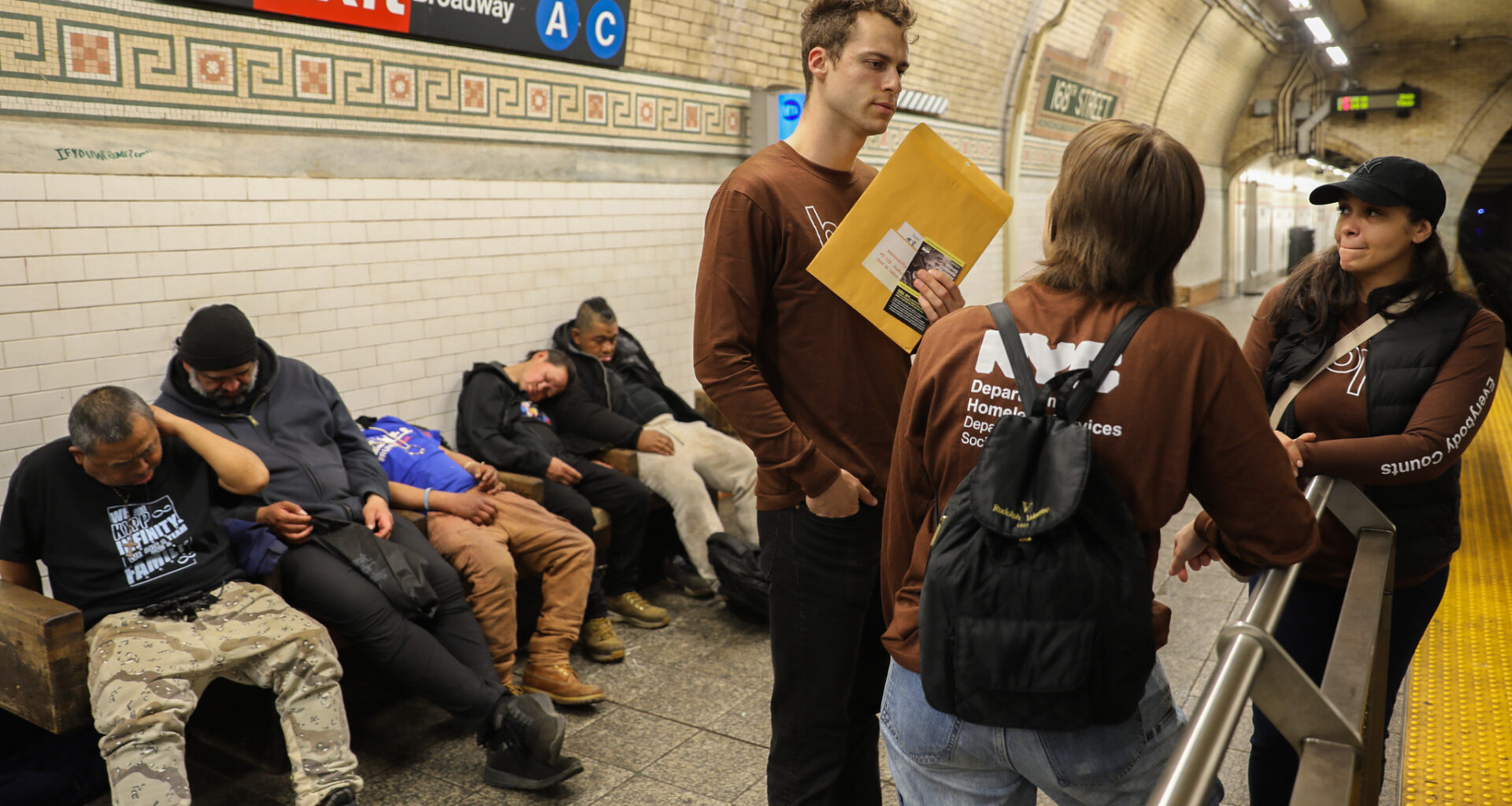
Hundreds of volunteers spanned out across the five boroughs early Wednesday, working through the night to survey unhoused New Yorkers for the annual Homeless Outreach Population Estimate, or HOPE, count.
They canvassed subway stations and sidewalks, pedestrian plazas and parks, in neighborhoods with an obvious population of unsheltered people and in neighborhoods that don’t have as many.
It was the 21st count, and the first where temperatures were not near or below freezing, as this year’s event was rescheduled from late January due to the extreme cold.
For Erin Dalton, the newly-appointed commissioner of the Department of Social Services, it was her first public event since taking on the role.
“This is a great experience to be with volunteers, outreach workers – people really care about the issues of homelessness,” she said inside the P.S. 116 gym in Kips Bay, where officials kicked off the count.
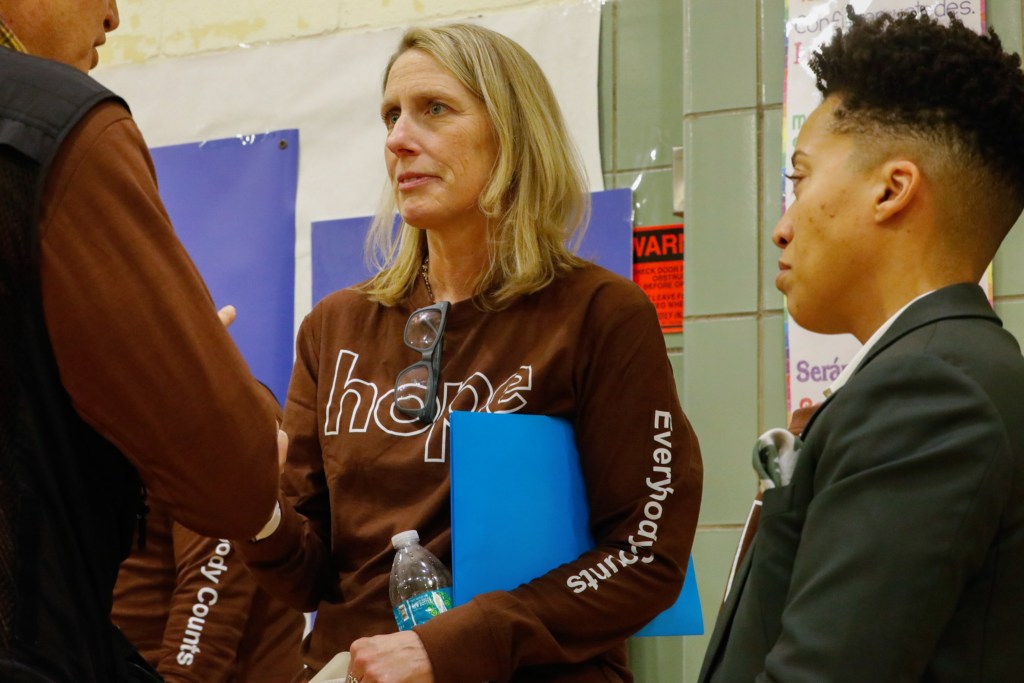 Department of Social Services Commissioner Erin Dalton speaks with volunteers preparing to help with the city’s annual homeless outreach survey, March 10, 2026. Credit: Alex Krales/THE CITY
The rescheduled date led to a drop-off in volunteers, a spokesperson said, but nearly 1,300 showed up Tuesday night, alongside 240 outreach workers.
The HOPE count provides useful data as the city grapples with an estimated population of more than 85,000 unhoused New Yorkers who sought space in city shelters. Last year’s HOPE count found 4,504 people experiencing unsheltered homelessness when it was taken on Jan. 28, 2025.
More than 20 people were found dead outside during this historically cold winter, putting the city’s shelter and outreach policies under a microscope. Although not all of those who died outside were technically unhoused — and none were found living in encampments — critics faulted Mayor Zohran Mamdani’s decision to stop encampment sweeps, which he said in December hadn’t been successful in connecting people to long-term housing.
He later reversed his position, putting Department of Homeless Services outreach workers in the lead, instead of the police or sanitation workers.
The switch could drastically change the outcomes for people living outside, Dalton said.
“Let’s focus on those who are most vulnerable, people who’ve decided they’re not going to accept traditional options,” she said. “They are traumatized by the services they may have received in the past, and they’ve decided, amongst the harshest conditions, to stay outside.”
People looking to reform the city’s policies and outreach towards unsheltered people was one reason the HOPE count began in the first place.
Maryanne Schretzman is the executive director of the Center for Innovation through Data Intelligence, a city office that works with all health and human services agencies to identify what’s needed.
She helped start the HOPE count, first as a pilot in Manhattan and Brooklyn before expanding citywide in 2005, in part because the city was “constantly being sued” by organizations like Legal Aid, she said.
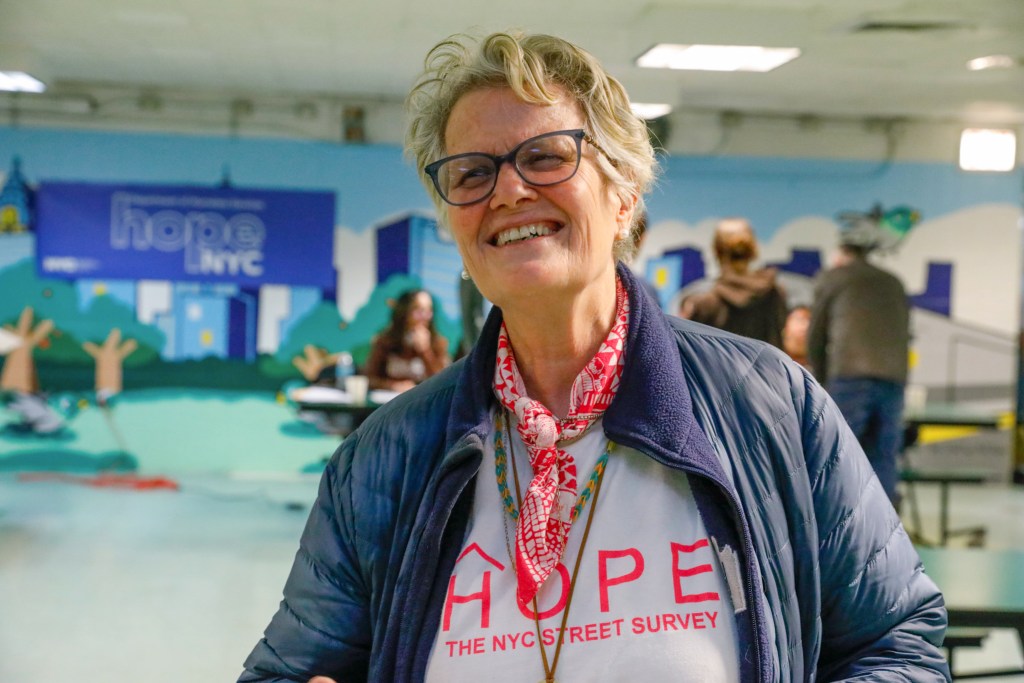 Maryanne Schretzman prepares to help with the city’s annual homeless outreach survey, March 10, 2026. Credit: Alex Krales/THE CITY
“The advocates were saying there were tens and tens of thousands of people [on the street] and we weren’t clear if that was true or not,” she said. “So we wanted to get a pulse on what that actual count is, so that if we knew what the numbers were, then we can manage to those numbers.”
Their methodology is to flood the city all at once, even in “low” areas where there isn’t usually any street homeless, to get as accurate a picture.
Volunteers watched a video training before Tuesday night and received another refresher before heading out at midnight. Inside PS 116’s gym, a few dozen people gathered at tables to go over their coverage areas, loading up on donuts and coffee and candy to get ready to stay up through the night.
Olivia Waldron, 23, found out about the count last year through her job at the Robin Hood Foundation. She was the captain of Team 9, which reporters from THE CITY joined.
She was struck by how connected she felt to the city during her first count last year. People often want a village, she added, “but they don’t want to be a villager.”
“A lot of people who … complain about things: the city is going through an affordability crisis,” she said. “You need to have strategy and empathy to fix these problems.”
After midnight, Team 9’s four members canvassed the 28th Street 6 and R and W stations, along with streets along Broadway and Sixth Avenue.
The work wrapped up after 1 a.m., with around 15 people tracked. Not everyone was unhoused, and not everyone spoke to the group; the app allows for observations of people who appear to be homeless and asleep.
Some groups didn’t encounter anyone who was unhoused. THE CITY also went out in Cobble Hill, Brooklyn, but didn’t find anyone.
The final tally, sent out Wednesday morning, said volunteers covered 1,491 unique areas across the city, although the full data will be released later this year.
Dalton said the HOPE count experience could change people’s perception of who is experiencing homelessness
“People will see both what people think is homelessness, but also the changing face of homelessness, which is older, people who are working,” she said. “People who have spent their whole lives working but just find themselves crowded out of the housing market.”
Related