
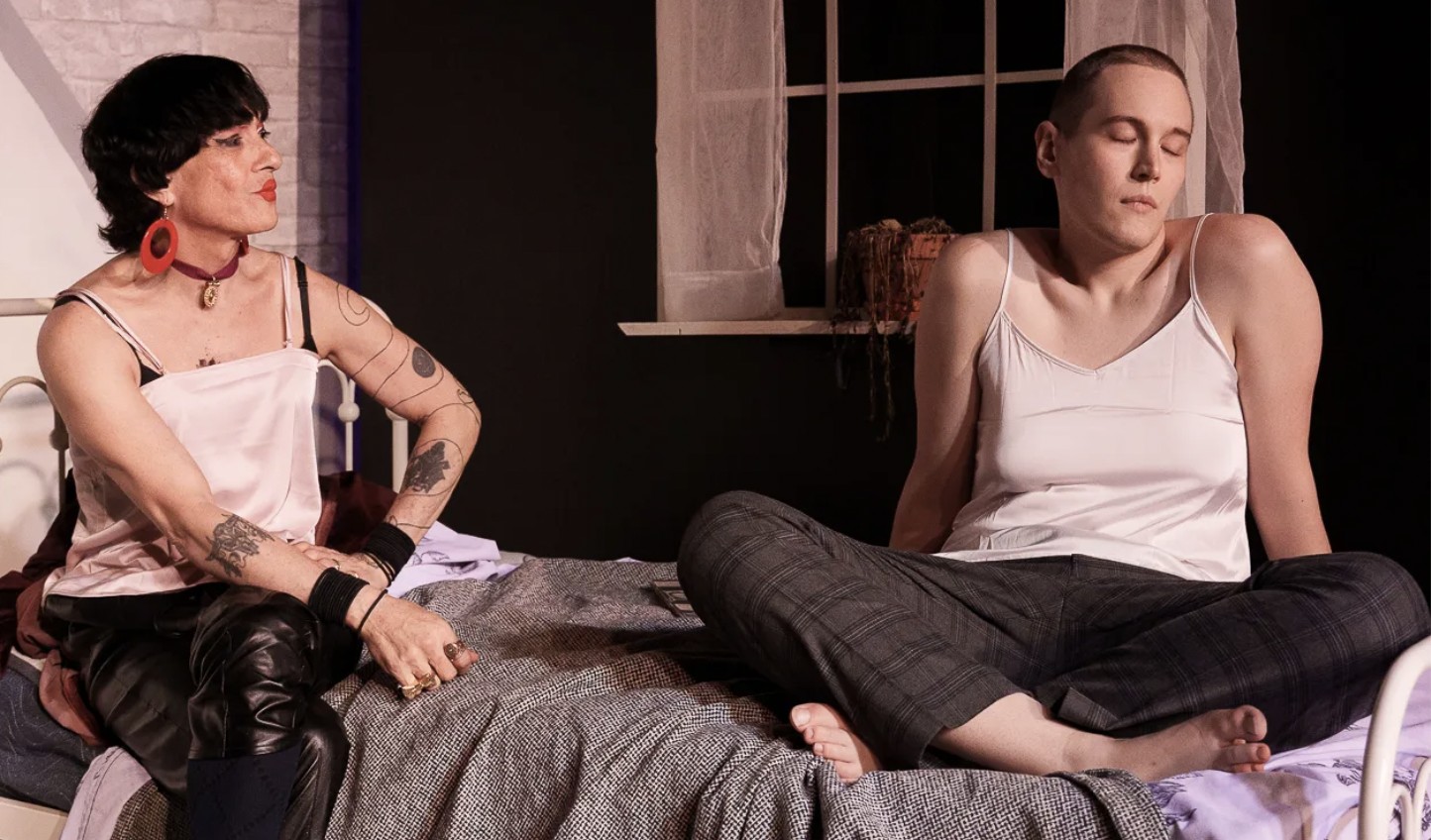
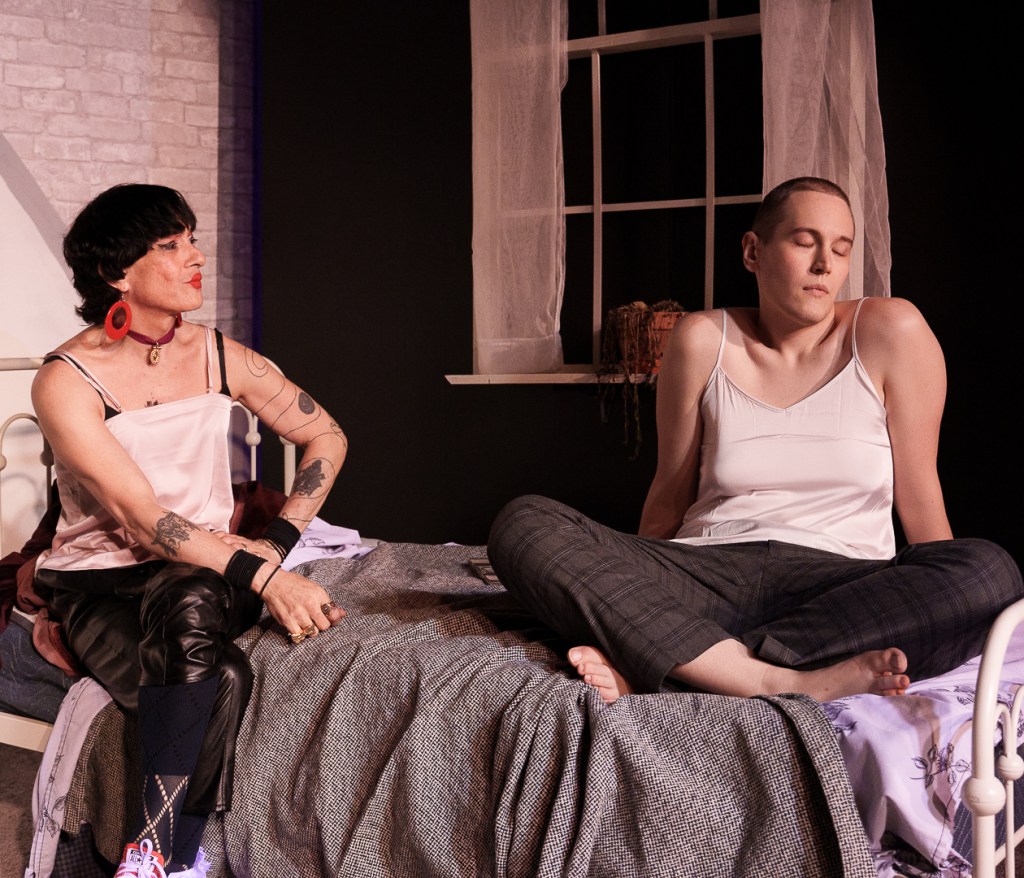
 Nineveh de La Luz Herrera (left) and Ethan Fieder in Riot Queens at Fuse Theatre Ensemble through March 29. Photo: Gregory Parkinson
History was made when a trans woman threw a cup of coffee at a police officer who was harassing her.
Mikki Gillette’s new play, Riot Queens, takes that real act – which sparked San Franciso’s 1966 Compton’s Cafeteria Riot, the first known full-scale riot asserting transgender and gay rights in the U.S. – and explores the emotional boiling point that led to it.
The show, directed by Harper York at Fuse Theatre Ensemble, is centered on three fictional trans women who frequent Compton’s, a 24-hour eatery and a social haven for the queer community. Among the customers there is Nina (Bryn Bollimpalli), a newcomer to the Tenderloin district of San Francisco, who has dreams of getting an education as well as pursuing gender-affirming care so that she can live as her true self. In contrast, Haley (Ethan Fieder) is a seasoned sex worker who believes her street smarts will keep her safe, and Dixie (Nineveh de La Luz Herrera), is a feisty activist who’s so hyper-fueled by her sense of justice that her jangling arms and legs are in perpetual motion.
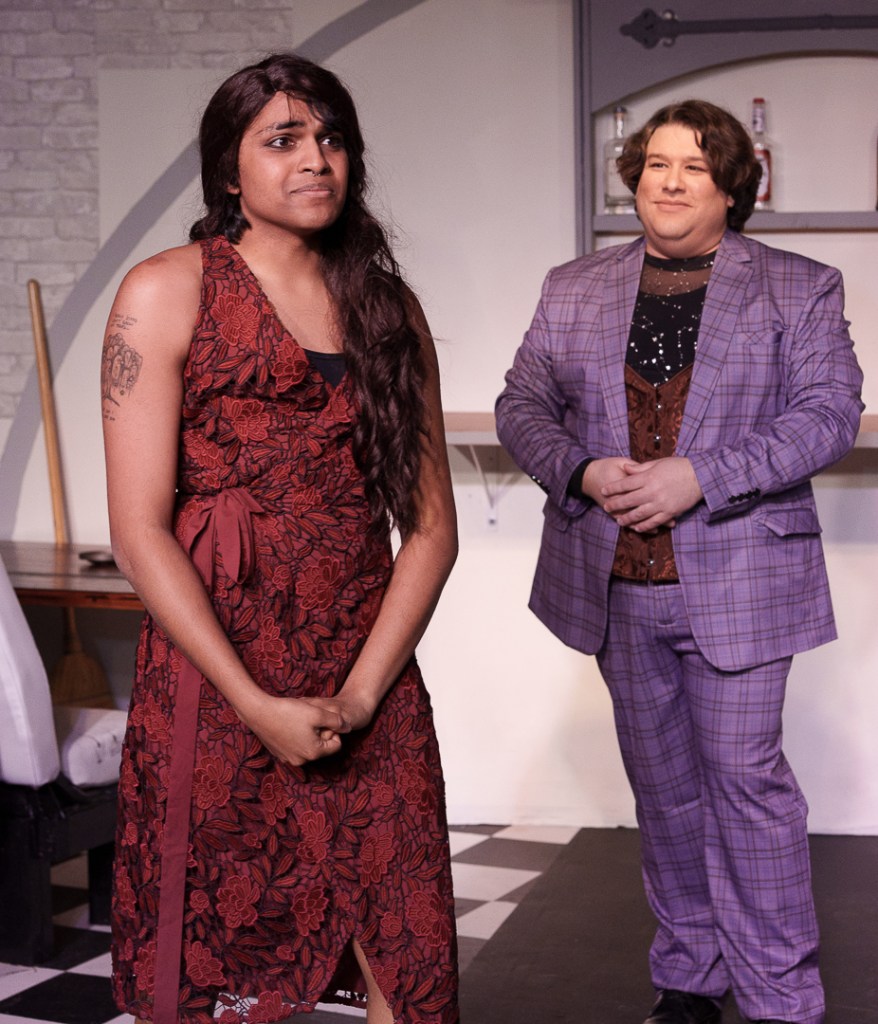 Bryn Bollimpalli and Riplie Sugden in Riot Queens. Photo: Gregory Parkinson
While these women share an identity in some respects, it’s a tenuous connection, and their separate goals come into conflict as their lives become more entwined. Nina is focused on her future beyond the Tenderloin, but Haley just wants to get by, staying within the two blocks of Turk Street, where trans people are relatively tolerated. As much as she’s drawn to Nina, she’s annoyed by the other woman’s dreams of a better life, and she’s also rankled by Dixie’s devotion to Vanguard, a group that protests businesses that discriminate against gay and trans people alike. Raising your voice, Haley thinks, will only bring the community more unwanted attention from the police.
That fear, it turns out, has some basis in reality. When a character shows up at the cafeteria wearing a stocking cap, we know she’s been arrested for “impersonating a woman” and then further degraded by the police, who’ve shaved her head.
It’s a chilling sight, and one that instantly expresses the fear these women are living with. But one of Gillette’s superpowers is that she confronts cold truths while avoiding crossing into gratuitous territory. Haley, for instance, says just enough about her childhood to let us know she has suffered a series of atrocities, without going into graphic detail that would distract us from the larger story about the power of trans activism itself.
Although the play imagines the fraught days that lead to an uprising that spilled into the street and overturned a police car, the drama here mostly builds through the three women’s conversations. And there’s plenty to talk about as they share the news of demonstrations and arrests, plus the constant harassment from an anti-trans server (Tyler Hunt) at Compton’s who keeps threatening to call the cops again.

Black-and-white projections separate these scenes and give more context, showing protesters carrying signs and big ’60s police cars cruising the street like sharks. Along with these images, period music adds a cheeky note, with Petula Clark singing “Downtown,” mixed in with “You Don’t Own Me” and “The Times They Are A-Changin’.”
 Conversation at Compton’s: From left, Bryn Bollimpalli, Cosmo Reynolds, Nineveh de La Luz Herrera, and Ethan Fieder in Riot Queens. Photo: Gregory Parkinson
Riot Queens may have a small cast (which also includes Riplie Sugden, as the owner of the bar where Nina works, and Cosmo Reynolds, as a cop and a protester), but Daye Thomas’s effective sound design creates a busy city atmosphere. A bell rings whenever the door to Compton’s opens; buses honk outside; and there’s a steady buzz of conversation inside the bustling business.
Like the increasingly divided characters themselves, who start to metaphorically dance towards each other only to step back again, Ezra Goetzen’s scenic design separates the stage into three spaces, with a simple bar framed by the booths of Compton’s on one side and Haley’s rented room on the other. Instead of drawing attention to themselves, these black, white and gray spaces let the emotions of the story – especially in a wrenching scene in which Haley lies like a wounded child on her bed – come through the characters.
York’s costume designs also represent something about each woman’s interior life. Haley, who doesn’t want to make waves, dresses in a prim blouse and plaid pants, while the fiery Dixie sports a shiny scarlet blouse and black leather-like pants. What they dare – or don’t dare – to wear tells us as much as the dialog does.
As harrowing as the story is, Gillette’s love for her characters shines through in every scene, and she even gives us reason to believe good things are ahead for them. While many Americans today are once again asking themselves whether or not protest is worth the risks it incurs, Gillette’s play offers a decided “Yes.”
Riot Queens
Company: Fuse Theatre Ensemble
Where: The Back Door Theatre, 4319 S.E. Hawthorne Blvd., Portland
When: Through March 29. Fridays & Saturdays at 7:30 p.m.; Sundays at 3 p.m.
Ticket & schedule information: here