
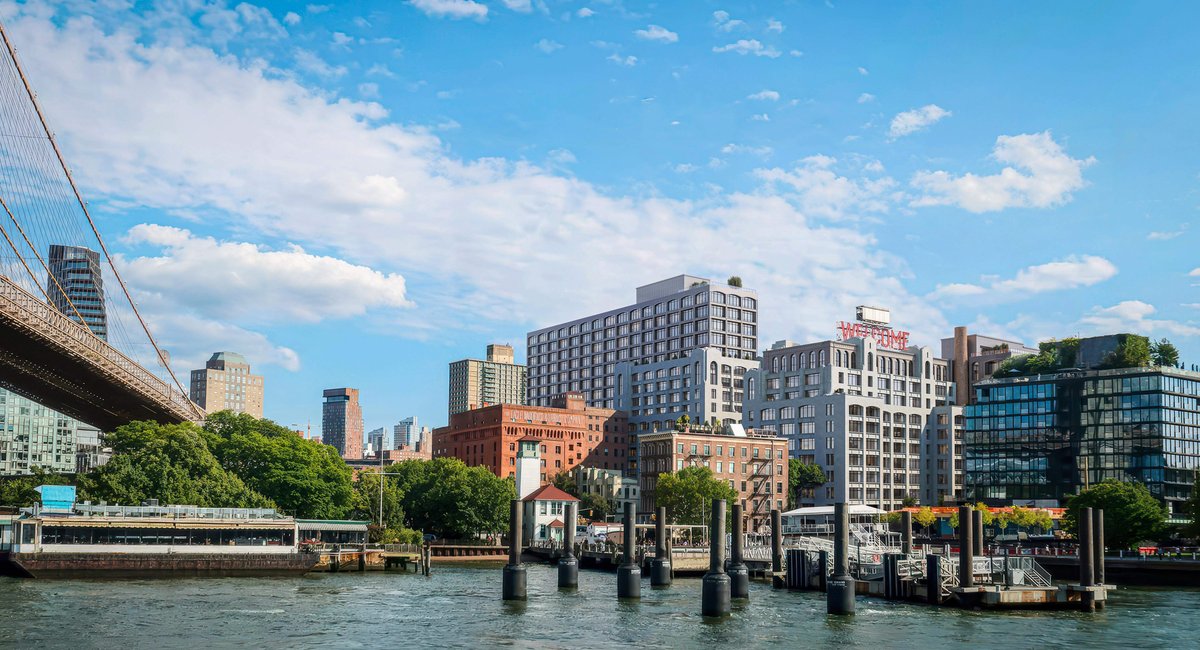
Brooklyn’s iconic Watchtower buildings, the largely vacant former headquarters of the Jehovah’s Witnesses, would be converted into hundreds of residential apartments under a proposed rezoning of the waterfront property.
The proposal by developer CIM Group, still in its early stages, would convert the office buildings to residential units, including 661 homes, of which 165 would be deemed affordable, according to planning documents.
No information on projected rents or other costs was immediately made available.
The sprawling complex includes five buildings, located at 25 and 30-58 Columbia Heights in Brooklyn Heights. The properties served as headquarters of the Jehovah’s Witnesses until a decade ago.
The site was easily identifiable from miles away due to a brightly illuminated “Watchtower” sign on its rooftop.
“I want to see empty buildings activated,” local Councilmember Lincoln Restler told Gothamist, ahead of a public scoping meeting on the project Thursday at the Department of City Planning. Restler added that the property has “essentially sat vacant for six or seven years” amid a citywide housing crisis.
The new housing would continue a transformation of the Brooklyn waterfront now decades in the making, with former industrial properties giving way to high-rise apartments and recreational uses.
David Wellspring, CIM Group’s vice president of development, said in a statement that the company sought to turn the site from “largely vacant former industrial buildings into a thoughtful mixed-use residential community, including much-needed permanently affordable housing” near the Brooklyn waterfront.
“We have been actively engaging local stakeholders and look forward to continuing that dialogue to deliver meaningful housing and economic benefits for the community,” Wellspring said in the statement.
The rezoning application still requires multiple rounds of review, including by Brooklyn Community Board 2, the borough president and the City Council, and could undergo revisions. Joe Marvilli, a planning department spokesperson, said the agency was reviewing the private land-use application for the site.
“We look forward to holding [Thursday’s] scoping meeting on the environmental impact statement and to this application starting public review in the future,” Marvilli said in a statement.
The two largest buildings on the site were constructed in the 1920s and ’30s by the pharmaceutical company E.R. Squibb and Sons and sold in the 1960s to the Watchtower Bible and Tract Society of New York, a nonprofit organization affiliated with the Jehovah’s Witnesses, according to public records shared by the Department of City Planning.
The religious group sold the properties in 2016. The Watchtower sign was replaced with a “Welcome” sign.
The current proposal would allow one of the buildings to add five stories to an existing 12-story structure and for the other to add a single story.
Restler said it was important to ensure that any future development would not obstruct views of the Brooklyn Bridge from the Brooklyn Heights Promenade, a subject of countless Instagram selfies.
“It’s one of the most famous views in the world,” Restler said, “and we want to make sure that any development on this site has no impact on the view plane.”