
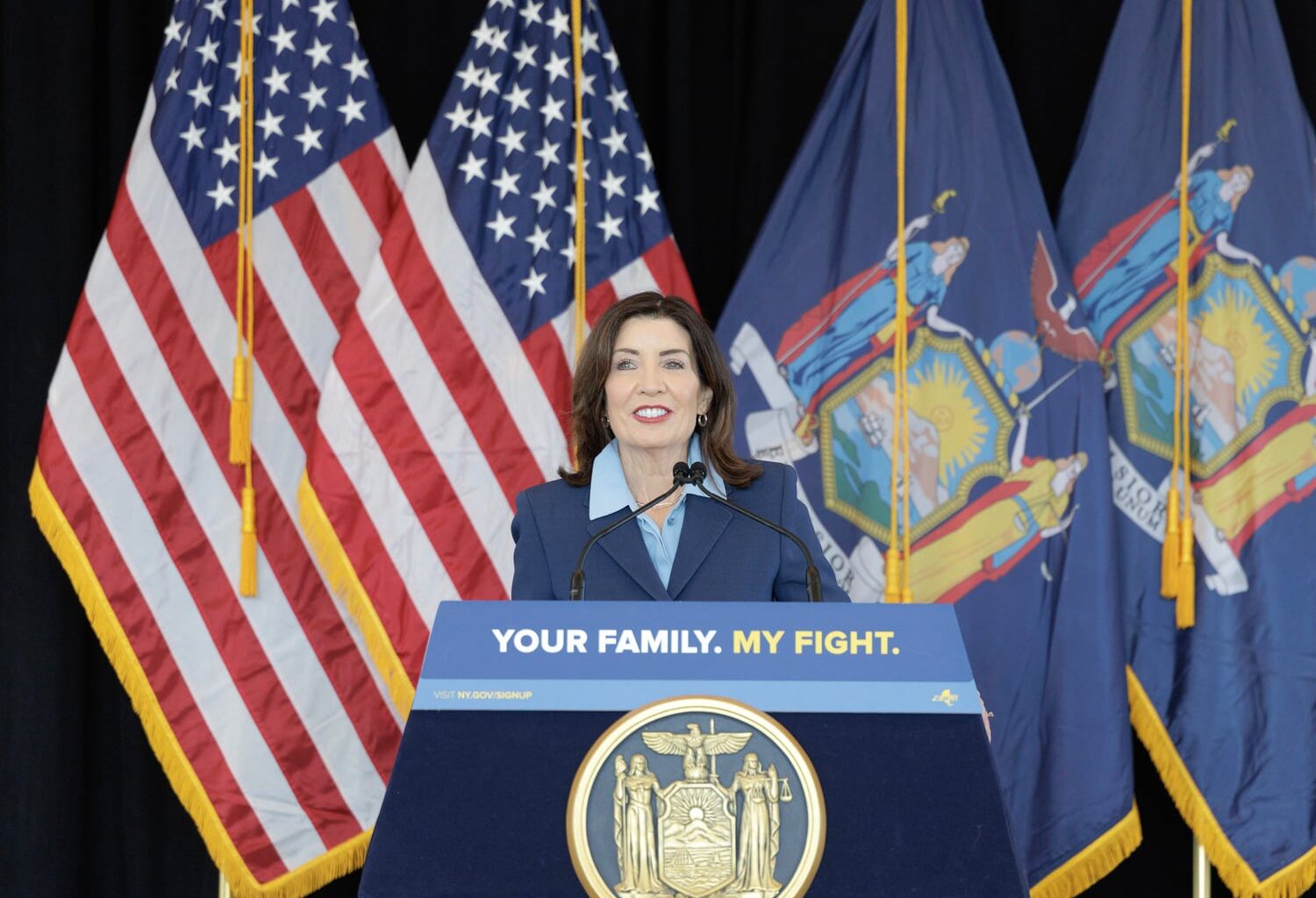
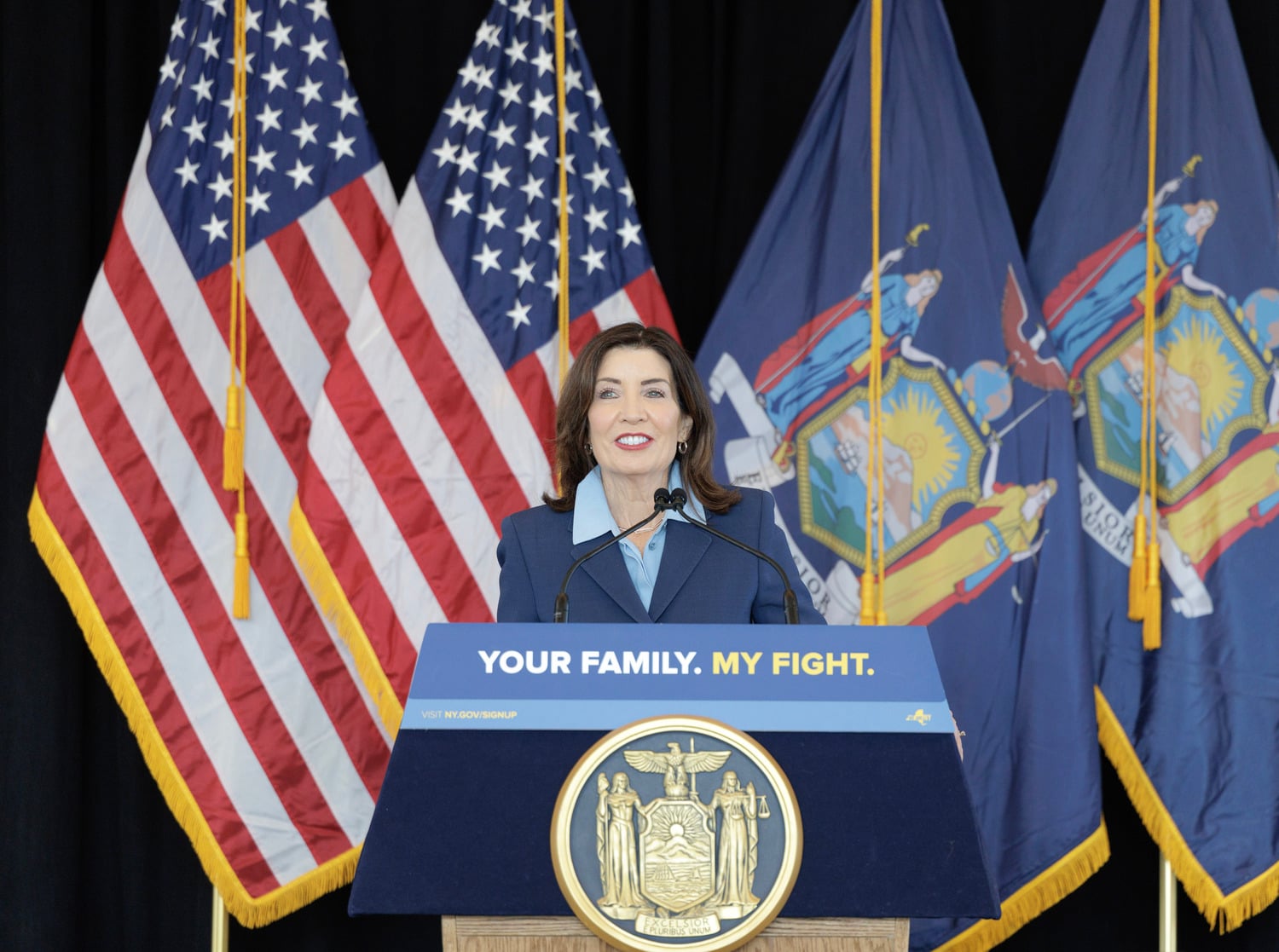
Kathy Hochul spoke in Ogdensburg on Tuesday, March 10, 2026. Photo: Mike Groll/Office of Governor Kathy Hochul
Catherine WheelerAre changes coming to New York’s climate law?
A recent state memo is creating a political tempest over New York’s ambitious climate change law.
The New York State Energy Development and Research Authority, or NYSERDA, estimates a speedy transition to non-carbon energy sources could hike upstate residents’ electric bills by thousands of dollars a year.
Republicans pointed to the memo as a sign of failed policy. Gov. Kathy Hochul wants to delay the law. Environmentalists see it as a huge setback in the fight against climate change.
Climate law challenges
When New York’s Climate Leadership and Community Protection Act was passed in 2019, it set a strict timeline for the state to reduce its reliance on fossil fuels and transition to renewable energy.
The target is to reduce emissions by 40% and get more than two-thirds of the state’s electricity from green energy by 2030, and follow that with total zero-emission energy a decade later.
But now, Gov. Kathy Hochul said she wants to adjust that timeline, in the name of affordability.
“I’ve said for a long time, affordability is my number one priority,” she said. “We’re seeing now that people are reeling under the effects of policies that could not have been foreseen in 2019 when this was passed.”
Hochul blames the COVID-19 pandemic, supply chain disruptions and the Trump Administration’s rollbacks of green energy subsidies.
She has been laying the groundwork for this delay for months.
Then, NYSERDA, an agency in her state government, released a memo in late February, forecasting that Upstate homeowners could see their heating bills rise by roughly $4,000 by 2031 if the law is implemented as is.
But environmentalists and experts say that is misleading.
Years behind on targets
“This calculation is based on nothing. It’s based on hypotheticals, right?” said Michael Hamersky, the executive director of the Pace Energy and Climate Center at Pace University’s Elizabeth Haub School of Law.
The real problem, Hamersky said, is that the state never enacted a policy it said was going to fund the transition to renewable energy by putting a cost on emitting carbon: “cap and invest.”
“Certain industries in New York State are heavy emitters, and specifically fuel producers and transportation providers, [and] are going to have an allocation of the amount of carbon they can put in the air. Then once they go over that amount, they’re going to have to pay a tax on it,” Hamersky said of cap and invest.
Hamersky argues the Governor’s concerns about affordability are a way to get public support to change the law’s timeline.
He said he does not want it to change. He wants the state to get to work.
“I think it’s really intellectually insincere for the governor, who’s been in charge for most of the post-CLCPA law, to say, ‘Well, since the state that I’m in charge of has not done enough to meet our obligations under the law, let’s change the law.’ That’s a weak, quitter’s attitude,” he said.
But New York is now years behind on its 2030 goals. In a 2024 report, the state comptroller said there are two big reasons: poor planning and not drilling down into the cost of funding a massive transition to renewables.
Hamersky said state officials have not put the effort into making it happen.
“When the state wants to get something done, they get it done,” he said. “The state could have done a lot more and should have done a lot more to get here now, but it chose not to.”
The infrastructure just is not there right now to get it done on time.
So the timeline might need to change, said Susan Powers, the director of the Institute for a Sustainable Environment at Clarkson University.
“In some ways, I agree that the CLCPA is really no longer applicable today, in terms of the estimated cost, electricity needs, and rates of inflation. So much has changed since 2019. It needs a tweak,” Powers said.
Powers said there is another thing missing from the conversation: the cost of climate change.
The impacts of climate change are stacking up. She said to consider how much governments have to spend to recover after extreme storms, more of which we are experiencing because of climate change. She also said to factor in how the government will have to take care of farmers who can’t harvest crops due to drought and heat, and how pollution from fossil fuels has health care consequences, particularly for people with asthma and cardiopulmonary disease.
Powers said that all has to be weighed against the potential for higher natural gas and oil bills during the transition.
“Yes, there will need to be an increased cost of the energy, especially fossil energy that we use, but it’s either that or the cost of public health damage and really struggling to be resilient to the climate future that we’re going to see,” she said.
Powers said she does not want to see the intent of New York’s climate law change. But she said the state has to figure out a feasible way to reduce its emissions.
Political decisions
Related stories:
This issue is a rare point on which Gov. Hochul and the state’s Republican lawmakers agree. Republicans have pointed to the NYSERDA memo as a sign that the climate law is impractical for residents.
North Country Assemblyman Scott Gray said they are working through how to move forward during ongoing budget talks.
“Climate laws are important,” Gray said. However, they have to have economic sense to them as well. We can’t make New York less competitive for economic development, and we can’t make it unaffordable for rate payers or consumers.”
While Republicans and Hochul are building a coalition, many Democratic state lawmakers are not convinced. Earlier this month, two-thirds of Democratic State senators said they oppose any changes to the state’s climate law.
Gray said we will likely see these changes presented in the state budget that’s due on March 31.
NCPR’s climate change coverage is made possible through the generous support of Margo and John Ernst.