
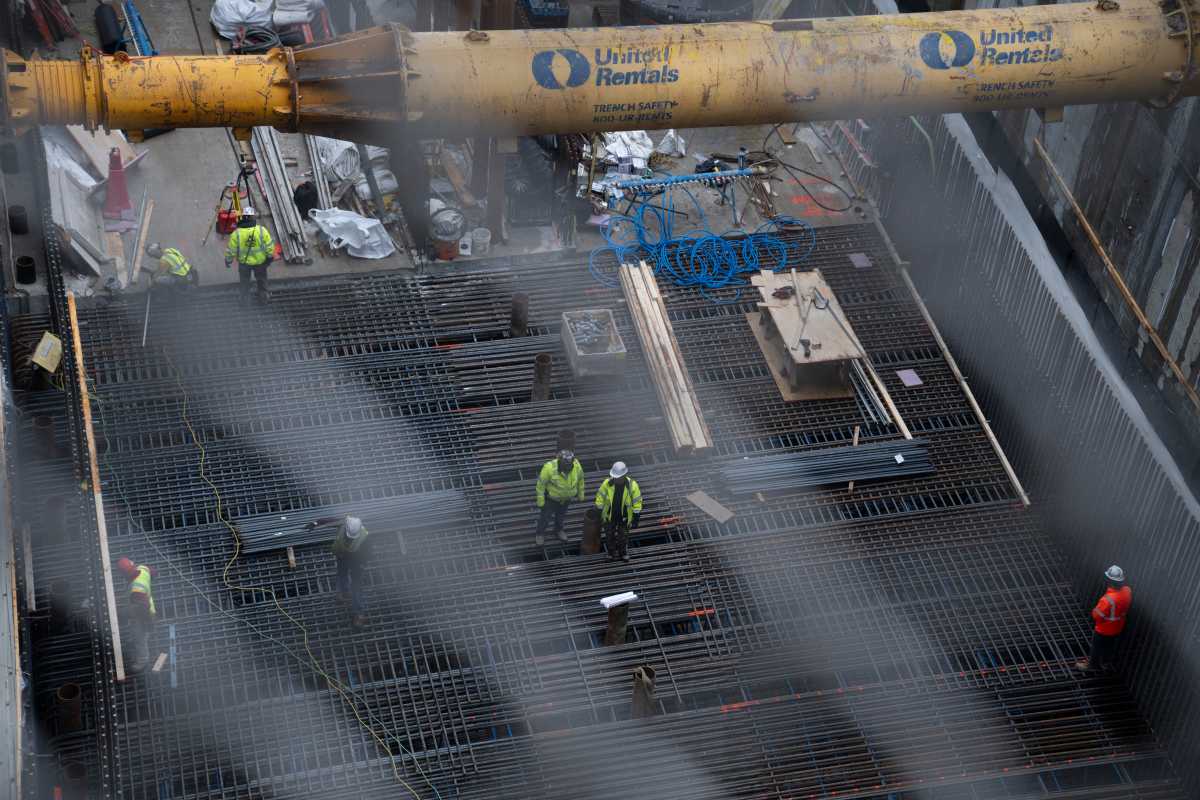
The Hudson Yards Gateway Tunnel project work site during the project’s work stoppage in February 2026.
Photo by Lloyd Mitchell
A federal judge on Thursday handed the Trump administration its first court victory in its effort to withhold federal funding for a project to build the new Gateway Tunnel under the Hudson River.
Federal funding for the $16 billion project, which will replace a 116-year-old two-tube rail tunnel that moves hundreds of commuter trains between New York and New Jersey each day, has been caught up in the courts since last month.
The Gateway Development Corporation (GDC), the entity overseeing the project, and the states of New York and New Jersey have sued the federal Department of Transportation (USDOT) in the Federal Court of Claims and in the Southern District of New York, respectively, to free up millions of dollars in funding they have withheld since the last government shutdown in October.
U.S. Court of Federal Claims Judge Richard Hertling ruled Thursday that, thanks to the states’ suit seeking to lift the feds’ funding freeze for the project, the case brought by GDC to recoup the $205 million it was supposed to receive between October and February was now moot.
That’s because the judge in the states’ case already issued a Feb. 6 order temporarily compelling the federal government to fund the project, meaning GDC already received the $205 million they were seeking in this suit.
The funding freeze caused a work stoppage that lasted from Feb. 6 until Feb. 25, after the funds were completely restored. One thousand laborers were laid off and GDC had to shut down its five active work sites during that time.
Hertling said he agreed that the feds violated the contract they held with GDC, but thought a ruling in GDC’s favor would essentially be pointless now, since the group was now in possession of — and presumably actively using — the $205 million they were asking for.
“I’ve determined that [GDC] has demonstrated [DOT] breached [the contract] … But, right now, I agree with the defendant…that the claims are moot,” Hertling said. “As I try to think through this, what I keep stumbling over … If I issue the order that [GDC] wants, what is that going to do? Tell the government to pay the money? Well, they have.”
But GDC attorney Colleen Sinzdak argued that a judgment in GDC’s favor was still necessary, even though they have the money now: If the states were to lose in their case in Manhattan federal court or that judge allows her order compelling temporary funding to expire, the feds could try to take the money back — something they’ve already indicated they would do.
“We don’t have all the relief we could get from this court,” Sinzdak said. “They want to recoup the money because the funding suspension was, in their view, lawful.”
Sinzdak also suggested the feds’ and judges’ implication that, if the federal government breaches the contract again in the future GDC could take the case back to court and sue again was inefficient.
As the states’ suit in the Southern District is still pending, GDC is guaranteed at least one more payment from the federal government in late March or early April. On April 16, the states and feds will face off again in that courtroom, where U.S. District Judge Jeanette Vargas will presumably make a more permanent decision on that case and funding issues.
The Trump administration’s efforts to appeal Vargas’ temporary funding order have been unsuccessful; their case to temporarily stay it was shot down by the U.S. Court of Appeals for the Second Circuit in a Wednesday evening ruling.
Though he ruled in the feds’ favor, Hertling questioned Justice Department attorney Geoffrey Long about the Trump administration’s reasoning for freezing the project’s funding in the first place — a review it said it needed to conduct of GDC’s contracting with minority-and-women-owned businesses to ensure it complied with recently changed rules. Acknowledging it doesn’t matter if the case is moot, Hertling questioned why it’s taking the government so long to conduct its review.
“Explain to me how it is conceivable that DOT has been unable to make a determination whether GDC is in or out of compliance with provisions of law, statutes and regulations that DOT is reviewing [in five and a half months]?” Hertling said. “More than five months for reviewing something? … Can you tell me what’s going on here? Because I don’t get it.”
When asked directly, Long told the judge he did “not have information to share today about the status of the review.”
Vargas is expected to revisit this issue in the states’ suit against the Trump administration.
But, part of GDC’s suit in Hertling’s court remains alive. The judge did not dismiss two counts of the commission’s suit, which hold the feds are on the hook for unspecified damages GDC incurred by a February work stoppage it holds USDOT is responsible for, arguing the Trump administration breached the funding agreement with the October freeze, violating the government’s implied duty of good faith and fair dealing.
“DOT’s withholding of payments from GDC … is intended to interfere with GDC’s performance … based on political considerations despite lacking any authority to do so under the terms of the agreements,” GDC’s initial February suit reads. “DOT’s breach … will cause GDC to suffer damages resulting from a suspension of work in an amount to be determined at trial.”
GDC and the federal government will be back in Hertling’s courtroom for a March 24 status conference on those matters.