
Historically, the public faces of state and city governments have maintained a manicured image, offering their constituents PSAs and schedules in a clean-cut format meant to be informative and little else.
That isn’t the case for the state of New York, whose official social media presence has increasingly become a destination for nonsensical memes.
While an extreme weather forecast could normally be expected to be presented succinctly, compellingly and self-seriously, the state Instagram account @NYGov took a very different approach in January.
“WE GOTTA RESPECT MOTHER NATURE’S THING,” the account captioned a digitally edited image of a Furby wearing bunny ears in a snowstorm. Elsewhere in the same carousel, a grimacing blue being appeared alongside the number to text for real-time weather updates, along with wind chill predictions from the National Weather Service.
Another era of taxpayers might have balked at an official arm of the state promoting meaningless, agenda-less content like viral baby hippo Moo Deng photoshopped in front of an Olive Garden, but in 2026, the message of nonsensical delight deeply resonates with young voters’ nihilistic senses of humor. The most bizarre content often appears to get the highest engagement.
“I noticed that the weirder the posts, the better it would perform, and therefore the more people would see really important government information,” said Milly Czerwinski, the 27-year-old who has run (and strange-ified) @NYGov for a little more than 10 months.
Czerwinski calls her social media strategy the “’Sesame Street’ approach” in that it makes learning practical information fun. Users don’t generally scroll social media looking for “information about free school meals or that you may be eligible for heating and cooling assistance,” she said. “You’re probably looking for funny Reels to send your friends.”
Now, the two are one and the same.
The inexplicable style of messaging has resonated with constituents as well as their elected representatives. Various state senators, state assemblymembers and city councilmembers have shared the account’s posts, sometimes with messages like “What is going on? What the heck is this?” The charity No Kid Hungry commented “FEED THE KIDS, GLORY TO WORD ART” on a nonsensical post about free school meals.
Czerwinski said she believes the strategy is so successful because, even in a profoundly desensitized and jaded age, the extreme contrast of deranged memes and banal government information is still surprising.
She said she’s noticed more public sector accounts embracing the aesthetic over the past two years, including the Portland Water Bureau, Utah Department of Transportation, Amtrak, NYC Ferry and the state of New Jersey (the profile image for which is currently Baby Yoda holding a yellow outline of the Garden State), as well as many Trump administration-related accounts.
Previously, beginning around 2016, New York City’s Conflicts of Interest Board maintained a humorous Twitter profile. A few years later, the city Department of Sanitation also started dabbling in the art of meme-nicipality on its TikTok page. Both accounts stopped operating in 2023, and neither were as off the wall as @NYGov or the NYC Ferry’s accounts, which are particularly weird.
“If you want to get your brand’s messaging out there, you have to be part of the cultural zeitgeist,” said Franky Ponce, who manages the ferry’s social media pages. He’s found great engagement success and received much praise from riders for the accounts’ zany content, or “edutainment,” as he calls it.
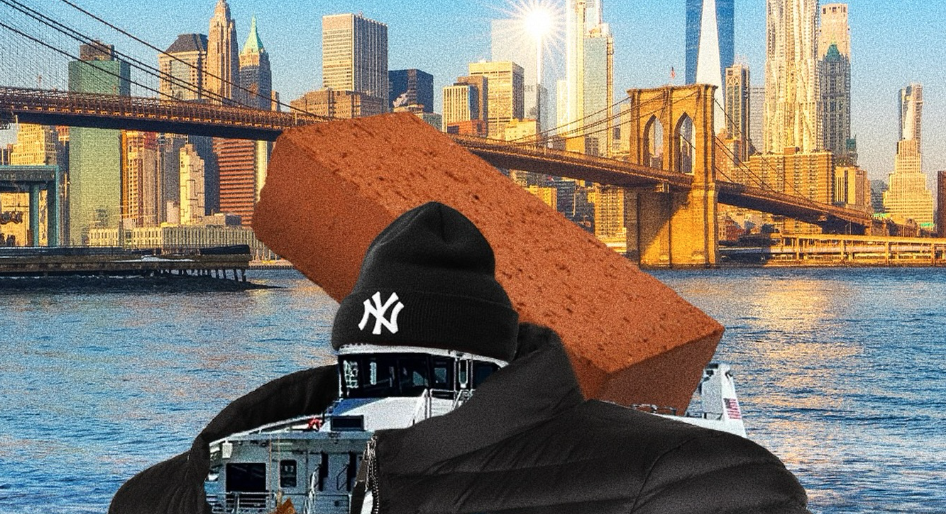
Ponce insists the purpose of it all — posts of a ferry wearing Timbs, a Yankees hat and an NYC Ferry-branded jacket, or of a nonsense acrostic poem about snow that includes an anthropomorphized ferry shooting flames at a yeti — is to better inform riders.
That’s a difficult feat in an informational ecosystem where everything is battling against everything else for limited attention.
“There’s been this kind of flattening where everyone’s competing in exactly the same space,” said Jason Eppink, assistant professor of digital media at Elmhurst University. On social platforms, we go from seeing a friend’s dog to possible war crimes to a meme about the state of New York all in the same newsfeed, all in rapid succession.
“That’s a very, very new phenomenon in human existence, that those ideas and emotions are juxtaposed,” Eppink said.
Many private-sector brands realized years ago that memes and general zaniness were an easy way to make their marketing stand out in a sea of distractions. What’s happening now can be seen as public sector accounts at last cutting through the bureaucratic tape and joining in on the same trend.
“I’m someone who believes that government is a collective good, and so therefore I think it’s great that they are choosing to compete in that space by making things that are playful and fun and engaging,” said Eppink. Ultimately, he added, the message that successful government social media campaigns spreads is “we do good work for you.”
In another sense, it’s just meeting the public where they are.
“I realized that in order to reach people, you just had to go full weird, and I’ve just kind of been doing that ever since,” said Czerwinski.