
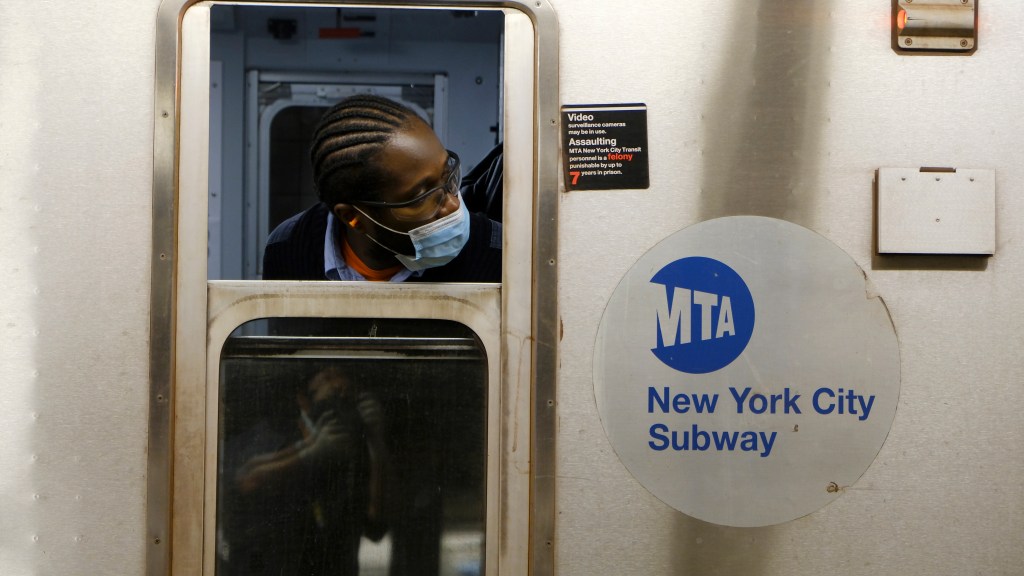
The union representing New York City’s subway workers has renewed its push to enshrine the role of subway conductor into law.
The Transport Workers Union — whose Local 100 represents many NYC Transit bus workers and all subway workers — is once again pushing for lawmakers in Albany to require subway trains to have a two-person crew.
Conductors are in charge of operating the trains’ doors, ensuring passengers get on and off the subways safely, and making announcements.
State legislators passed a law last year that would have required all trains — including those like the shuttle trains, or weekend service on low-ridership lines, which currently run without a conductor — to run with two crew members.
Gov. Hochul vetoed that effort, which would have cost the MTA an estimated $10 million in order to add conductors to trains currently running under OPTO — one-person train operation — rules.
But now union leaders — who say they expect the MTA to try to expand OPTO during upcoming contract negotiations — are trying again, preparing to ask lawmakers to pass a bill that would lock in the status quo by mandating conductors only on the trains that currently have them.
“The overwhelming majority of riders want to keep Conductors on their trains and don’t want to see staffing reduced because of automation,” TWU International President John Samuelsen said in a statement. “They don’t trust their safety and security to robots, to artificial intelligence, to technology.”
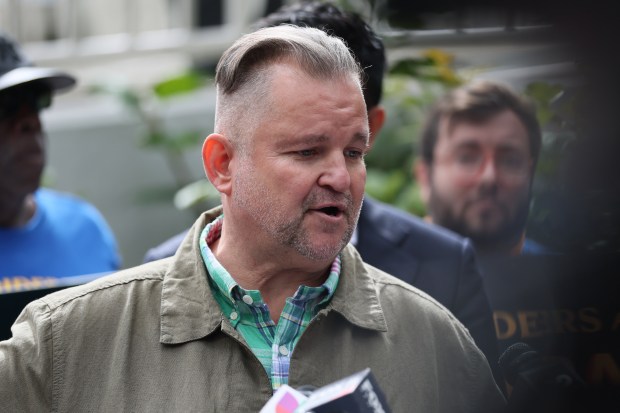 Transit Workers United President John Samuelson speaks during a press conference on Oct. 8, 2025, in New York City. (Photo by Michael M. Santiago/Getty Images)
According to a poll by the union that was conducted by the Honan Strategy Group, among 1,517 transit riders surveyed in New York City, North Jersey and Long Island, 87% said they would support legislation mandating two-person subway crews and 61% said they opposed moving to OPTO system-wide.
The pollsters said 86% of respondents felt uniformed conductors on trains deter crimes, and 84% said two-member crews are better during emergencies.
Indeed, the MTA has previously recognized train conductors for their role in tending to train passengers in distress, and conductors and train operators have worked together to safely stop trains during instances of subway surfing.
The union has also built up a coalition of support, including the groups Disabled in Action, the Brooklyn Center for the Independence of the Disabled, and the Riders Alliance.
But modern signaling systems — like those currently installed on the No. 7 train, the L train and portions of the E, M, F and R trains along the Queens Blvd. line — are capable of controlling trains with minimal input from a human operator.
..
John Minchillo/AP
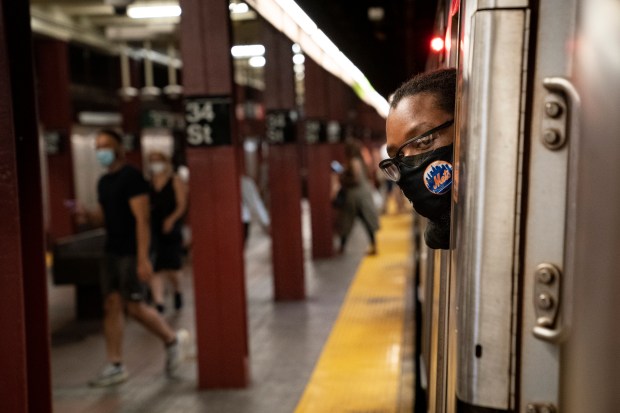
MTA subway conductor Desmond Hill looks out his crew cab window to check the platform for late-arriving passengers on the N subway line in this file photo. (John Minchillo/AP)
As modern signaling is installed elsewhere throughout the system, some transit advocates say it’s an opportunity to make the system more like others worldwide by paring down the number of train crew members to one.
Payroll and benefits for the New York City subway system’s roughly 3,600 conductors costs the MTA roughly $400 million per year.