
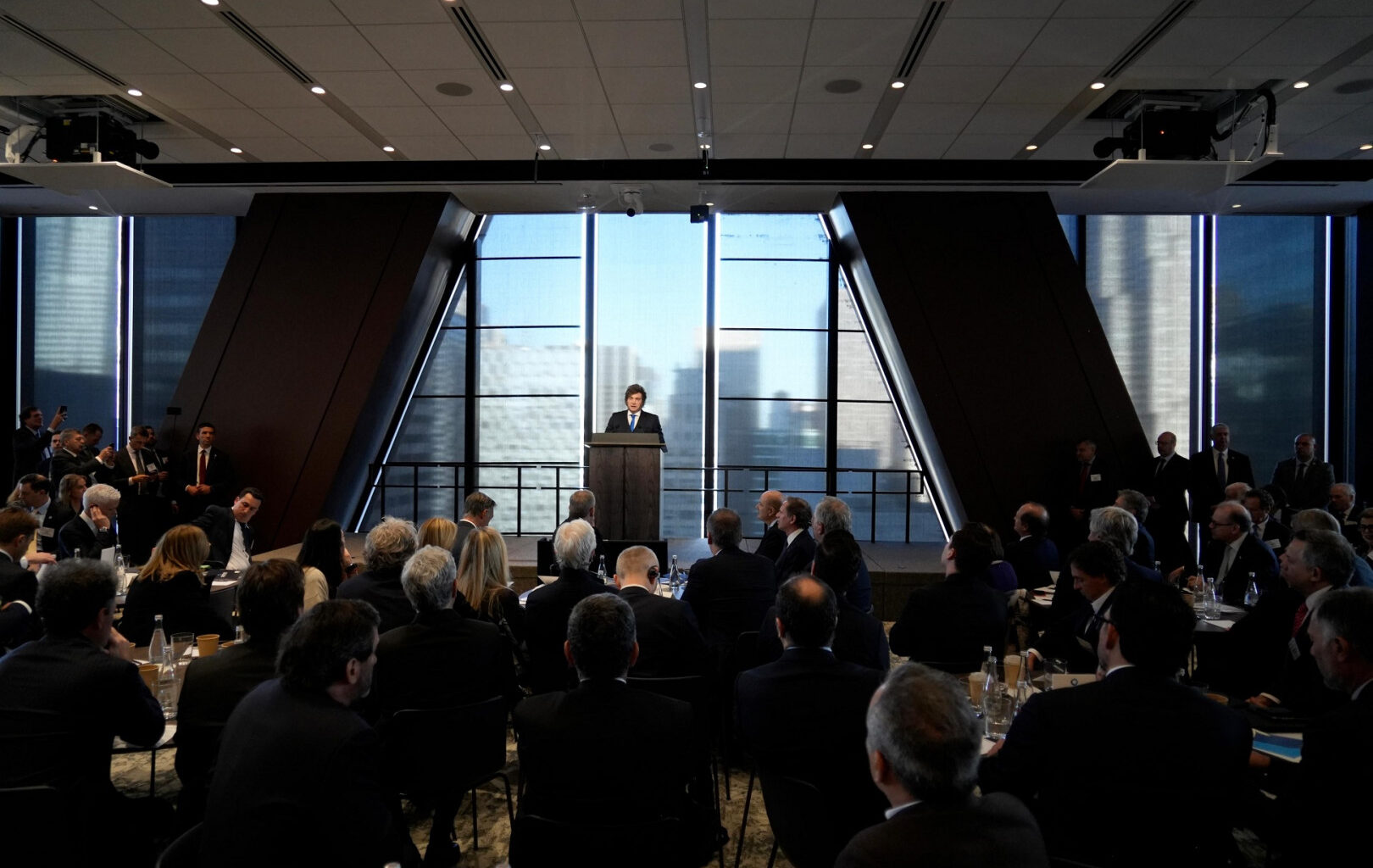
Argentina Week, a New York City event organized by the Argentine government to attract foreign investment, wrapped up on Friday after a week of meetings with investors and business leaders.
Economy Minister Luis Caputo called it “wonderful.”
“Everyone in attendance could see that the interest in investing in Argentina’s real economy is at an all-time high,” he wrote on X. “Investment decisions that would normally take more than six years to make are already being made. We’re talking about tens of billions of dollars that are already starting to flow in.”
However, in Argentine media outlets, the event itself was overshadowed by a scandal involving the government’s chief of staff, Manuel Adorni, who traveled to the U.S. city with his wife, who is not a public official.
So, what really happened in the Argentina Week?
US$16 billion in investment was announced
Four projects were announced as a result of the event, totaling US$16.1 billion — however, most of them came from Argentine companies. “Mercado Libre will invest $3.4 billion to expand its logistics operations in the country, creating 1,900 direct jobs,” said a communiqué by the President’s Office.
Transportadora de Gas del Sur (TGS), also an Argentine firm, announced a $3 billion investment in Vaca Muerta to process natural gas liquids. Pampa Energía applied to join the Large Investment Incentive Regime (RIGI) with an investment of over $4.5 billion earmarked for the exploration and production of unconventional oil.
The only announcement from a foreign company came from Canadian-based mining firm First Quantum Minerals, with an estimated investment of $5.25 billion in the Taca Taca copper project in the province of Salta.
“More than 80% of the attendees were Argentine in almost every session. It could have been held in [Buenos Aires neighborhood] Puerto Madero,” posted Sebastián Lacunza, a journalist and former director of the Herald, quoting a source that attended the event.
A person close to the organization of the event said that was in fact the case, but added that if the event took place in Buenos Aires, “the global CEOs of big multinationals would not have attended.”
Interest in mining and Vaca Muerta
“There is undoubtedly interest in investing in certain sectors in Argentina—specifically those that were most prominently promoted during Argentina Week in New York,” Gastón Carelli Lynch, a Clarín journalist who covered the event, told the Herald.
He said that the mining sector, particularly critical minerals, is “undoubtedly one of them”, especially since several copper-related projects are set to begin in Catamarca and San Juan as well.
“And of course, Vaca Muerta, which is, above all, the hope not just of the national governments, but also of the Patagonian governors, of Neuquén and Río Negro, the only two provinces that haven’t seen a net loss of jobs over the last two years,” he added.
Political doubts and reassurance
Carelli Lynch added that the main question during the event revolved around political risk. “Specifically, doubts about whether the government will continue along the path set by Milei’s administration when he is no longer in office,” he explained.
He added that “the fate of the Argentine government may also depend on the fate of Donald Trump, who, according to all U.S. polls, is in a tough spot for the midterm elections, and a poor election result could lead to many calls for Trump’s impeachment.”
Those are reasons why Milei traveled to New York with 11 governors from different political parties — “to demonstrate governance and consensus around ‘mining, farming, oil and gas’.”
“There are doubts as to whether the government took advantage of this week, and there were also doubts among some sectors —businesspeople and bankers— who said, ‘If [Peronist Buenos Aires governor] Axel Kicillof starts to become competitive in the coming months, the government is going to have a problem sustaining the macroeconomic indicators’.”
Insults against business leaders
A diatribe by President Javier Milei against business leaders didn’t go unnoticed: at Argentina Week, an event aimed at getting investments, he called Paolo Rocca and Javier Madanes Quintanilla, two of the country’s leading industrialists, “crony businessmen.”
Paolo Rocca leads Techint, the largest producer of steel pipes for the oil industry. The company made headlines when it recently lost out on a pipeline construction contract to the Indian company Welspun Group.
Javier Madanes Quintanilla owns aluminium giant Aluar and tire manufacturer Fate, which shut down two weeks ago.
According to Marco Kofman, an economist and researcher at the Observatory on Current Affairs, Labor, and the Economy (MATE), “these are large business groups that have been part of our economy for many decades and will continue to be so, regardless of the governments in power or the direction of economic policy.”
For Kofman, these actors are taking advantage of the national administration’s liberalization of the foreign currency market to engage in capital flight.
On the other hand, he said, major business leaders such as Rocca and Madanes Quintanilla are not exclusively industrialists. Rocca has a gas and oil division in the form of Tecpetrol, which continues to expand its operations in Vaca Muerta. Madanes Quintanilla, for his part, is also in the energy business: Aluar Wind Farm involved investments of nearly $400 million.
Whatever these business leaders lose in the manufacturing sector, they gain in their energy ventures.
“This is a business community that, wherever it sees opportunities, invests a portion of its capital,” Kofman told the Herald. According to the economist, business leaders may be “more or less annoyed” by Milei’s insults, but in reality, they don’t care. “These are powerful groups that will remain so even when Milei is no longer in the Casa Rosada, and they will emerge from this administration more financially driven and more dollar-dependent than ever,” he concluded.