
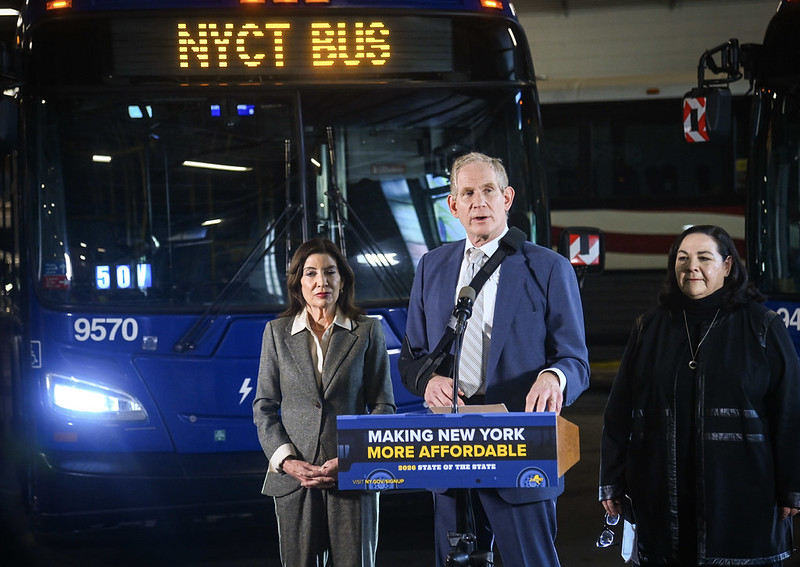
MTA Chair and CEO Janno Lieber standing with Gov. Kathy Hochul touting her proposal to lower car insurance premiums as a boon for New York City transit riders. Friday, March 13, 2026
Marc A. Hermann / MTA
MTA Chair and CEO Janno Lieber stood shoulder-to-shoulder with Gov. Kathy Hochul on Friday to tout her controversial proposal aimed at lowering auto insurance premiums as a boon for New York City’s millions of subway and bus riders.
The governor and the MTA boss, during a Friday news conference at the Mother Clara Hale Bus Depot in Harlem, both highlighted the agency’s new finding that the measure will save it approximately $50 million that it spends on personal injury insurance payouts annually. The announcement comes as the proposal has drawn controversy over reports that it is being backed by big tech spending and may, if enacted, make it harder for crash victims to get compensated for their injuries.
Hochul — who is running for reelection this year — has mainly pitched the proposal as a way to lower costs for New Yorkers by reigning in “skyrocketing” car insurance premiums. She claimed rates have gone up dramatically in recent years due to “jackpot payouts” to those she said are fraudulently scamming the system.
Hochul insists auto insurance reform is about saving drivers money
The state’s top executive said city residents, a large portion of whom take public transit instead of driving, should support the proposal because the MTA could be using the money it spends on payouts toward improving service instead.
“They’re sometimes forced to pay some really outrageous jackpot legal settlements, even when their own drivers are not at fault,” Hochul said. “And it’s costing us millions and millions of dollars. So who loses in this? All the transit riders. Because the money that we’re spending on these payouts is money that’s not being spent investing in this system.”
Yet the news site Streetsblog has reported that the proposal is being pushed by an Uber-backed group, Citizens for Affordable Rates (CAR), which has spent millions on ads in support of it, according to state filings.
The governor on Friday denied that special interest spending on the proposal is motivating her to push to get it over the finish line.
“This is a high priority of mine,” Hochul said. “Anytime I can find a way to put more money back in New Yorkers’ pockets, I’ll be at the front line of that fight. … I don’t know how you can say that one company that has an interest in this has any influence over the fact that everybody has an interest.”
Concerns about shift in liability, and financial responsibility
Additionally, safe streets advocates argue the legislation will shift the financial responsibility for crashes from drivers and insurance companies to victims by narrowing the definition of “serious injuries” to leave out non-permanent injuries that prevent victims from working for over 90 days.
“We don’t want any sort of attempts to quote, unquote, cut down on fraud [to] actually end up just being something that screws over crash victims even more,” said Alexa Sledge, spokesperson for the safe streets advocacy group Transportation Alternatives.
The governor is attempting to pass the proposal as part of the state budget, which must be delivered by an April 1 deadline to be considered on time. But both chambers of the state legislature left the proposal out of their budget resolutions, unveiled earlier this week.
Under Hochul’s proposal, the current system — which awards payout amounts based on the percentage of responsibility a jury finds those involved in the crash to have — will be scrapped and replaced with one where those found to be more than 50% at fault will get no compensation.
Lieber takes aim at ‘billboard lawyers’
Lieber said that under the current system, the MTA ends up shelling out large payouts in lawsuits where its bus drivers were found to be less than 50% responsible — a phenomenon he blamed on personal injury attorneys, whom he labeled “billboard lawyers.”
He said there are instances where the MTA has been found not to be at fault in a crash but has still been forced to pay out massive sums.
“The MTA ends up being liable, even though we are found to be 1% responsible for an accident,” Lieber said. “What’s happening now is, if they can get a jury to say the MTA was 1% responsible, we’re responsible for the entire damages. And frequently the other guys don’t even have insurance, so it’s a huge number.”
The MTA chair said those massive payouts mean the agency must also set aside more dollars in its budget reserve each year to satisfy its actuaries.
Lieber argued the MTA could use the money it spends on the suits to instead fund transit improvements. For instance, he said the agency spent less than $50 million — $35 million — on its recent redesign of Queens’ bus network.
But Danny Pearlstein, director of communications and policy for the group Riders Alliance, said that while $50 million is no small amount of money, it is a drop in the bucket for an agency as massive as the MTA.
“Every dollar in the MTA’s budget is, of course, important to riders, but it is important to keep the size of the budget in perspective,” he said. “Out of a $20 billion budget, $50 million is a quarter of a percent.”