
Real journalists wrote and edited this (not AI)—independent, community-driven journalism survives because you back it. Donate to sustain Prism’s mission and the humans behind it.
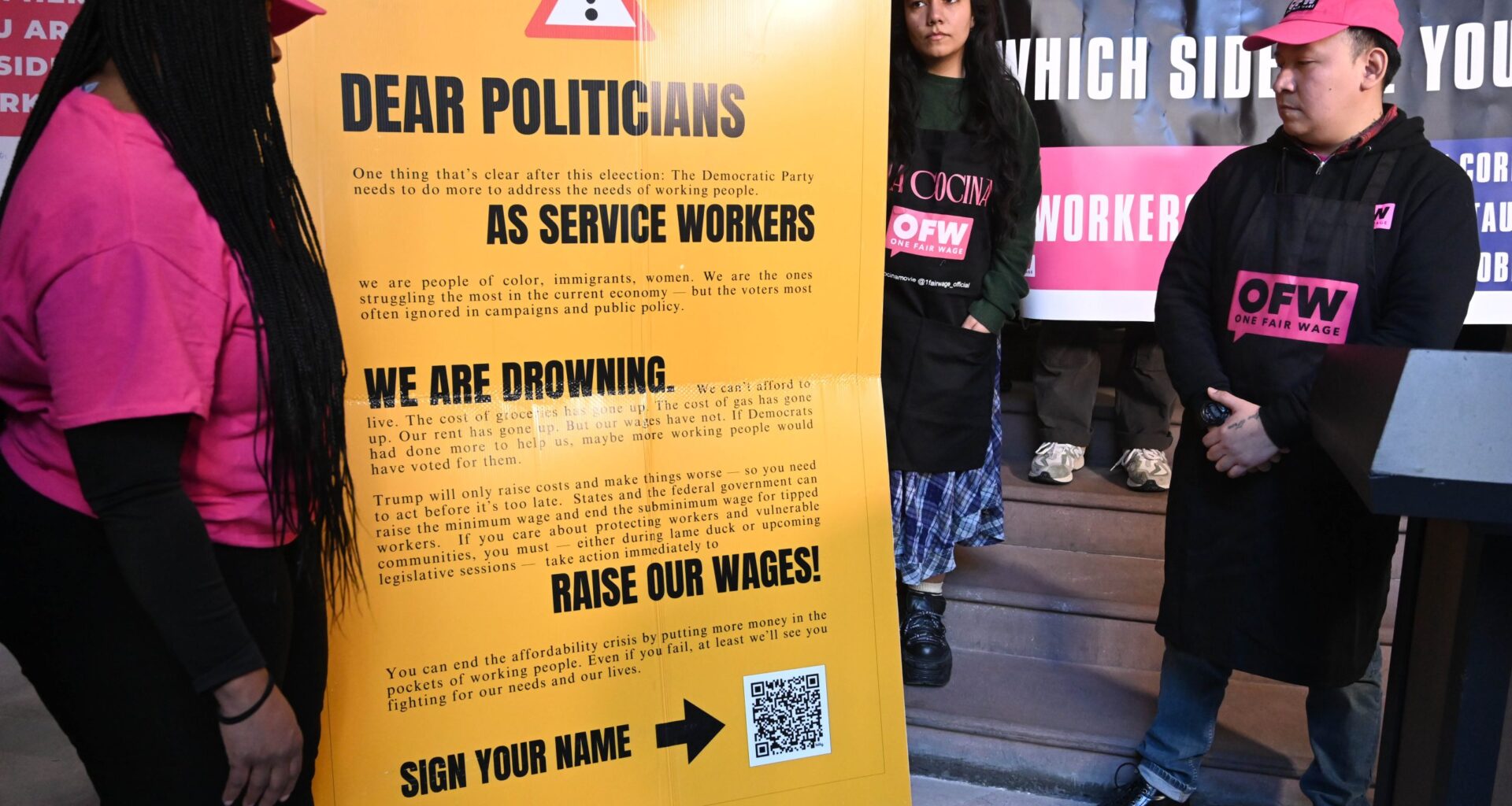
Advocates, business owners, workers, and elected officials in New York City want to change the economic reality of more than a million workers by proposing substantial increases to the minimum wage.
Advocates say that a substantial increase to the hourly minimum wage, which sits at $17 and could rise to $30 by 2030 under a new legislative proposal, would help workers meet their needs at a time when increases to the cost of living in the U.S. are far outpacing growth in workers’ spending power.
Twelve New York City Council members introduced the measure, which would gradually increase the hourly minimum wage to $30 for large employers, on March 10. The bill also proposes a slightly lower scale of increases to minimum wage workers at businesses with 500 or fewer employees nationally.
“We are one of the most expensive cities on this planet,” Sandy Nurse, the council member who introduced the measure, said at a press conference outside City Hall.
“The wages aren’t adding up. They are too damn low, and the cost of living is too damn high,” Nurse added. “This is not a dignified life.”
If the legislation is approved by the council, the minimum hourly wage would rise on Jan. 1, 2027, to $20 for workers at larger employers and $19 at small businesses, then $23 and $21.50 respectively in 2028, $26 and $24 in 2029, and $30 and $29 in 2030.
After 2030, according to the bill, the minimum wage would increase based on the rate of inflation during the preceding 12 months. The minimum wage for tipped workers, currently $11 per hour in New York, would also increase under the proposed legislation. It would be set to at least two-thirds of the overall minimum wage rate in a given year.
Raising the minimum wage to $30 has gained major saliency as a political issue in the past few years. The proposal in New York City is similar to a campaign promise made by Mayor Zohran Mamdani, who during a meteoric ascent to the mayorship declared that he would like to see the minimum wage in the city bumped to $30 by 2030.
Recent polling in major American cities—New York, Chicago, Los Angeles, and San Francisco—showed that a diverse coalition of would-be voters, around 66% of those polled, would support a gradual increase of the minimum wage to $30 by 2030.
“We have to fix the game, it is rigged against us right now. The gears of this city are moved by working people every single day,” Connor Spence, the president of the Amazon Labor Union, said at the March 10 press conference. The union represents around 8,000 Amazon workers in Staten Island.
“We know in our hearts something is wrong. That is why we are demanding $30 for our groceries, $30 for our rent, $30 for our families and our future,” Spence said.
That bump would barely be enough to approach some estimates of the cost of living in New York. The Living Wage Calculator, a tool created by the Massachusetts Institute of Technology, indicates that the requisite hourly wage to afford life in New York City is around $31.50. The tool factors in the costs of food, health care, transportation, personal goods, internet, housing, and taxes.
Rising costs and stagnant wages in New York have long been sources of struggle, particularly for those employed by Amazon, workers say. Joëlle Jean, who works on Staten Island at JFK8, the first unionized Amazon fulfillment center, said she was not able to rent an apartment once she started working for the company in 2023. Landlords would deny her tenancy because they did not believe she could make rent every month, she said at the press conference.
“Not making enough money, no job security—not good for them,” Jean said.
Her life had become a menu of sacrifices where, once billing cycles arrived, Jean would have to choose between one vital aspect of life in the city or another. Sometimes it was choosing between paying for her cellphone plan and the internet bill, other times the choices were food or utility bills, she said.
“We work hard, 60 hours, just to make ends meet,” Jean said. “We still cannot face our responsibilities as hard-working people. We make our employees billions, but they still can’t pay us.”
Proposals to increase the minimum wage in New York extend beyond the city. New York Assembly Member Demond Meeks, a Democrat from Rochester, has proposed a similar bill aiming to bump the hourly rate across the state.
Saru Jayaraman, a lawyer and activist who founded the One Living Wage campaign, said the popularity of proposals to bump the minimum wage is a sign of the current economic moment.
The campaign is a platform for workers, unions, elected leaders, and restaurant owners seeking to raise workers’ spending power and end subminimum wage employment—mostly found in workplaces that pay a “tipped wage.”
Jayaraman said affordability is an issue that trumps other immaterial topics in Washington, D.C., that plague national political campaigns.
“We’re hearing from workers all over the country that they’re not motivated by a ‘fight to save democracy’ because they say, … ‘what has democracy done for me lately?’” Jayaraman said. “Democracy can deliver on the issue they keep telling us is their top issue, which is meeting the cost of living.”
Jayaraman said affordability has become a goal that transcends political partisan divides. However, she said elected leaders in both parties are focused too heavily on reducing the cost of living, something Jayaraman said seems highly unlikely.
“It’s never going to happen,” she said. “Affordable child care, housing, and health care are all critical, and the only way to actually address people being able to afford things is to put more money in their pockets. What people are telling us is that there’s no world in which $15, $17, or even $20 is going to be enough at this time to meet the basic needs of life.”
Editorial Team:
Sahar Fatima, Lead Editor
Lara Witt, Top Editor
Stephanie Harris, Copy Editor
Related