
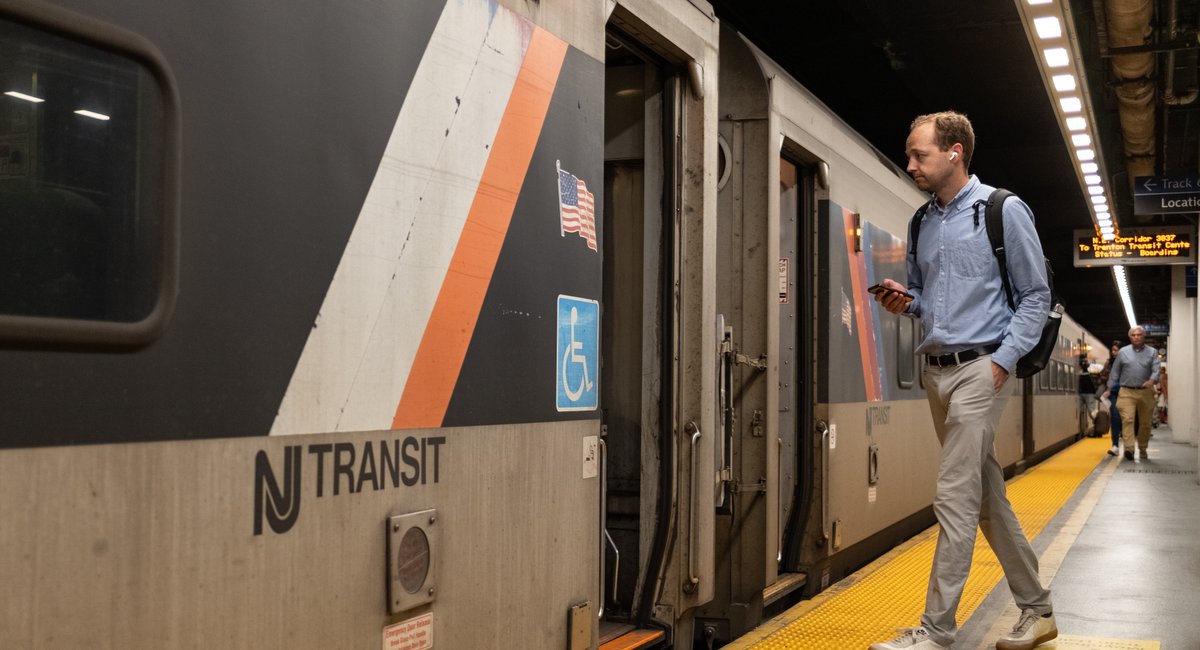
NJ Transit commuter rails are back on their regular weekday schedules after a month of disruptions tied to opening the new Portal North Bridge, a critical piece of infrastructure for trains crossing the Hackensack River.
The new bridge is a yearslong project to replace the old Portal Bridge, built in 1910 by the Pennsylvania Railroad company. The crossing is shared by NJ Transit and Amtrak trains, and in 2020, the Gateway Development Commission approved a $2.3 billion project to replace the old bridge.
Monday is the first official weekday of regular service on the new bridge, but the Garden State transit agency scrambled to use it during last Friday’s morning rush hour after overhead wire issues on Amtrak jammed up service on the old bridge. Crews were able to get limited service running on the new bridge, partially alleviating the commute meltdown.
Unlike the old bridge, which frequently gets stuck when swinging open to let river traffic through, the new Portal North Bridge is tall enough to allow boats and barges to pass without having to open. Trains will also be able to travel up to 90 mph on the new bridge, compared to 60 mph on the old one, according to NJ Transit.
The Portal North Bridge is one of the first steps in the multiphased Gateway megaproject to improve service to Manhattan Penn Station. The megaproject includes building new Hudson River tunnels along the Northeast Corridor.
Still, the completion of the first phase of the Portal Bridge “cutover” project, as transit officials call it, hasn’t solved all of NJ Transit’s service issues. Early Monday, the agency reported up to 20-minute delays into and out of New York Penn Station due to a disabled train near Newark.
And commuters said they suffered for a month with limited train schedules and constant delays while officials finetuned the final work on the new bridge.
“There was extensive delays,” Adelso Callado, 44, said at Penn Station last week, waiting for his train back to New Jersey during the afternoon rush hour. “I have friends that take the New Jersey Transit daily, and it was chaotic.”
A second phase of the cutover project is planned for the fall, when the old bridge will be fully phased out, according to transit officials. The old bridge carried 450 daily Amtrak and NJ Transit trains and 200,000 daily riders, the two railroads said. Officials said the new bridge, alongside the eventual new Hudson River tunnels, will double rail capacity between Newark and New York City.