
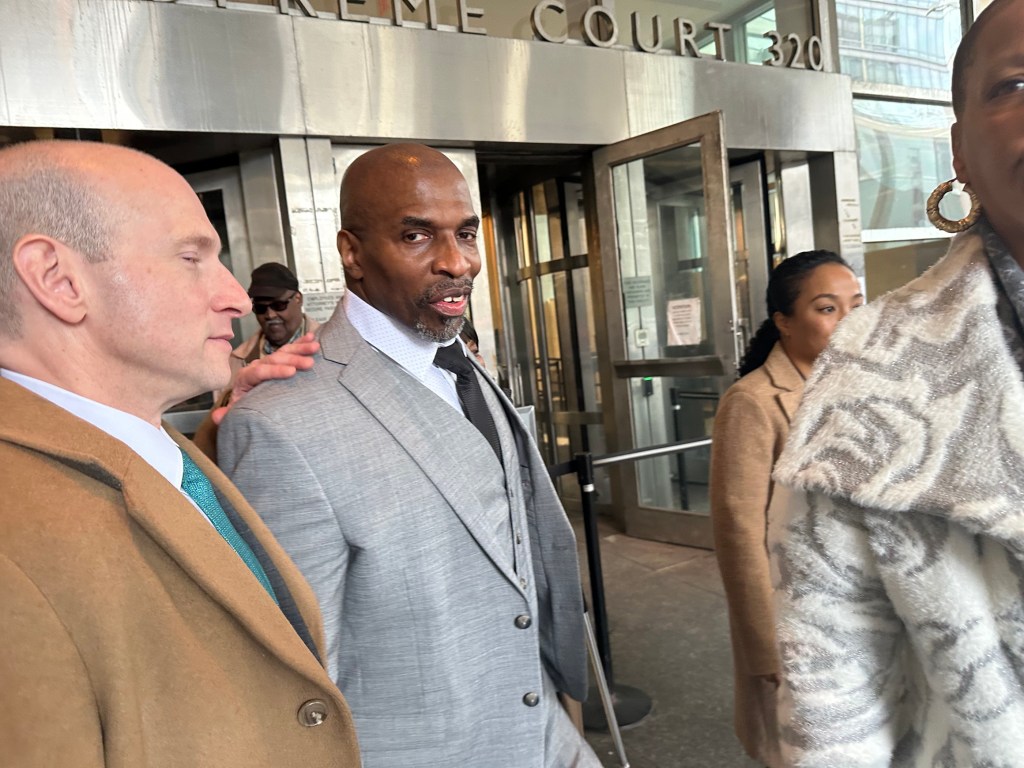
A Queens man was freed and exonerated after 19 years in prison for a robbery he didn’t commit — after the Brooklyn district attorney’s office found he unwittingly used a money order belonging to the victim to buy a stove for his mother.
Kenneth Windley, 61, walked out of Brooklyn Supreme Court a free man Monday, after Judge Matthew D’Emic ordered his 2007 conviction vacated.
“I feel great! I feel great!” Windley said before leaving the courtroom, later telling reporters, “I didn’t give up, and I kept my determination, my faith, and I had an excellent legal team.”
Windley, who was serving a 20-to-life sentence, said he plans to spend his newfound freedom with his friends and family, but he’s not ready to go right home.
“I’m going to celebrate,” he said, adding that he’s looking forward to “some seafood.”
Windley seemed like the “low-hanging fruit” for cops after a April 1, 2005, mugging in Crown Heights, according to a Conviction Review Unit report by DA Eric Gonzalez’s office.
The 70-year-old victim was walking home when a pair of crooks ambushed him in his building elevator and robbed him of two unsigned money orders, one for $542.77, the other for $9.48.
That same day, Windley used one of the money orders to buy a $379 stove at a Brownsville appliance store. A month later, police found out that Windley used a driver’s license with his name on it and had the stove sent to his Queens address. He was arrested on robbery charges and, ultimately, convicted at trial.
But the reality of how Windley got the money order wasn’t so cut and dry.
Windley, a heroin dealer with a lengthy criminal record, headed to the store with cash that day, ready to buy a stove. Windley was staying with his girlfriend in the Howard Houses, where he kept his drug stashes, and on his way out, he ran into two men.
He told them where he was headed, and when they asked him if he was paying with cash and they came up with a proposition — use the money order they had to buy the stove, and they’d cover the tax on the purchase.
Windley told investigators he was wary, but one of the men assured him the money order was meant for a car insurance bill that his girlfriend had already paid, and he couldn’t “take it back” because he had no ID.
So Windley agreed, and the two men accompanied him to the store, convincing the manager to go along with the transaction.
At the time, Windley only knew the men by their street names, but after his arrest, he managed to find out one of their real names.
Windley testified in his own defense, and the victim was “vague and confusing” on the stand, according to the report. But the jury didn’t believe Windley and found him guilty on March 1, 2007, of second-degree robbery. Windley was sentenced as a predicate felon.
What the jury didn’t know, though, was the two robbers Windley described were real people, not a fiction — and they were actually being prosecuted for a string of similar robberies from April 5, 2005, through Feb. 1, 2006.
One pleaded guilty to the pattern and was sentenced to 14 years, the other took it to trial and lost, and was sentenced to 40 years.
The prosecutor handling Windley’s trial didn’t investigate his claims, telling investigators the name of the robber Windley provided was too common. Another prosecutor handling the robbery pattern case was never contacted by anyone involved in Windley’s case.
“It’s a case that, you know, was a cautionary tale,” Gonzalez said. “Over the years, this Conviction Review Unit has showed the problem with witness identifications and tunnel vision, and there was a lot of evidence that connected him to the case, but he was steadfastly declaring his innocence.”
Windley and his family did their own investigations after his conviction to pin down the identity of the two robbers and pressure them to do the right thing and confess, hiring a private investigator to help them. He and his legal team submitted statements to the Conviction Review Unit from both men admitting they committed the robbery and sold him the stolen money order.
“It’s a great day for justice, especially for Mr. Windley and his family. He deserves this so much,” Windley’s lawyer, David Shamies, said. “He was an innocent man who fought for his freedom for 20 years, telling the truth the whole time.”