
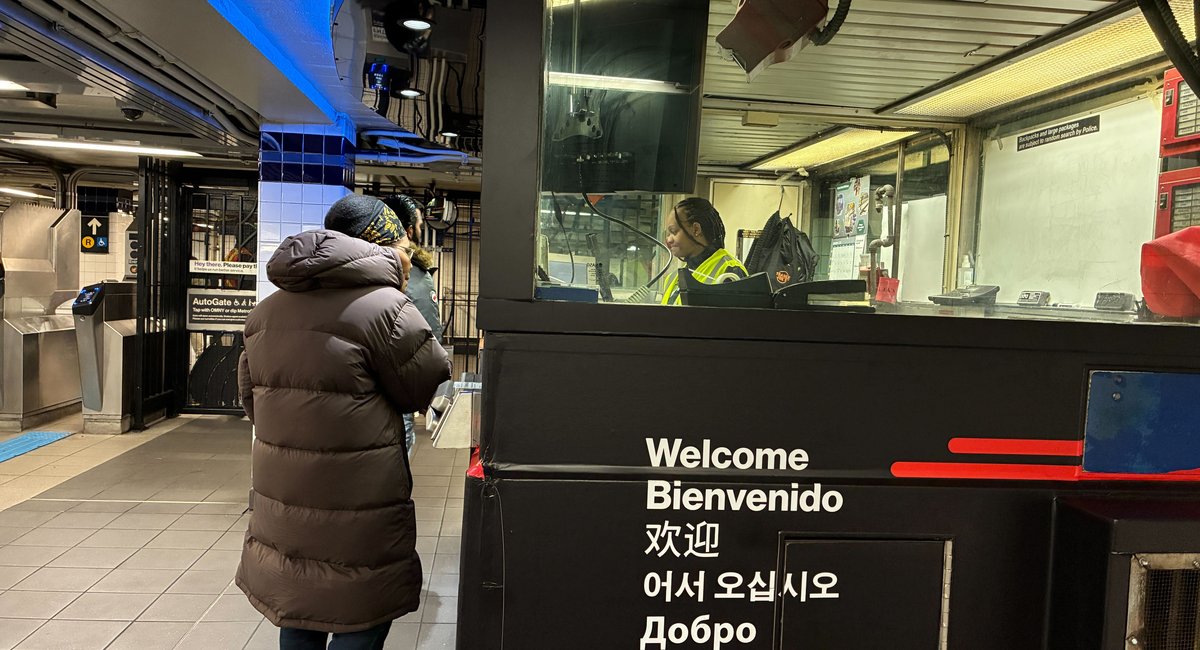
The powerful union representing transit workers has sued the MTA, seeking to block a new policy eliminating a staffing requirement for subway token booths.
The new MTA policy, implemented in January, allows token booths to be unstaffed if the assigned booth agent is out sick or on vacation.
The Transport Workers Union argued that the booth agents serve a vital, underappreciated role assisting riders, including those with disabilities. The effort comes as the MTA seeks to get booth agents out of their boxes to interact more with commuters.
“ What we’re seeing today is not only an affront to… the union workers and an affront to the disabled community, but also an affront to New York City,” Brooklyn Borough President Antonio Reynoso, who is a plaintiff in the lawsuit, said at a press conference Monday. “When people are in trouble, they don’t go walking around looking for a phone, looking for a button to press. They’re looking around for a [transit] worker to assist them.”
The lawsuit is the latest development in an ongoing battle between the union and Gov. Kathy Hochul. Last year, Hochul vetoed a bill that would have enshrined two-person subway crews into law, even as trains became increasingly automated. The bill is expected to be reintroduced this session. TWU’s contract with the state will expire this spring.
In the new lawsuit, the union argues empty station booths jeopardize public safety.
“These are our frontline soldiers, our people that are eyes and ears of transit,” said John Chiarello, president of TWU Local 100. “You see what’s going on out there. People are getting shot, stabbed, and beat up. I would want somebody to call 911. I wouldn’t rely on anything but a person.”
The union’s lawsuit argues the new policy is an improper addition to a 2022 agreement with the MTA, which required station agents to work inside and outside the booths. The union says it wasn’t until January that the MTA changed the rules to eliminate the requirement that a replacement worker fill in if the regular booth agent was out sick or on vacation.
The union said the move is an attempt to save the MTA money.
“ They need to understand there’s more value in safety than a couple of pennies,” said Robert Kelly, Stations Vice President for Transport Workers Union Local 100
The MTA stood behind the new policy.
“The MTA and the union agreed three years ago to new rules where station agents moved outside booths to better assist not only persons with disabilities but all New Yorkers at fare gates, payment machines and throughout the entire station,” said Demetrius Crichlow, NYC Transit President. “At the time of that signed agreement, public notice was provided, hearings were held, and station agents were provided additional pay.”
According to Kelly, the MTA has around 2,400 station agents to work across 472 stations. Agents’ responsibilities have shifted substantially in recent decades.
The heavily fortified booths once housed thousands in cash and subway tokens. But they were rendered obsolete in the 1990s when the tokens were replaced by the MetroCard.
Workers in the booths used to be able to take cash and reload riders’ MetroCards, but the MTA ended that practice in 2020 during the COVID-19 pandemic, saying they wanted to keep their employees safe from the virus, and never restored that duty.
Kelly said there are many reasons agents call out.
“We have people that are pregnant, we got people that are sick… we have all kinds of [reasons that cause] somebody not to be there,” Kelly said. “In the past, our practice has always been, if someone is out, that booth is covered by someone else.”
The advocacy group Center for Independence of the Disabled also joined the lawsuit. The center’s executive director, Sharon McLennon Wier, said booth agents are crucial to helping New Yorkers with disabilities navigate the subway system.
”When we talk about having booth attendants working in the stations, it’s about life or death,” Wier said. ”We’re talking about litigation because, unfortunately, we find that every time we talk about accessibility in the city, it’s not done on someone’s goodness of their heart.”
Several riders at the Jay Street station in Downtown Brooklyn said they valued the booth agents’ presence. One rider, Hassan Ahmod, noted that his first language is Arabic.
“I’m not good with English. I don’t know how to use the [OMNY] machine,” Ahmod said. “Why do you think somebody stays inside [the booth]? To help people.”
Roz Sophas said she would look to the agents for help in the event of an emergency.
“It’s really crazy. Someone may get injured, they need help, then you out of luck,” said Sophas, 63, of East New York.