
The largest union of New York City transit workers has launched its latest legal challenge against the MTA over its staffing of booths in subway stations.
A lawsuit filed Friday by Transport Workers Union Local 100, Brooklyn Borough President Antonio Reynoso and the head of Center for the Independence of the Disabled New York accuses MTA executives of dodging state public authorities law by not holding public hearings that are required before any “complete or partial closing” of a booth. The suit says the transit agency could sporadically affect hundreds of booths.
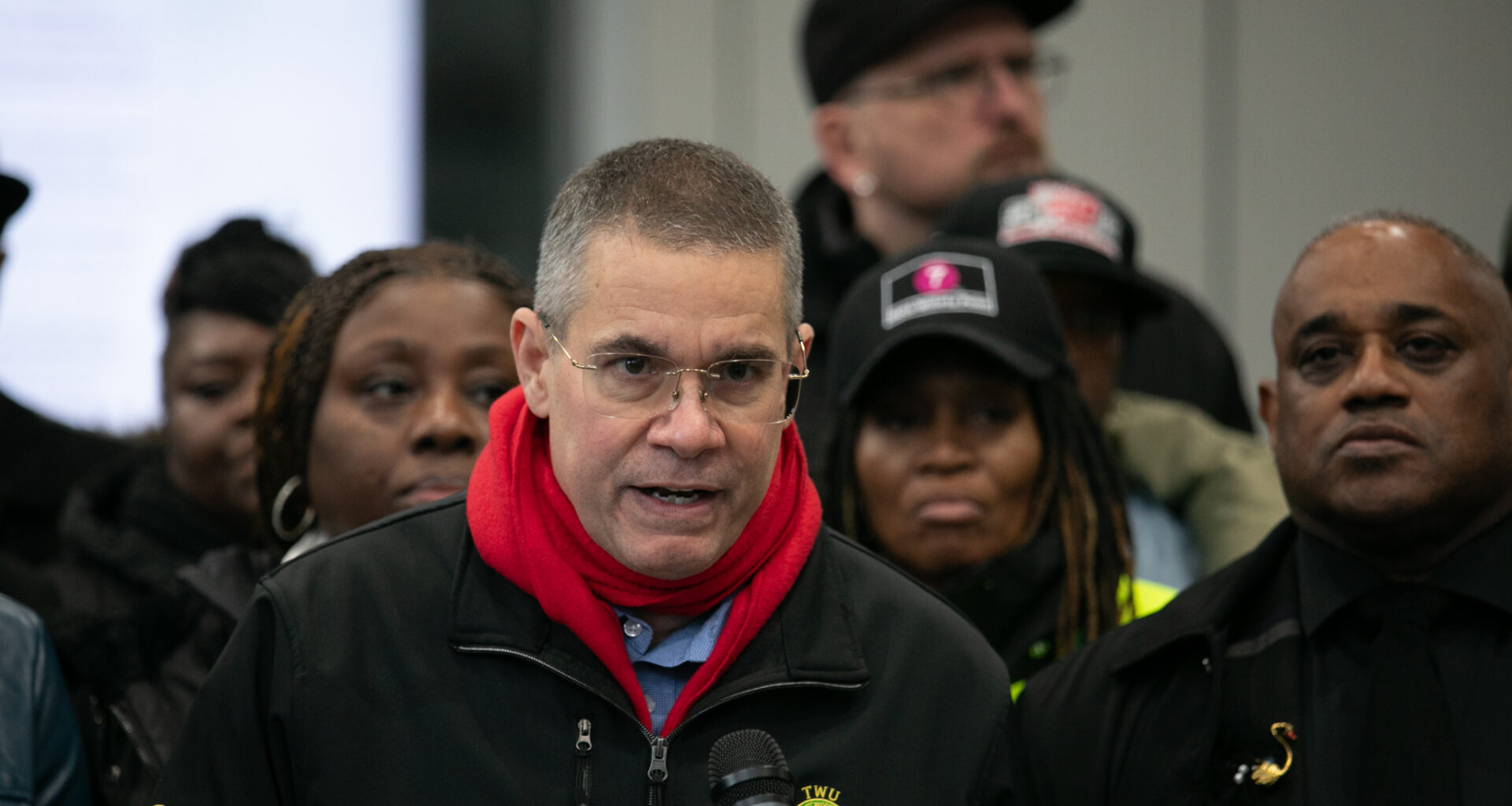
“The MTA, in their not-so-infinite wisdom, once again is taking away people who are the eyes and ears of everyone inside the transit system,” John Chiarello, president of TWU Local 100, said Monday at a news conference outside the Jay Street-MetroTech station in Downtown Brooklyn. “I know that if you don’t have this in the system, there’s going to be issues.”
The complaint in Manhattan Supreme Court also charges the heads of the MTA and New York City Transit with violating the city’s Human Rights Law by limiting access to the subway system for people with disabilities by closing booths at stops where station agents operate service gates.
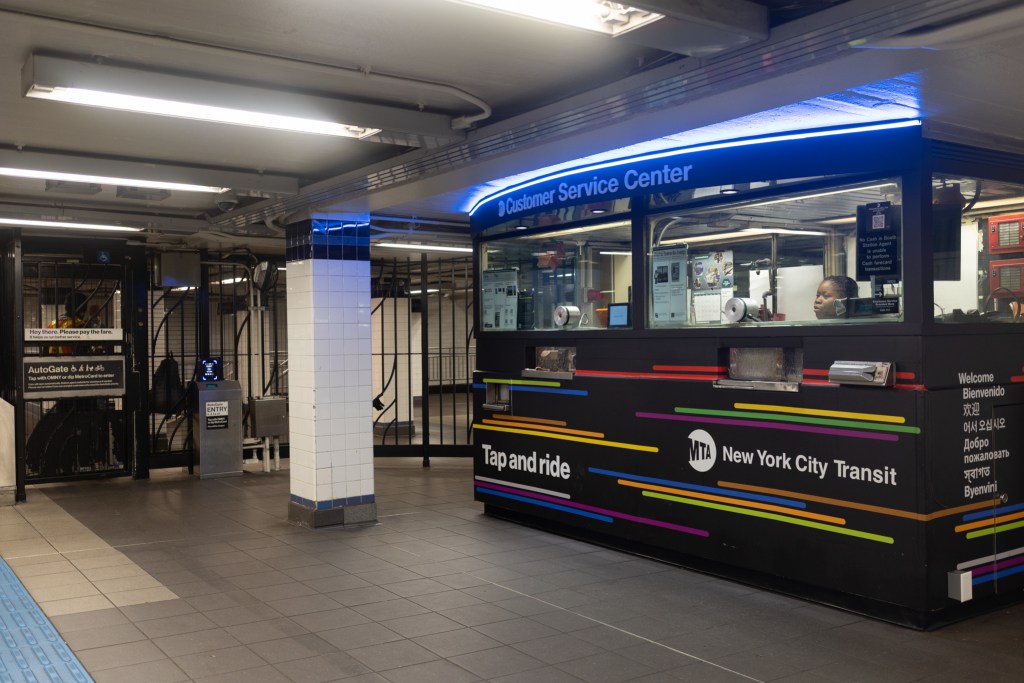 An MTA station agents works at the Jay Street Metro-Tech station, March 16, 2026. Credit: Ben Fractenberg/THE CITY
“There’s always a booth operator present to help make that happen,” Reynoso said. “And what the MTA decided to do is, unilaterally not replace a worker if they go out of work, if an emergency happens — they want to keep the booths empty.”
The lawsuit marks the latest flare-up between the union and the MTA over reduced staffing in what many New Yorkers still know as “token booths” and it comes in the run-up to the two sides entering contract negotiations later this year.
The union has repeatedly challenged the MTA’s efforts to scale back staffing in station booths, but agreed to allow its more than 2,500 station agents out of booths in early 2023 so workers could provide customer service elsewhere inside of stations, including platforms. That move was accompanied by a $1 hourly pay increase for station agents.
An MTA spokesperson declined to comment on the specifics of the lawsuit, but the president of New York City Transit pointed to new rules reached in the deal reached three years ago that moved station agents outside of booths.
“At the time of that signed agreement, public notice was provided, hearings were held and station agents were provided additional pay,” Demetrius Crichlow said in a statement.
The legal fights between the two sides date back nearly a quarter century, when there were more than 900 booths across the subway system. In August 2001, the union and several other groups secured orders temporarily barring the MTA from closing 53 of them without first holding public hearings. There are now about 400 booths, according to Arthur Schwartz, a lawyer for TWU Local 100.
But long after the 2003 retirement of the token — and, more recently, the last of MetroCard sales at the end of 2025 — the union has continued to battle the MTA over staffing in station booths.
“If the governor and mayor are saying that the subways are safer and you’re diminishing the first line of defense, which is the customer agent, the station agent, then how does that make any kind of sense?” Chiarello said. “You’re not safer, you’re less safe because nobody’s going to call when you’re being hurt.”
Subway crime last year fell to its lowest level in 16 years, with Gov. Kathy Hochul and MTA officials touting a 14% drop from pre-pandemic numbers in 2019.
At the Jay Street-MetroTech station in Downtown Brooklyn — next to where the union held its news conference — riders offered varying opinions on what station agents offer to commuters.
“I tried at two stations to get help and they weren’t able to help me,” said Judyuria Hernandez, a tourist who was trying to add value onto her OMNY fare card.
Dasean Paynes, 18, said station agents can be especially useful for riders who are not so familiar with the subway system or for people with disabilities.
“Just in case you want to ask for directions or if you need help with the OMNY,” said Paynes, who lives in Manhattan. “If you’re new to the city, the subway can be pretty hard to navigate.”
Related