
For most sunsets during Ramadan, New York City firefighter Tahmida Taher breaks fast in her firehouse in Queens, usually with a quick sip of water and whatever food she can grab before resuming work.
But one recent evening, Taher, 23, was among dozens of Muslim firefighters and EMS workers who gathered in the fire department headquarters in Brooklyn.
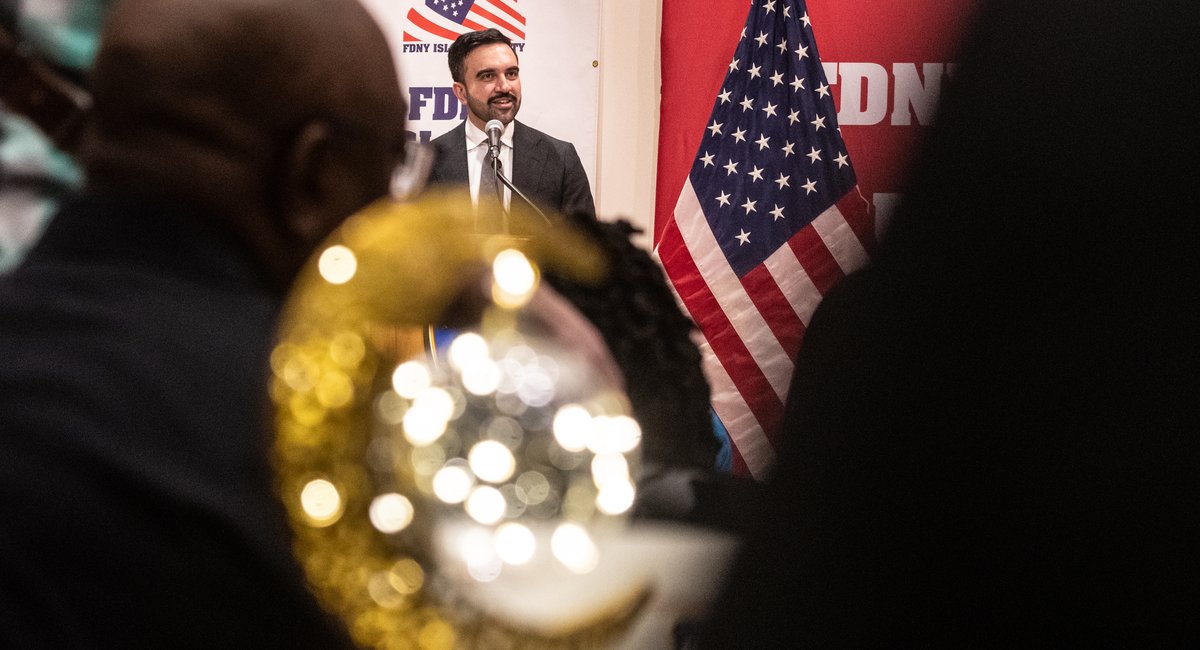
Massed around tables lined with golden crescent moon figurines, they passed around plastic water bottles and paper plates of dates, and broke their fasts with Mayor Zohran Mamdani, the city’s first Muslim mayor.
Mayor Zohran Mamdani celebrates Ramadan along with dozens of Muslim firefighters and EMS workers in an iftar at fire department headquarters in Brooklyn.
Stephanie Keith/Gothamist
It was the first time a New York City mayor attended an FDNY iftar, the evening meal during Ramadan, this one hosted by the agency’s Islamic Society. For Taher, who grew up in the Bronx in the wake of the 9/11 attacks and the subsequent wave of Islamophobia that swept the city and country, the scene felt improbable.
She recalls stories she’d heard growing up about family members and friends facing racist and anti-Muslim attacks. Her father, a taxi driver, was assaulted by a passenger, who hurled racial slurs at him. Taher said she avoided wearing hijab, in part due to fear.
“[Nearly twenty-five] years later, after 9/11, having a Muslim mayor,” Taher said before trailing off and breaking into tears. “It’s humbling.”
Muslim New Yorkers have been working for decades to gain acceptance, recognition, and institutional power, such as in their years-long battles to add Muslim holidays to the city’s public school calendar and to end the NYPD’s surveillance of Muslim communities. Many said Mamdani’s meteoric rise, from assemblymember to mayor, has marked the start of a new era, one crystallized during the monthlong Ramadan celebration — the first with a Muslim mayor and first lady in Gracie Mansion.
Mamdani’s inauguration delivered something unimaginable for many of the city’s Muslims: representation of their identity for the first time among the elite echelons of political power in the city and country.
That representation, some said in recent interviews, has accompanied a growing confidence: to wear their faith openly, to see themselves in the machinery of government, and to hope that the stigmas forged in the wake of 9/11 — and still all too present this Ramadan — might lose their cultural power.
Dozens of Muslim firefighters and EMS workers celebrate Ramadan in an iftar at fire department headquarters in Brooklyn.
Stephanie Keith/Gothamist
Mamdani is publicly embracing his Muslim identity even as he navigates political pressures tied to his faith and endures Islamophobic attacks. Despite a packed schedule, he says he has fasted daily until sundown through this holiday, reaching out to Muslims from all walks of life.
“He’s starting to normalize the very, very open practice of Islam,” said Sahr Ali, the founder and director of the community group Black Muslims Now, based in New York City. “He’s bringing Islam into the public consciousness.”
Mamdani’s Ramadan
Last year, during his campaign for mayor, Mamdani embraced his South Asian heritage and loudly proclaimed his Muslim faith. The son of Indian immigrants ran campaign ads explaining ranked-choice voting in Hindi, Urdu and Bengali.
As mayor, Mamdani has stayed the same course during Ramadan, the holiest month of the year in Islam, observed by the faithful as a period of communal prayer, reflection, and fasting. This Ramadan, Mamdani said in remarks at several iftars that he’s reflecting on one particular Quran passage: “With hardship there will be ease.”
New York City is home to an estimated 769,000 Muslims, representing nearly 1 in 10 New Yorkers and nearly 1 in 5 of the country’s Muslim residents, according to a 2018 report by the Institute for Social Policy and Understanding, a Michigan-based organization researching American Muslims.
Dozens of Muslim firefighters and EMS workers celebrate Ramadan in an iftar at fire department headquarters in Brooklyn.
Stephanie Keith/Gothamist
Mamdani typically skips the Ramadan pre-dawn meal known as suhoor, the mayor told Gothamist and others, as he ate Indian food at an iftar at City Hall. Instead, the mayor said he stays up as late as he can at night, eating meals that include high-water content fruits and vegetables and drinking plenty of water.
But Mamdani has embraced iftars as a time to connect with the city’s Muslims. Almost daily during the holy month, Mamdani has met with different groups to pray and break his fast: delivery workers, police, firefighters, teachers, domestic violence survivors, and mosque congregations across the city.
At the events, he’s often surrounded by senior Muslim officials in his administration and at times, his wife, artist Rama Duwaji, who is a Sunni Muslim and otherwise does not usually accompany Mamdani to official events. Mamdani is a Shia, a minority sect of Islam.
Mamdani has moved across the city’s diverse Muslim communities during Ramadan. He’s attended events with the Imam Al-Khoei Foundation, a longstanding Shia mosque in Jamaica, Queens, once visited by former Mayor Mike Bloomberg, and Ali’s organization, a group for Black Muslims formed in the wake of George Floyd’s death and the subsequent racial uprising. His social media team regularly posts photos of his Ramadan events.
Mamdani and his administration have been mindful of the politics of representation and identity. His adviser Zara Rahim, who organized many of his Ramadan visits, said the team was looking to highlight and connect with the breadth of the city’s Muslim communities and its working people. And in the hours before an iftar with city workers, Mamdani decided to overhaul his prepared remarks to address the Islamophobic attacks he had endured.
One morning in February, before the blizzard began, Mamdani awoke before sunrise to pray and break fast with a small group of sanitation workers before they began their snow preparations.
Earlier this month, he invited the pro-Palestinian protest leader and former Columbia student Mahmoud Khalil to a more intimate iftar at Gracie Mansion, a decision criticized by the White House and several Jewish groups but which Mamdani has defended.
At an iftar at City Hall hosted for local journalists, Mamdani told Gothamist that he felt his role during Ramadan is “to be myself and to share also what it means to be Muslim in New York City, and how these are not identities that are in tension. In fact, each one is a part of the other.” A few weeks later, the mayor hosted an iftar with a group of social media influencers — an event that garnered anti-Muslim vitriol from the right.
Battling Islamophobia
Mamdani’s visibility has also come with a cost: He’s faced a torrent of anti-Muslim attacks, on the campaign trail and throughout his first months in office, especially as he publicly celebrates Ramadan.
Conservative radio talk show host Sid Rosenberg, in early March, called Mamdani a “jihadist” and a “Radical Islam cockroach,” in a social media post. He later deleted and apologized for the comments.
The same week, far-right activist and pardoned January 6th rioter Jake Lang hosted an “anti-Islamification” rally outside Gracie Mansion and brought a roasted pig along with him.
U.S. Rep. Brandon Gill, a Republican from Texas, recently posted a photo from Mamdani’s City Hall iftar with social media influencers, calling the event “stomach churning” and “truly repulsive.”
U.S. Sen. Tommy Tuberville, a Republican from Alabama, posted a photo of Mamdani from the iftar alongside another image, of the World Trade Center attacks on 9/11, with the caption, “The enemy is inside the gates.”
Mamdani has condemned the various attacks, making a point to criticize not just the hatred directed at him but the Islamophobia faced by Muslims across the city.
“ For nearly as long as there has been a New York City, there have been Muslim New Yorkers, and yet for nearly just as long, those with power and platform have sought to dehumanize us,” Mamdani said at a recent iftar speech for hundreds of city workers at the Museum of the City of New York.
Mamdani also addressed what he called “the smaller indignities…that Muslims are expected to face in silence.” He said, “When I hear such hatred and disdain unchecked in its rancor, I feel an isolation and a loneliness that I know that many of you have felt as well.”
Karina Qazi, 63, gets a selfie with Mayor Zohran Mamdani, at an iftar in Brooklyn.
Courtesy of Mandar Parab
Karina Qazi, 63, of Brooklyn, an immigrant from India who has lived in the U.S. for nearly 30 years, said she’s concerned by the rise of Islamophobia. In the years immediately following the 9/11 attacks, she said, teachers at her son’s preschool said of Muslims: “Send them back. They are killers.”
But Qazi, who met Mamdani at an iftar in Brooklyn for South Asian domestic violence survivors, said she is optimistic about the mayor’s approach. “Zohran is now a hope for Muslims,” she said. “I feel positive that what he is doing as mayor is going to change the mindset of people about Muslims.”
A longer history
Mamdani joins a long tradition of mayors from religious minority groups publicly embracing their faith while in office. The city’s first Jewish mayor, Abe Beame, regularly attended synagogue and hung a mezuzah, an enclosed Torah fragment, in Gracie Mansion. The city’s first Catholic mayor, William Russell Grace, attended mass each morning.
Mamdani is also not the first mayor to visit a mosque. In the wake of the Iraq War, Bloomberg visited the Al-Khoei mosque and later gave speeches in support of a mosque set to be built near ground zero.
Former Mayor Eric Adams, who identified as Christian and spoke often about his conversations with God, visited several mosques during his tenure as mayor, as part of a stated effort to reach out to communities across faiths. But some Muslim leaders criticized Adams after he spoke out in support of Israel in the wake of the Oct. 7, 2023, Hamas attack on Israel, and the following siege by Israel in Gaza.
Mamdani has taken a sharply different line. He’s been an outspoken critic of U.S. policy in the Middle East, condemning Israel’s bombardment of Gaza — which he has called a “genocide” — and more recently, the U.S. war against Iran.
For many Muslim residents, the conflicts in the Middle East have cast a shadow over Ramadan this year and in recent years. But some said they appreciated Mamdani’s vocal support of the Palestinian cause and his swift condemnation of President Donald Trump’s decision to strike Iran.
“You have a mayor who stands for all people,” said Imam Khalid Latif, the founder and director of the Islamic Center of New York City, a mosque formed last year in Greenwich Village. “It gives people a sense that they don’t have to be the ones speaking. There’s people who will speak for them and will leverage their power and privilege to ensure that our voices are heard. And that applies to crises all over the world.”
Asad Dandia, a Muslim New Yorker and tour guide who researches Muslim history, said he feels like “the community has finally made it.” In 2013, Dandia sued the NYPD for spying on him and other Muslim New Yorkers, and won a settlement prohibiting NYPD investigations based mainly on race, religion, or ethnicity.
In what Dandia described as “a poetic twist of events,” his lawyer in that case — who is also Muslim — is now Mamdani’s chief counsel.
“The Muslim community now is only going to grow in its institutional influence and power,” Dandia said. “If there’s going to be a Muslim renaissance in the United States, it’s going to start in New York City.”
Brigid Bergin contributed reporting.