
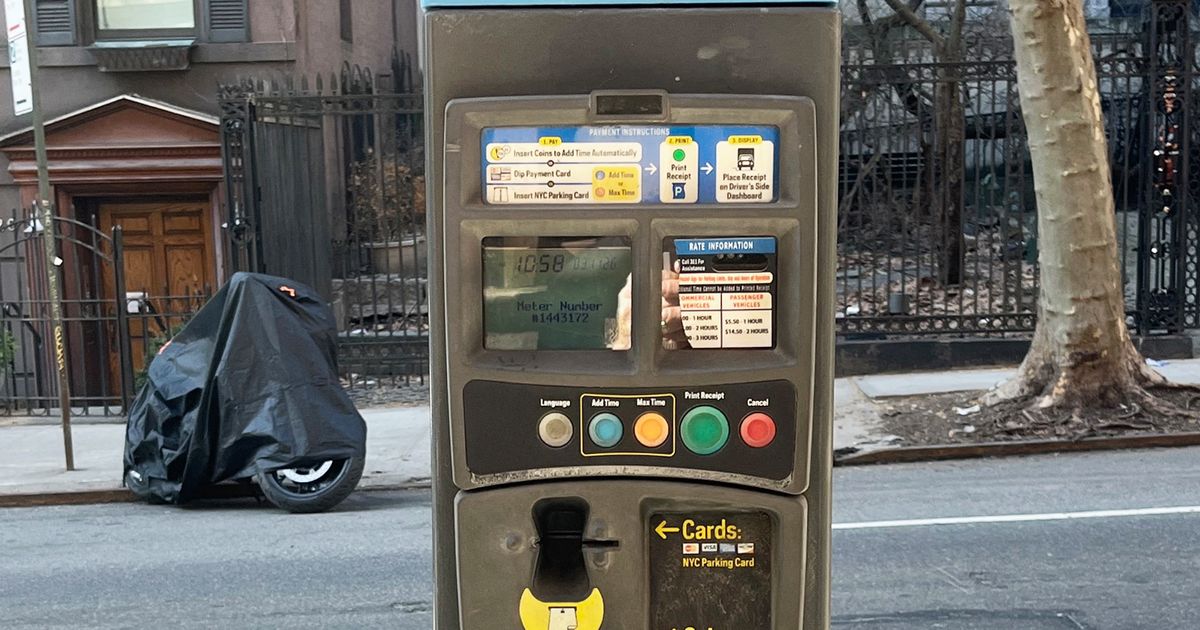
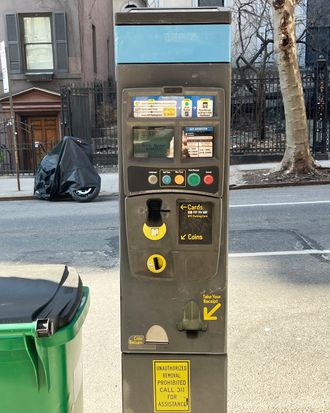
Feed me!
Photo: Christopher Bonanos
I happened to be 1,800 miles from New York when the prospect of parking fees as budget-gap closer entered the chat, and I could very nearly hear the howling from there. The New York Post, as is its custom, went with a scare headline based on one sentence spoken by Deputy Mayor Dean Fuleihan at a March 5 budget event — “Yes, we should be looking at all those things” — because the things in question included charging for parking places that are now unmetered. The Post included, but did not highlight, the next clause in his sentence: “… but it’s not going to address the $5.4 billion problem.”
Maybe it won’t, but we do have to look at these things, and not just because we have a budget gap. Parking occupies a huge amount of public space that could instead be shared with pedestrians, bicyclists, other vehicles, and everyone else. (The air pollution alone from drivers endlessly seeking a space is a cost few want to calculate, although someone should do so.) If I one day asserted the absolute right to store any other heavy steel box — say, a deep freezer or a coffin — at the curb in front of my home, my neighbors would call the cops, the Sanitation Department, and possibly Bellevue. Choose a steel box with radial tires, though, and somehow it’s fine. The urbanist Donald Shoup — may he rest peacefully, without a single moment spent circling the block — wrote multiple books and thousands of pages that make a persuasive case against free urban parking: It is an extremely undervalued asset, he argues, and putting a fair price on it will both make it easier to find a spot and pay for lots of city services.
Anyway. Whether it’s paid for by taxes or fines or other means, free parking isn’t going away. Too many New Yorkers have built their existence around it, especially in the subwayless low-rise areas of Queens and Brooklyn, and City Hall isn’t going to cut them off lest every public official be immediately defenestrated. Besides, although a comparatively small percentage of New Yorkers own cars relative to the rest of the American populace, more than half of all New York households have one. (They’re affluent, too — the average car-owning New Yorker has twice the income of the average carless one — and affluence tends to correlate with influence.) So the question becomes: How might some policy adjustments turn parking into both a better revenue stream and less of a nightmare for car owners?
Legally, it’s pretty straightforward. The Department of Transportation has both discretion and authority when it comes to setting parking rules and deciding where the meters go. It’s explicit in the city charter. No City Council vote or other approval is required. In practice, of course, people scream bloody murder when their parking rules change, and some community-board and similar pushback is likely. The optics and politics thereof are thus less cut-and-dried than they seem. But basically, if the Department of Transportation decides to add a lot of meters to the streets or introduce a lot of new limiting regulations, it can. In 2025, it took in an estimated $620.4 million in parking fines.
To talk to someone who’s thought a lot about this, I called up Henry Grabar, author of Paved Paradise: How Parking Explains the World (and newly hired staff writer at The Atlantic). He was quick to agree that plunking down meters on streets where parking has been free for three generations, no matter how wrongheaded it may have been to make them free in the first place, won’t happen and perhaps shouldn’t. “It’s a political and logistical challenge to ask people to pay for something they currently get for free,” he told me. Moreover, many of our car owners don’t run their vehicles as often as other cities’ residents do. They’re weekend, day-trip, Costco-run, visit-mom-in-Jersey drivers who use a significant portion of their mileage on alternate-side parking days. “Really, what distinguishes New York City streets is that people do not use their cars to go to work. It’s not like Los Angeles, where at 7 a.m. the street is full of cars and at 9 a.m there are no cars.” For those owners, a metered block may as well be a no-parking-at-all block.
Nonetheless, it’s a shock to learn just how few parking meters New York City actually has. Philip Miatkowski, a policy expert at the activist group Transportation Alternatives, told me there are a mere 80,000 metered spots out of 3 million — 2.6 percent — and that counts every single metered space, even the ones that charge for only a small portion of the week. A recent Center for an Urban Future paper suggested that adding meters to 25 percent of all those free spaces would cover perhaps a third of the budget shortfall, although the knock-on effects of such a sharp change to the city invite a little skepticism about the numbers. That said, Miatkowski reminds me that, right now, the city takes in a surprisingly tiny amount of money through parking meters: $9.68 per spot per day.
More significant than raising the rates, though, would be making the meters’ pricing fluctuate — “demand-responsive pricing,” in urbanist lingo. Much as Uber prices fluctuate, going up when, say, it’s rainy at rush hour and falling to almost nothing when you’d just as soon walk, so too can parking meters now respond to demand. The numbers can be floated up and down until the economics of desire and demand work out just right, leaving a space or two available on most blocks at most times. San Francisco put a pilot program in place to do this, and it has been highly effective, both at raising money and making it easier, rather than harder, to park. It aims to have a space open on most blocks most of the time.
Grabar, though, was quick to differentiate between two types of paid parking that are likely in the conversation Fuleihan says we need to have: adding meters and adding neighborhood permits. The former takes away the ability to park your car in front of your house for days or weeks, because it limits occupying a space to a couple of hours. The latter, though, is a different animal. You, a resident of (let’s say) Fort Greene, Brooklyn, would pay a fee for a Fort Greene–specific sticker on your window, and that would entitle you to leave your car on your block almost indefinitely, street-cleaning days aside. It’s commonplace in other cities; decades ago, when I lived in Baltimore, Maryland, I had a neighborhood permit that cost $20 per year, and I am startled to report that when I checked just now, its price has not gone up. New York, being New York, could and almost surely would charge more.
In parking-theory circles, neighborhood permits are a point of debate, because they’re not without a downside. If you get a permit, you are more formally entitled to curb space than before. If you can park in front of your house for months on end, you probably will. You might buy a car when you wouldn’t have before. There will surely be fraud, too, if today’s placard abuse is any guide. On the other hand, Grabar pointed out to me, “the promise of the permits is, from a cynical perspective, you are effectively kicking out the virtual friends and out-of-state insurance-fraud drivers” — that is, people who register their cars to a summer house on the Cape for the cheaper coverage but spend 11 months of the year in Brooklyn — “to reserve the space for people who live there, and that’s a system you can actually get political support for. It’s a onetime giveaway of this public space, and it institutionalizes the right people feel to take ownership over it, but you also establish a framework where you can grant access.”
Another possibility for capturing some city income through parking would be amending the effective but unsettling bargain the city made, in 2004, with the companies that perennially park where they’re not supposed to, in the form of the stipulated-fine program. Delivery companies were tiring of constantly paying parking tickets, and the city was weary of handling the endless parade of court challenges to them. The solution was for the FedExes and UPSes and Amazons of the world to pay discounted fines in exchange for ceding the right to challenge them. The companies have saved millions through this system, and the city likely has too — it’s hard to say for sure, because you never know how all those contested tickets would have gone, but it seems likely to be a net positive. The Adams administration even cut the rates a little in 2024. But it’s also likely that (a) by accepting that we’re going to have a lot of illegal parking, the program may tacitly encourage it, and (b) the immense growth of online shopping means that there are far more double-parked delivery trucks on our streets than there were just a few years ago. If we are to live with the stipulated-fine program, it is not inappropriate to ask whether we should try to get more money out of it. One could, for example, add a heavy penalty if a company’s number of tickets continues to increase year over year, thus disincentivizing illegal parking even further.
Politically speaking, charging for parking is still a risky proposition. There are plenty of pro-streets, pro-bike environmentalist groups that advocate for parking reform, but they have rarely had the upper hand in a mayoral administration as they do now. While there is no free-parking lobby per se, what we do have are relatively rich car owners who stand up and grump at community-board meetings. We also have business owners — remember Kathy Hochul’s diner guy who said congestion pricing would kill his restaurant? — who claim they’ll lose business if their customers can’t park out front. (That diner hasn’t gone anywhere, by the way.) On that subject, Grabar has some wise words about survivorship bias: “Everybody who comes into a restaurant who has a bad time parking complains about it. Everybody who takes the subway in, or has an easy time parking, just comes in.” During a similar push to raise parking-meter rates during the mayoralty of Mike Bloomberg, various City Council factions leaned in, and the mayor backed partway down. But today’s city, the one that chose Mamdani, is perhaps more willing to pay for a private tradeoff that comes with public benefits. As was true of congestion pricing, the biggest resistance comes just before any policy takes effect, when people are simply wary of change.
Sign Up for the Curbed Newsletter
A daily mix of stories about cities, city life, and our always evolving neighborhoods and skylines.
Vox Media, LLC Terms and Privacy Notice
Related