
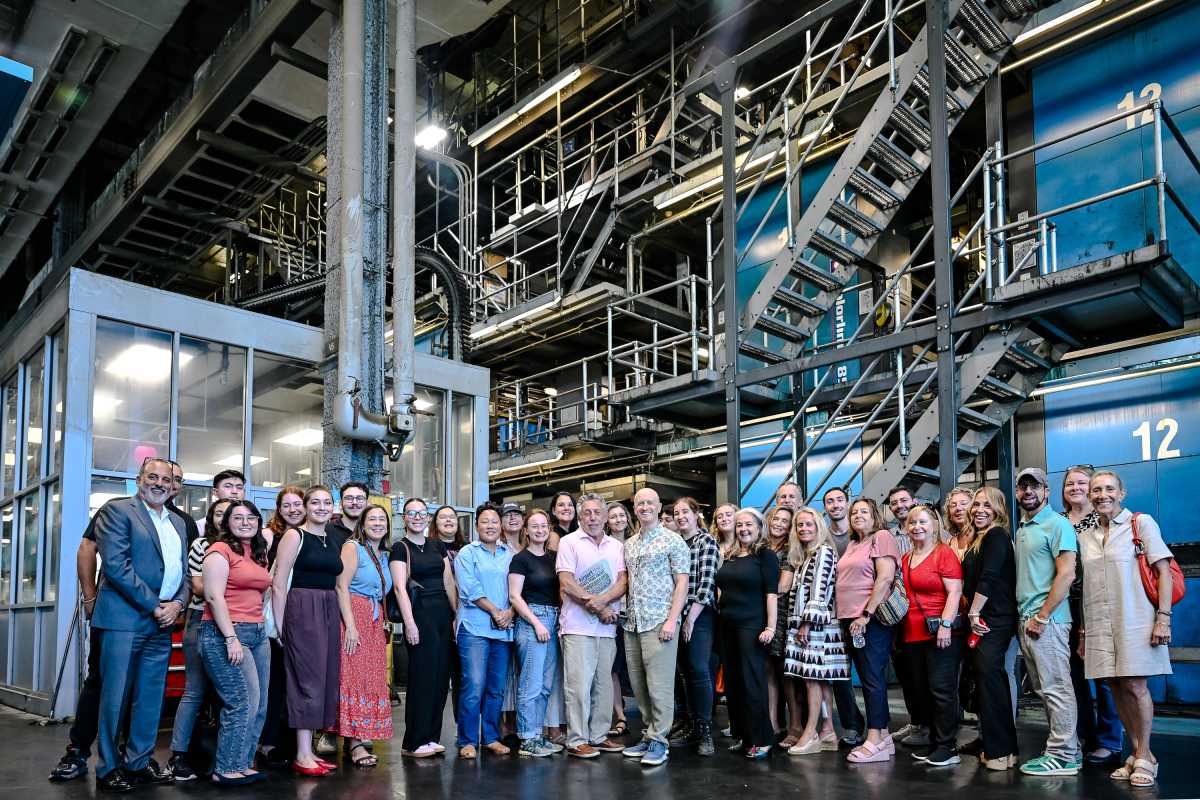
The newspaper you may be currently holding began its journey in a massive production facility off the Van Wyck Expressway in College Point, Queens. The New York Times Company prints hundreds of thousands of copies of Schneps Media daily and weekly newspapers produced every week.
On a hot summer day last year, Schneps Media team of reporters, production artists and sales reps watched as their print products, like The Queens Courier, amNewYork and Caribbean Life, were launched upward by high-speed rollers.
All the hard work put in by reporters, editors, graphics designers, salespeople and publishers is done on computer screens through internet clouds, but becomes a tangible product in a place where high-speed machinery hums, rattles and clacks, and the smell of fresh ink hangs through the air.
It’s also a sign that print is very much not yet a relic of the past, but still a very present and necessary part of not just Schneps Media, but also journalism in America today.
 Schneps Media tours the NYT plant in Queens, New York, on Aug. 14, 2025.Photo by Gabriele Holtermann
“Although Schneps Media is evolving in the digital space, print remains a foundation of the company,” said Joshua Schneps, co-publisher and chief executive officer of Schneps Media.
Ink is in the family blood, so to speak. Schneps Media grew from one newspaper, The Queens Courier, originally printed in founder and president Victoria Schneps’ living room. Before he was co-publisher, a young Joshua Schneps got his first job delivering pages to the printer on deadline. When necessary, he would personally deliver printed papers.
Schneps: More than 100 publications
Today, Schneps Media has grown to include more than 100 publications, like amNewYork, Brooklyn Paper, Brownstoner, Long Island Press and more. While millions of readers rely on their always-on digital news products, including amNewYork.com, QNS.com, BrooklynPaper.com, BXTimes.com, NewYorkFamily.com and others, Schneps Media publishes and distributes more than 600,000 printed copies of its properties each week in New York City. Production takes place at The New York Times Company’s plant in College Point on seven machines the size of houses.
“To me, when you read a newspaper, when you get a full article, you get the whole story,” Mark Heltzman, NYT’s vice president of production, says. “I think, especially the young people, get their stories in quick little blurbs, a post here, a post there. A headline might tell you one thing, and the story might tell you something totally different.”
In addition to Schneps Media products, the plant prints 1.7 million copies of The New York Times every single week, as well as editions of USA Today, Newsday and more. There are 25 other NYT print sites in the United States, but College Point is by far the biggest.
“We’re up there with the Wall Street Journal,” Schneps said, motioning up the pages spinning overhead. “Because the presses you’re gonna see? These are the ones that are capable of printing the amount of newspapers that we produce.”
Each press can print 28 full broadsheets simultaneously. The building receives 27 tractor-trailers full of newsprint each and every week, part of the reason why this facility, at its peak, can print as many as 80,000 newspapers per hour of operation.
“The presses run probably 100, 120 hours a week. Tuesday, Wednesday, Thursday are our highest,” Heltzman said. “We run afternoon shifts Tuesday, Wednesday, Thursday, Friday, Saturday. Only night shifts on Sunday and Monday.”
The NYT printing plant legacy
Like Schneps Media, The New York Times’ printing plant has its own legacy. Mike Connors, who manages the College Point plant, began his journey with the organization 46 years ago, and has been working at the Queens location since the company built this plant in 1997. Connors is a fourth-generation employee with The New York Times; his family has been working for the paper since the 1890s.
“It was built as a newspaper facility, so it’s ideal, it’s optimal, and we still have room for more,” Connors said. “When we first opened it, it was 350,000 square feet.”
Now, the plant is a 515,000 square foot building.
“We opened it in 1997 for live production,” Connors said. “So you can imagine when you go around, all the construction and timing and systems, that everything had to be tied in from the beginning.”
About 10 unions operate out of the printing plant, including the New York Printing Pressmen’s Union, the Newspaper and Mail Deliverers Union and the International Brotherhood of Electrical Workers. Even though most of the presses have been in operation since the 1990s, the safety system of each machine and its myriad components needs upgrades every three years or so.
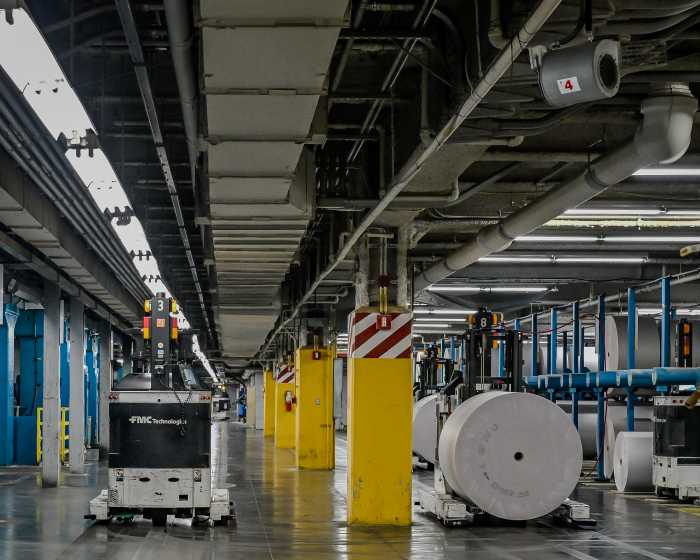
“This is the start of everything. You can’t print a paper without these things,” said Thomas Grosso, the plant’s current director of commercial printing while gesturing to paper rolls which will eventually become issues of amNewYork.
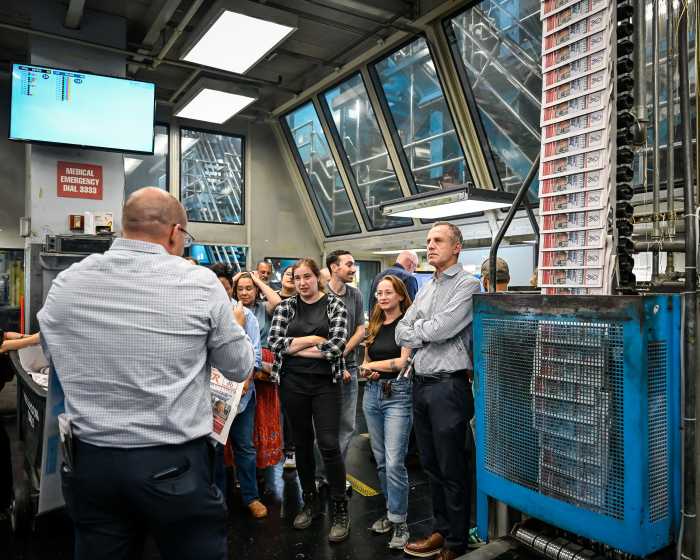 Schneps Media tours the NYT plant in Queens, New York, on Aug. 14, 2025.
Each roll of paper weighs 2,000 pounds and unspools up to 10 miles, and can only be moved from storage to the machines with the help of three robotic cranes.
Finished papers move via conveyor belts to the bundling machines. The bundles are then forklifted into delivery trucks. All print runs should be complete by 3 a.m. on a typical night.
“Let’s put it this way, “ Gross said. “I left my house at 1 p.m., and I got home at six in the morning every day.”
That’s something the entire team can relate to. Whether writing the news, laying out the pages, placing the ads or printing the paper, we are all subject to the same universal truth: The news never sleeps.