
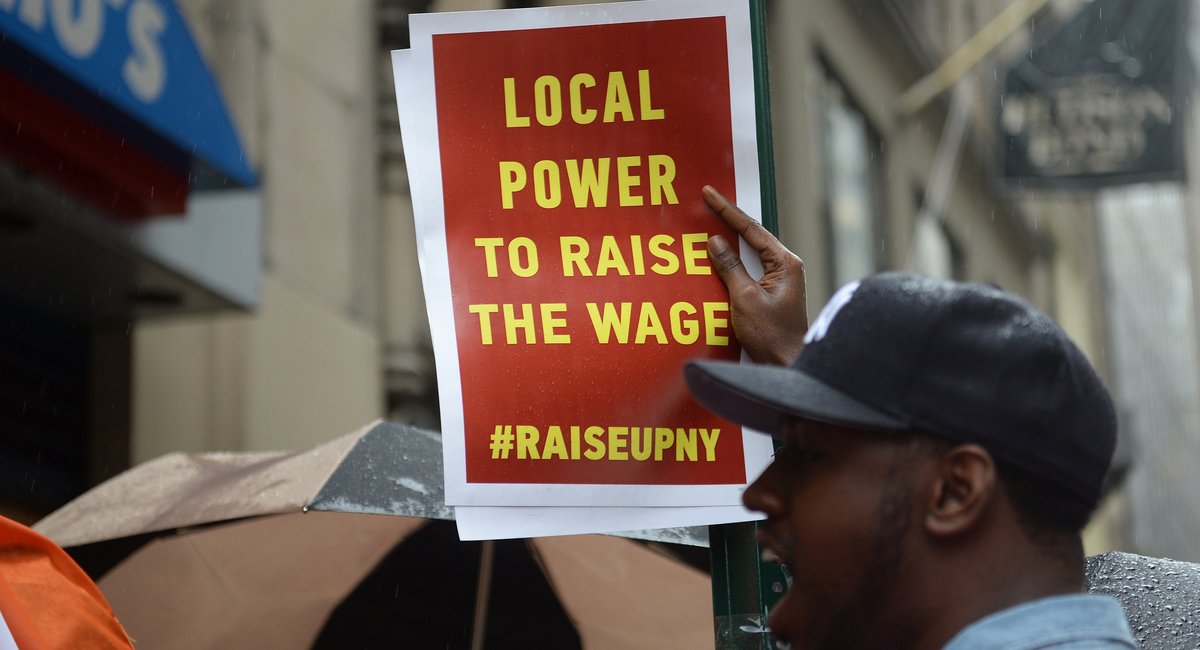
Supporters and opponents of a proposed $30-minimum wage for New York City are preparing for a battle a week after the measure was introduced in the City Council.
“We’re not going to take this lying down,” said Tom Grech, CEO of the Queens Chamber of Commerce, who said foes will take their case directly to the public. “It can’t stand.”
Supporters are girding for a protracted fight as well, calling the bill a must-have in a city where low-wage workers bear the brunt of the affordability crisis and the city’s current $17-an-hour minimum wage lags the rate paid in less costly cities.
More than a million residents of the city currently earn minimum wage, according to a 2023 report from the city comptroller’s office.
City Councilmember Sandy Nurse, who introduced the minimum-wage legislation, said those workers are “barely scraping by, pushed into overcrowded housing, forced into the shelter system” or driven from the city altogether.
“The workers we rely on, the deli guy, the delivery worker, the cashier, simply can’t afford to live with dignity here and are reaching a breaking point,” she said. “If we fail to act now, the businesses that depend on their labor will suffer as well.”
Grech said the proposed $30 minimum, which would make the city’s the nation’s highest minimum wage, would amount to more than $62,000 in annual wages, and with benefits would cost New York City employers more than $75,000.
He called that “unacceptable for small businesses, and medium businesses, by the way.”
The path ahead is uncertain.
Council Speaker Julie Menin has not yet weighed in. And Mayor Zohran Mamdani, who campaigned on the promise of a $30 minimum wage, has yet to take a public stance on the Council proposal.
It would require businesses with more than 500 workers to adopt a $20 hourly wage by 2027 and a $30 rate by 2030, while smaller businesses would have until 2032 to phase in the $30 wage. The federal minimum wage of $7.25 has remained unchanged since 2009.
Eric Sunshine, a spokesperson for Menin, said in a statement, “Speaker Menin looks forward to reviewing this legislation introduced last week.”
And it isn’t entirely clear whether the city even has the authority to raise the minimum wage on its own.
Nurse said the city could unilaterally enact a raise.
“There is no New York state law preventing cities from setting their own minimum wage,” she said in a statement. “And with New York City facing a higher poverty rate than the state as a whole, it’s time to chart a different path.”
But some legal experts said the question is more complicated.
Stephen Louis, a distinguished fellow and counsel at New York Law School’s Center for New York City and State Law, pointed to a 1964 case that emerged when then-Mayor Robert Wagner raised the city’s minimum wage from $1.25 to $1.50 as part of what Wagner called the “war to eradicate poverty.”
The issue went before the state’s court of appeals, which ruled localities were preempted from setting minimum wages.
“That still remains the law, so I think the City would need authorizing state legislation to proceed,” said Louis, who also serves as a distinguished adjunct professor at the law school.
Avrohom Gefen, a partner who oversees the employment law practice at Vishnick McGovern Milizio law firm in Manhattan, concurred with Louis’s view.
Gefen said state officials “haven’t yet ever given the power to municipalities to decide their own minimum wage laws.” Former Gov. Andrew Cuomo approved the last increase in the city’s minimum wage in 2016, following action by the state Legislature.
Gov. Kathy Hochul’s office did not respond to a request for comment.
Even some supporters contend the city can’t enact a minimum wage raise on its own.
“As far as I understand, the city would have to get a home rule message from the state to be able to set its own minimum wage,” said Helen Schaub, the political director of 1199SEIU, which represents health care workers.
In any case, supporters are looking to make their case.
Michelle Murray, CEO of Living Wage for Us, a nonprofit group based in Sleepy Hollow, Westchester County, said the $30 hourly proposal was not excessive and was below the rate her group calculated as a “living wage,” $34.19.
That figure relies on a number of factors that go into the ability of a “typical family” of two adults and two children to live within an hour of the city.
That one-hour radius, she said, pegs the $34 living wage to the cost of living not within the five boroughs but in Passaic County, New Jersey. For someone to both work and live within New York City, she said the living wage would be $40 an hour.
Some employers have proactively embraced higher wages for what they say are business reasons.
Aaron Seyedian, owner of Well-Paid Maids, a cleaning company that operates across the country, said its employees in New York were paid $27 an hour and received 24 paid days off each year.
Seyedian said his pay structure ensured turnover at his firm is 25% to 30% annually, compared to 80% at “most cleaning companies.” He said the lower turnover provides savings that would otherwise go toward advertising for new workers as well as screening and interviewing them.
“It costs us around $7,000 every time we have to do that,” Seyedian said. “ Turnover is costly.”
But opponents of the legislation said the timing of the measure was poor.
Grech of the Queens Chamber of Commerce pointed to the ongoing war in the Middle East and sharp rise in oil prices, which posed challenges to many employers.
Other opponents said a minimum-wage hike would compound problems posed by technology, including artificial intelligence.
Santiago Vidal Calvo, a policy analyst at the Manhattan Institute, a conservative think tank based in New York City, said the wage increase would be a “highly interventionist policy” at a time when some companies are already automating working-class jobs and would result in workers being shed.
“Likely they’re going to get fired or removed from the job,” he said.