
This article originally appeared at Your Local Epidemiologist New York. Sign up for the YLE NY newsletter here. Public health, explained: Sign up to receive Healthbeat’s free New York City newsletter here.

There’s a lot going on this week in New York health news, including a city campaign trying to encourage conversations about vaccines, a win for vaccine access at the federal level, and a new program for PFAS testing in private wells. Let’s jump in.
NYC launched a new vaccine campaign. Here’s what it gets right, and where it misses.
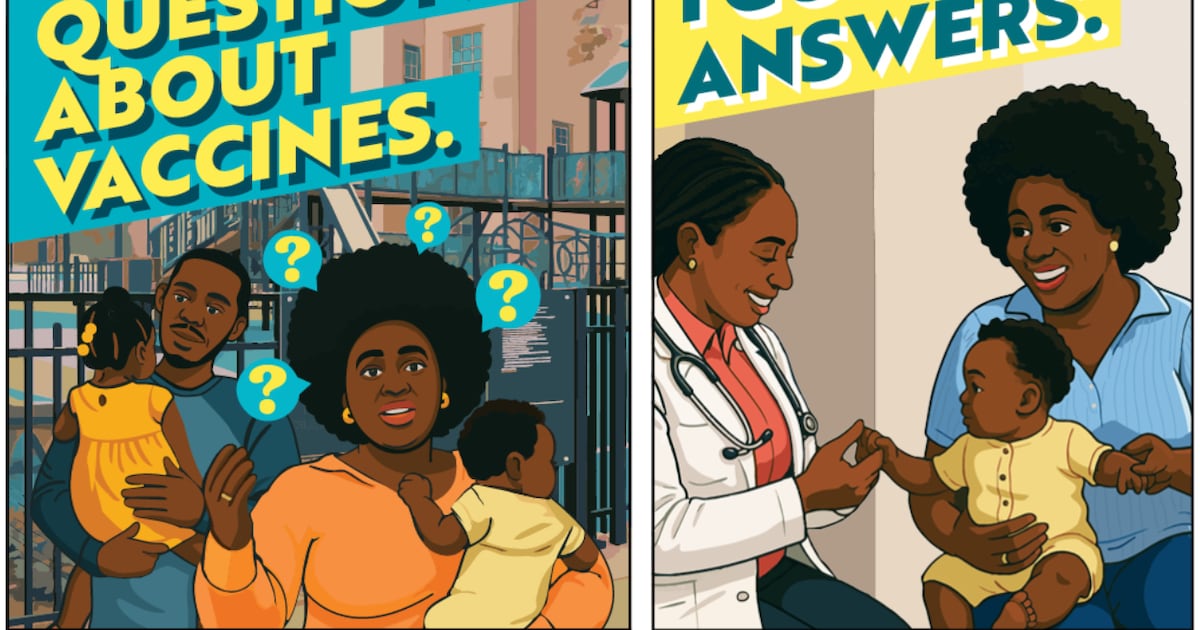
The NYC Health Department has launched a new $1 million, four-week vaccine campaign: “Ask Questions, Get Answers, Vaccinate.”
When a friend first shared it with me, I was genuinely stoked. A campaign trying to create a feedback loop between institutions and local communities?! Yes, please! That’s exactly what we need right now —more health departments meeting people where they are, addressing real confusion, and empowering New Yorkers to make evidence-based decisions. Something that closes the distance between officials and the communities they serve.
But after looking into it further, and seeing the price tag, I was honestly pretty bummed.
The campaign will run across TV, radio, print, LinkNYC kiosks, and on transportation hubs, with a focus on neighborhoods with lower vaccination rates. Medical practitioners participating in the Vaccines for Children program will also receive posters and handouts to share with families. The city also launched a webpage that answers common vaccine questions and links to additional resources (which are pretty good FAQs).
The intent was there. And, it’s really important to acknowledge that people have questions about vaccines. That is a good thing.
But if you dig deeper, the campaign falls short in a couple of important areas:
The cost. A four-week ad campaign is not the same as long-term trust-building, and it’s expensive ($1M!), especially for its length, at a time when public health departments are scraping for pennies.Telling people to “talk to your doctor” assumes they have a doctor they trust and can access. One in three Americans don’t have a primary care physician. It also assumes that clinicians themselves feel equipped and empowered to respond to these questions in a short 12-minute visit. What we’re hearing at YLE is that many clinicians need more support in this area.This also doesn’t move us toward the affordability that the new health commissioner is prioritizing. Telling someone to see a doctor is, for many people, telling them to take time off work, find child care, and potentially take on debt.There doesn’t appear to be much of a feedback loop. Good communication is not just sharing information; it also means listening and asking for feedback.It misses some of the places where many families are actually getting health information now, especially social media.
If I had $1 million to spend, it wouldn’t be on a short-term advertising campaign. What is needed is something far more structural: direct public access to the health department and supporting trusted community messengers with the tools, staff, knowledge, and partnerships to reach families where they’re at, sustainably. I would also like to see greater investment in open communication channels for families to share their questions, concerns, and experiences back to the health department, instead of information flowing only top-down.
This could look like:
Hosting listening session in neighborhoods with lower vaccination rates.Partnerships with community-based organizations, schools, and faith leaders.Regular surveys and summaries of questions and concerns from New Yorkers.Clinician training and tools for talking about hot-button topics.Online and social media monitoring to know what is circulating in real time.
Being trustworthy happens over time, through a set of actions taken over and over and over again. Some of those actions include repeated conversations in communities, schools, clinics, and neighborhood spaces, through relationships.
What this means for you: If you have questions about vaccines, drop them in the comments here, and we will get back to you! And maybe we can send them to the health department as well.
New York is offering free PFAS testing and money to fix contaminated wells
If you own or rent a home with a private well in Westchester, Suffolk, Dutchess, Putnam, Orange, or Ulster County, this is for you.
New York state launched a new program on March 9 that offers free private well testing for PFAS, often called “forever chemicals.” If contamination is found above the state threshold, the state will also help pay to address it.
PFAS (per- and polyfluoroalkyl substances) are a group of manmade chemicals that persist in the environment and in the body. They’ve been used for decades in products like nonstick cookware, firefighting foam, and food packaging. They’re also linked to some health issues, including kidney and testicular cancer, thyroid disease, immune suppression, and pregnancy complications.
This matters especially for people with private wells because private well water does not get the same routine oversight as public drinking water systems. Private household wells are not regulated under the federal Safe Drinking Water Act, and government agencies usually do not monitor or treat private well water—that’s the responsibility of the owner. Sources of PFAS in well water can come from runoff from manufacturing, landfills, wastewater, contaminated soils, or fertilizers.
Here are the details for the new program:
Testing is free for eligible households in six counties.If PFOA or PFOS (specific types of PFAS) levels are at or above 10 parts per trillion, New York’s drinking water standard, residents may qualify for financial help.Eligible households can receive up to $5,000 for a PFAS treatment system, or up to $10,000 to connect to public water.Renters are eligible too, not just homeowners.Funding is first-come, first-served, with $1.5 million available per county.
Dutchess and Putnam County applications are open now. Orange, Suffolk, Ulster, and Westchester are expected to open in the coming months.
What this means for you: If you live in one of these counties and use a private well, this is a concrete opportunity to check for contamination and get financial help if a problem is found. Apply or learn more here.
A judge blocked RFK Jr.’s ACIP overhaul —what it means for New York
A judge blocked Health and Human Services Secretary Robert F. Kennedy Jr.’s overhaul of the Advisory Committee for Immunization Practices and the related changes to the childhood vaccine schedule. While this is a win for Americans, it likely doesn’t change much day to day for New Yorkers. That’s because New York had already moved to preserve prior vaccine recommendations, protect access, and require insurance coverage, creating a buffer against much of the federal disruption. (I’ve covered this previously.)
In practical terms, the ruling mostly restores nationally what New York had already protected locally.
The bigger issue here is continued confusion: Back-and-forth changes to vaccine guidance are hard for families, clinicians, and schools to follow, even when access is protected. For a deeper dive into the ruling and what it means nationally, read Katelyn Jetelina’s YLE National piece from Tuesday.
Bottom line
The bottom line this week is that the city’s new campaign to improve communications around vaccines has a lot of room for improvement, the state PFAS well-testing program is a clear example of environmental health in action, and the court decision on ACIP was a win for federal vaccine policy but doesn’t practically affect New Yorkers. You’re all caught up — see you next week!
Love,
Your NY Epi
Dr. Marisa Donnelly, PhD, is an epidemiologist, science communicator, and public health advocate. She specializes in infectious diseases, outbreak response, and emerging health threats. She has led multiple outbreak investigations at the California Department of Public Health and served as an Epidemic Intelligence Service Officer at the Centers for Disease Control and Prevention. Donnelly is also an epidemiologist at Biobot Analytics, where she works at the forefront of wastewater-based disease surveillance.