
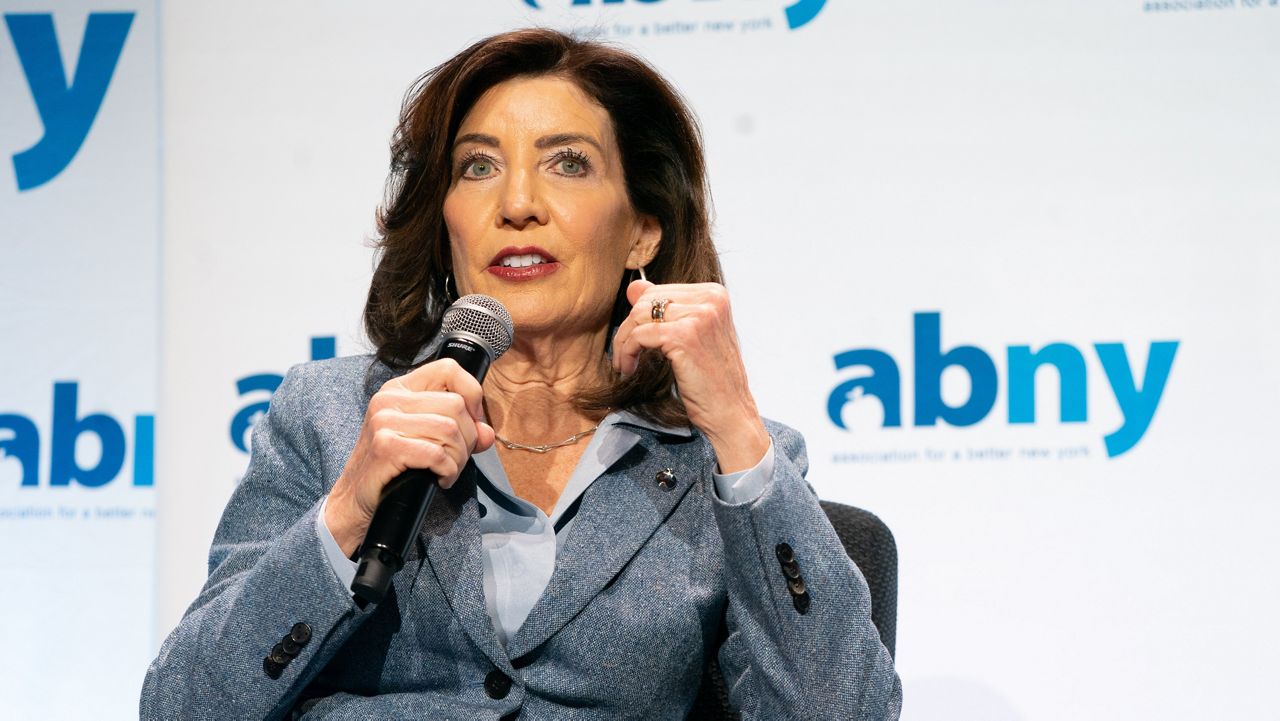
Responding to concerns over job loss due to rapidly developing artificial intelligence, Gov. Kathy Hochul made a pitch to civic leaders on Thursday to help state government minimize the impact of artificial intelligence on the state’s economy.
What You Need To Know
Responding to concerns over job loss due to rapidly developing artificial intelligence, Gov. Kathy Hochul made a pitch to civic leaders on Thursday to help state government minimize the impact of artificial intelligence on the state’s economy
As of December, the state’s unemployment rate stood at 4.6%, according to state labor department statistics. However, Hochul argues it’s not just tech workers who could be hit hard, but every industry
The panel, whose members have yet to be named, would be tasked with issuing a report by the year’s end regarding suggestions for new state law or regulation concerning AI’s impact on workers and businesses
“Almost no line of work is immune,” Hochul said to a crowd of business and civic leaders who are part of the Association for a Better New York.
“One recently laid-off graphic designer told me she feels even if she finds another job, she’s catching the last train because the opportunities are rapidly evaporating. And she has a decade of experience, and it’s even harder for someone just starting out,” she added, describing a recent conversation she had with a tech worker.
As of December, the state’s unemployment rate stood at 4.6%, according to state labor department statistics. However, Hochul argues it’s not just tech workers who could be hit hard, but every industry.
That’s why she wants to commission a new state study.
“I am launching the ‘FutureWorks Commission,’ convening leaders in business, technology, labor, academia and government to help us understand the risks and opportunities ahead,” Hochul said.
The panel, whose members have yet to be named, would be tasked with issuing a report by the year’s end regarding suggestions for new state law or regulation concerning AI’s impact on workers and businesses.
Hochul added she wants to possibly include those recommendations in next year’s state budget.
“Everything that is part of state government has been there for decades, and have AI help us figure out: does it make sense today, why is this law still on the books when it’s obsolete, is this policy redundant, is this too burdensome?” she explained.
“Do I use it? I use it more as a search engine — like a Google. I wanted to check on the price of gas today in New York state,” she admitted.
It’s not her first foray into tackling AI’s rapid development. Two years ago, the state approved what’s known as “Empire AI” — a $500 million public-private funded effort for university research.
“This has been troubling me for a while,” the governor said. “I also want to look at the laws and regulations that are barriers to our prosperity and success and pro-growth.”
Hochul also said she’ll train about 100,000 state workers in “responsible AI use,” based on an expanded pilot program of 1,000 state employees established last year.
She is also pushing future college students to partake in training programs offered by SUNY.