
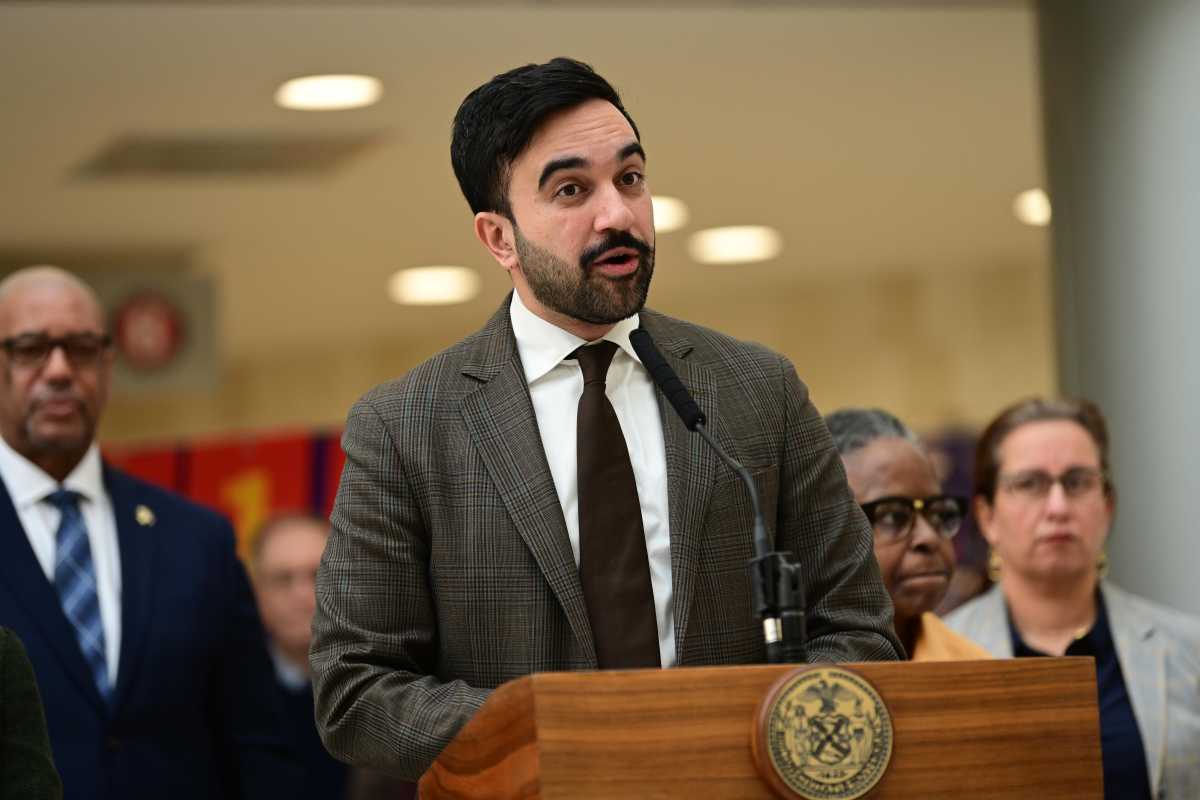
Mayor Zohran Mamdani at a press conference on Jan. 31, 2025.
Photo by Lloyd Mitchell
As NASA prepares to send astronauts back to the moon, coordinating thousands of engineers, real-time data streams, and predictions precise enough to navigate the vastness of space, New York City is still relying on a crisis response system built in a previous era, poorly used to inform strategy, and fails to deliver real safety.
New York routes acute crises to the police in part because it has never built the infrastructure required to resolve them. Instead of constructing a system designed to stabilize people before a crisis escalates, we’ve transferred responsibility to law enforcement to absorb what they can only address through arrest, removal, or force.
Last month, Jabez Chakraborty’s family called 911 for an ambulance after exhausting every option for community-based psychiatric care. They did what the system tells families to do when every other door is closed. The result was gun violence and criminal charges. We wait for crises to become a crime, then punish people for collapsing under it.
Just last week a writ filed in Brooklyn Supreme Court exposed how overpolicing manufactures crisis at scale. As broken windows enforcement intensified, roughly three hundred people were cycling through central bookings, not because of a surge in crime, but because of policy decisions. Arraignment delays stretched up to seventy-two hours, a constitutional violation that destabilizes lives, drains public resources, and undermines public safety.
A Department of Community Safety is how we change trajectory. Mayor Zohran Mamdani’s plan calls for expanding and retooling a number of existing programs to address mental health crises, gun violence, gender based and domestic violence, hate crimes, and outreach to those unhoused. What all these interventions share is a need for acute crisis stabilization and urgent connections to long term support.
It needs to start with transforming 911 into a transparent shared data tool across agencies, allowing the city to identify needs and design deployment and operation plans for the entirety of the public health and safety ecosystem. Only then can we integrate a 24-hour civilian crisis response into 911 and 311that would allow calls involving behavioral health and other social issues to be routed to trained responders equipped to de-escalate and stabilize. Hundreds of cities across the country are already doing this. We know tens of thousands of calls now handled by police could be diverted, with available data suggesting merely 7% of calls are for crimes in progress. Our efforts need to be focused on the predictable fallout of poverty, unmet behavioral health needs, and housing instability.
Turning campaign rhetoric into operational reality is now Mamdani’s moonshot. Building a Department of Community Safety will require courage, governance, data transparency, disciplined coordination and sustained investment. It will require funding, training, elevating and integrating the community responders, mental health teams, violence interrupters, peer specialists who already stabilize neighborhoods but operate without real-time information or access to social services and care.
Safety is a shared responsibility across housing, health care, schools, community organizations and, when necessary, law enforcement. But continuing to structure the system so that crisis defaults to enforcement has not made New Yorkers safer. It has revealed the cost of confusing response with capacity, and supervision with resolution.
Building a Department of Community Safety is New York City’s launch: ambitious, complex and entirely within reach for a city of this scale and ingenuity. We already have the talent and data. What we need is the political will to align them.
Dana Rachlin is Co-Founder of We Build the Block. Alex S. Vitale is Professor of Sociology at Brooklyn College and the CUNY Graduate Center. Both served on the Community Safety Subcommittee of Mayor Mamdani’s Transition Team.