
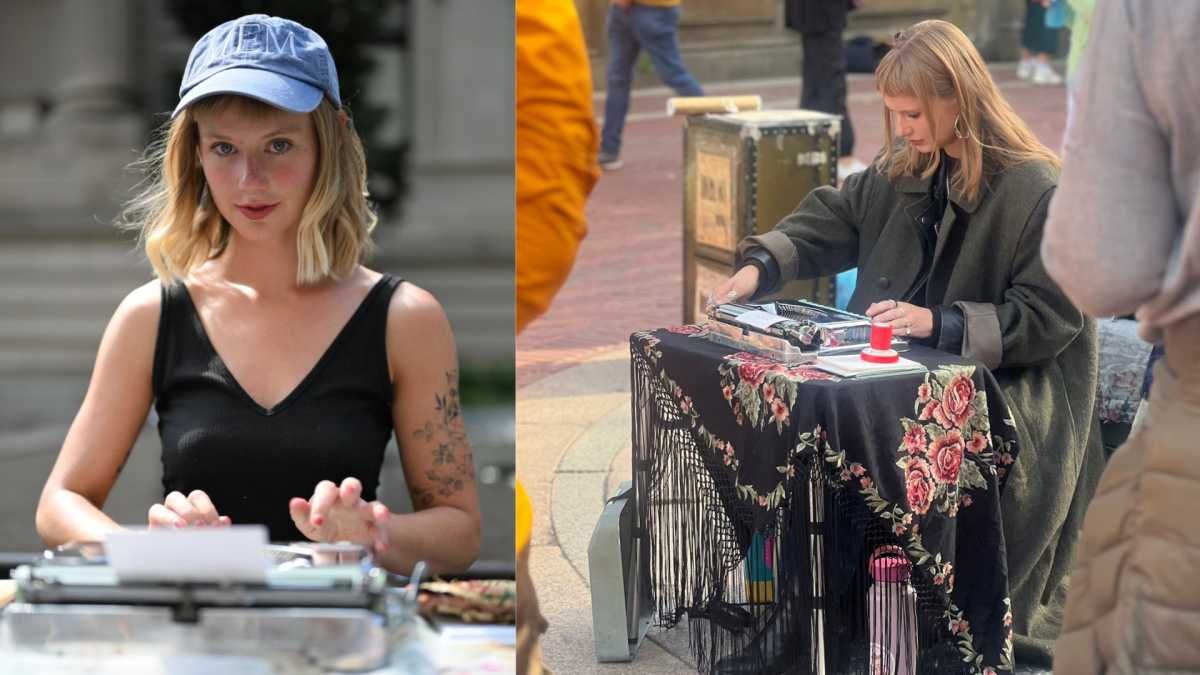
When Zoe Branch left her journalism career in Washington State and moved to New York at the height of the COVID-19 pandemic, she never would have imagined that her grandfather’s typewriter would turn her into a recognizable fixture on the city’s cultural map.
“People will tell me that they came to Central Park to see me, which is a huge honor,” Branch said, still awed by her own prominence. “In New York City, the art capital of the world, someone is intentionally seeking me out?”
Indeed, even in the midst of the coldest winter the city has seen in decades, Branch’s unassuming table by the Bethesda Fountain was often swarmed with customers lining up for a personalized poem. The angel at its center, as Branch noted, “the first piece of public art commissioned by the City of New York from a woman,” serves her as a reminder that the creative process is inherently communal; something to be experienced together.
Live typewriter poetry is a form of materializing private thoughts and feelings for those who want to see them preserved in writing. With no constraints on subject matter, any idea can find its way onto the page.
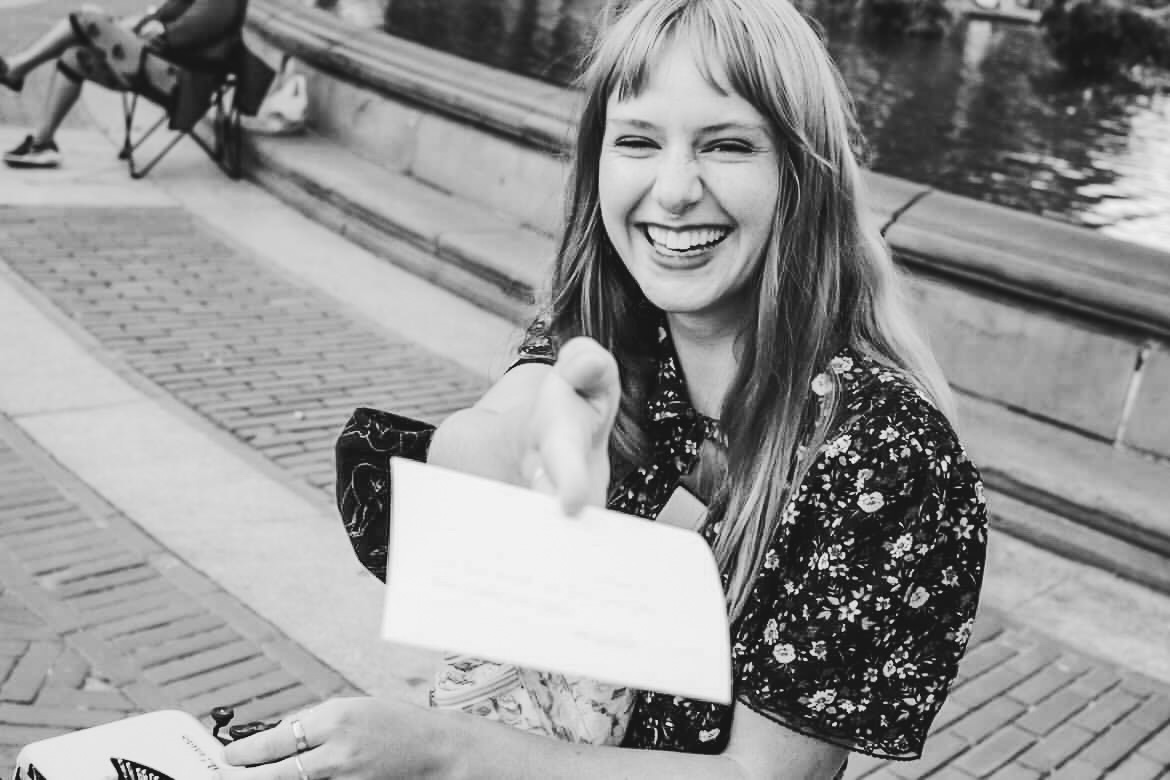 Zoe Branch
“I even write for people’s pets. It’s really anything under the sun,” Branch said. Given a prompt, the poet has mere minutes to capture them in verse.
“It’s all done on the spot, totally impromptu, so it’s a lot about trusting your first gut instinct as an artist,” she explained.
Once the A6 cardstock slides out of the machine, she parts with her words forever, letting them live on with those who inspired them in the first place. “It’s special that it’s just between me and that person,” she reflected.
At a suggested price of $20, the poems Branch produces in Central Park are one of her main sources of income, occasionally complemented by “gigs” at private events or brand activations. Yet she also removes any financial barriers to the experience, letting participants know that “they can pay whatever is accessible to them.”
“Often people will pay $30 or more to basically sponsor the person behind them,” she added.
This pay-it-forward attitude is only one of the many ways the project forges connections. An intimate moment that can be shared, it invites strangers and kins alike to bond.
“Soul sisters” Rachel and Rebecca, as they called themselves, came looking for a memento to commemorate their trip to New York. “We need to hold it to feel it, to connect to it,” the latter described the perfect keepsake.
Others, to the contrary, come carrying grief. Branch recounted one of the day’s more poignant encounters:
“That last girl told me about her boyfriend who had passed away a couple of years ago. She said, ‘I’m healing.’ He always wanted to come to New York and never made it so I’m now here in his honor.’” Just last month, however, terminally ill Sungyull requested a piece about the last Valentine’s Day he would ever get to celebrate.
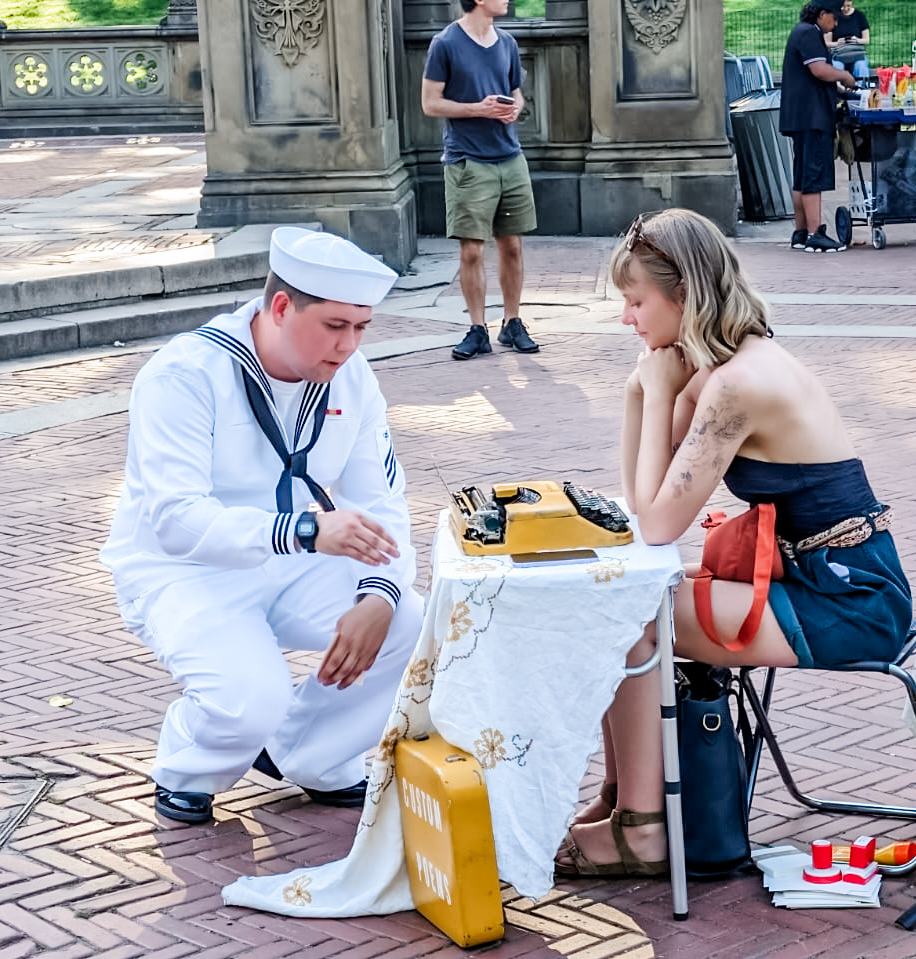 Zoe Branch interacts with a sailor.
It’s through raw stories like these that people, time and again, surprise Branch with their vulnerability and openness.
“I think a lot of people feel very unheard,” she went on to hypothesize about what draws her customers to confide things in these unprecedented circumstances. In an increasingly digitized world, where curated expressions of the self are competing for attention, moments of genuine connection have become a rare commodity.
“There’s so many social conventions around oversharing” that come undone when confronted with a stranger whose sole purpose is to listen, she noted.
At the same time, Branch recognizes that social media has been instrumental to her success. Having once found herself short on money around Christmas, she decided to write her loved ones custom poems as gifts.
“I posted some of them on my Instagram stories, and I had people responding to me, asking if I could write them one about this or that to the point where I was like, ‘I think this is a business. I think there’s a demand for this,’” she said of her humble beginnings.
Since then, Branch has amassed over 90,000 followers on the platform, sharing—with the customers’ permission—videos of their unique prompts and her writing process. In turn, they repost them or create their own, feeding a cycle of discovery.
Rebecca, who arrived at Branch’s stand to honor a period of personal growth, said, “I saw some clips online before and understood what she was doing.”
Many others in line reported spotting Branch in much the same way: first encountering her work on their feeds, a product of algorithmic serendipity. Customer Ollie deemed this resurgence of an analog form in a modern context as “something old that feels new.”
In the midst of what she described as “a transition where [she’s] juggling more projects and writing more than [she] usually has been,” Branch also leverages social media to maintain and encourage public-facing accountability, posting daily word counts as she completes her debut novel Daughter Daughter.
“People are responding and being like ‘this is making me want to write my novel,’ or ‘this is helping me stay on track,’ or ‘this is making me realize that doing something like this actually could be possible if I do it for an hour a day,’” she said.
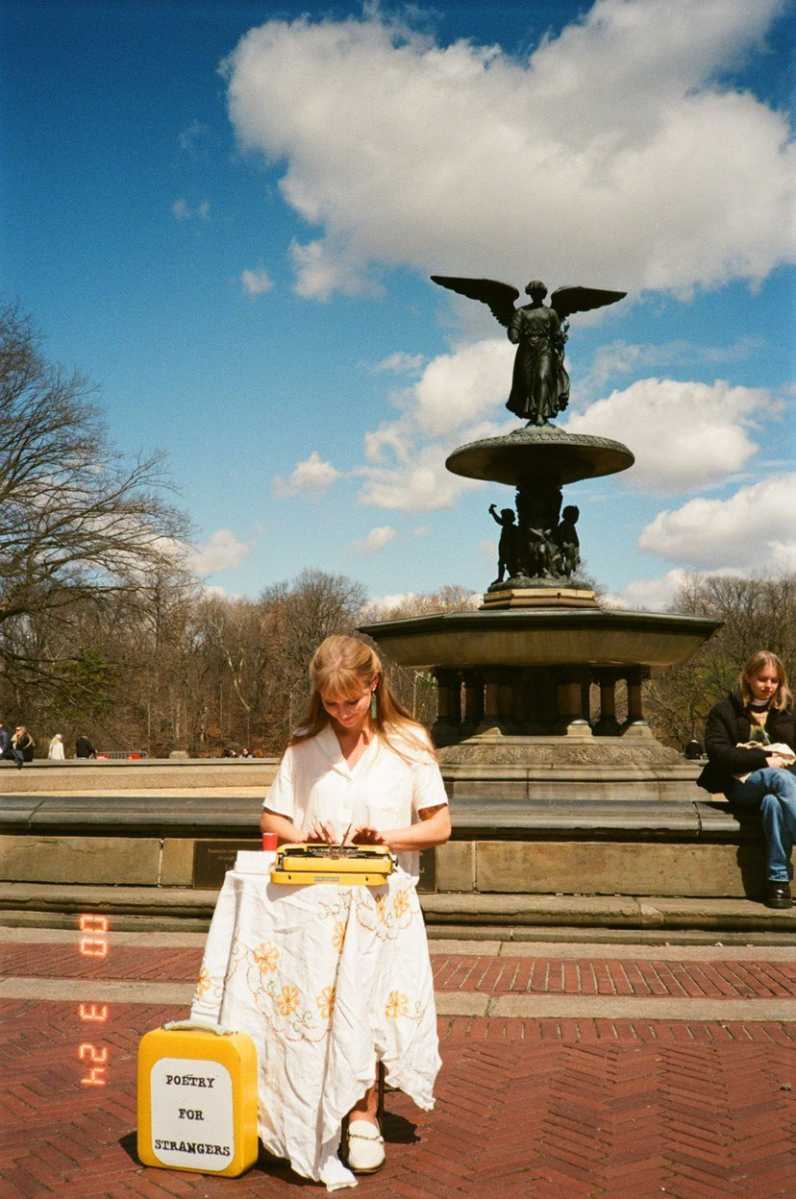 Zoe BranchPhoto courtesy of Zoe Branch
Given that “the internet can be such a hopeless place,” Branch’s mission, as she shows up online, is to remind users of their shared humanity in a time of deepening division. Despite the singularity of each story and poem, she has come to learn “how much people are really the same and how much we have in common regardless of political party, religion, race, or age.”
Busking in Central Park has upended not only Branch’s understanding of connection but also of poetry’s role in sustaining it.
“There’s this idea of a lot of the arts, but especially of poetry, that it’s dead. Poetry is dead, print journalism is dead, art is dead… When I first started doing this, I kind of thought that too. I doubted anyone was going to come up to me and want a poem. Now, it’s the most amazing thing to see how genuinely alive something like poetry is and how much people want it, to the extent they will wait in line for it and will pay for it,” she said.
Branch, in her own words, has gotten a front-row seat to witnessing “the way that words can be really healing and communal”—a seat that, on World Poetry Day and beyond, remains open to anyone willing to pause and feel.
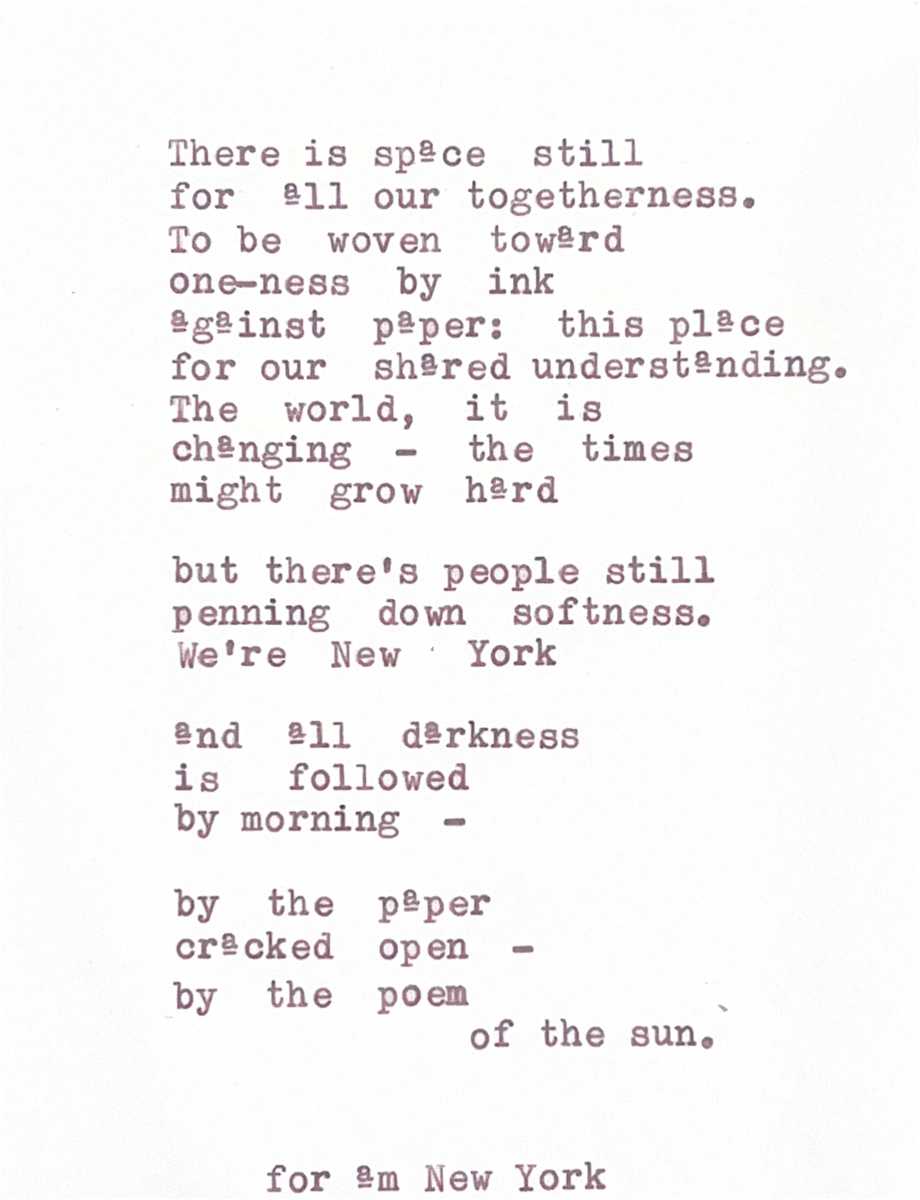 Poem by Zoe Branch