
Early in her fertility journey, hoping to eliminate a problematic genetic match, Jen Leffel and her husband went to get IVF testing. After getting the necessary bloodwork, Leffel discovered that in addition to the match, she had a low ovarian reserve. What was initially expected to be a several-week treatment turned into one lasting several months.
Four years ago, that experience morphed into a years-long journey, when Leffel, along with Alyssa Kolatch and Alex Peyser, co-founded the Stardust Fertility Foundation, a nonprofit providing financial support for Jews in the tristate area hoping to start families.
“Fast forward, after I was pregnant with my third son, all I could keep thinking was, like, who’s helping all these Jewish people have babies that need to do IVF?” Leffel told eJewishPhilanthropy ahead of the gala. “Whether they’re infertile or they want to have the healthiest Jewish baby possible, and they want to eliminate a certain match, like myself, or are cancer survivors or someone with a low sperm count, who is helping them afford this treatment that is just exorbitantly expensive?”
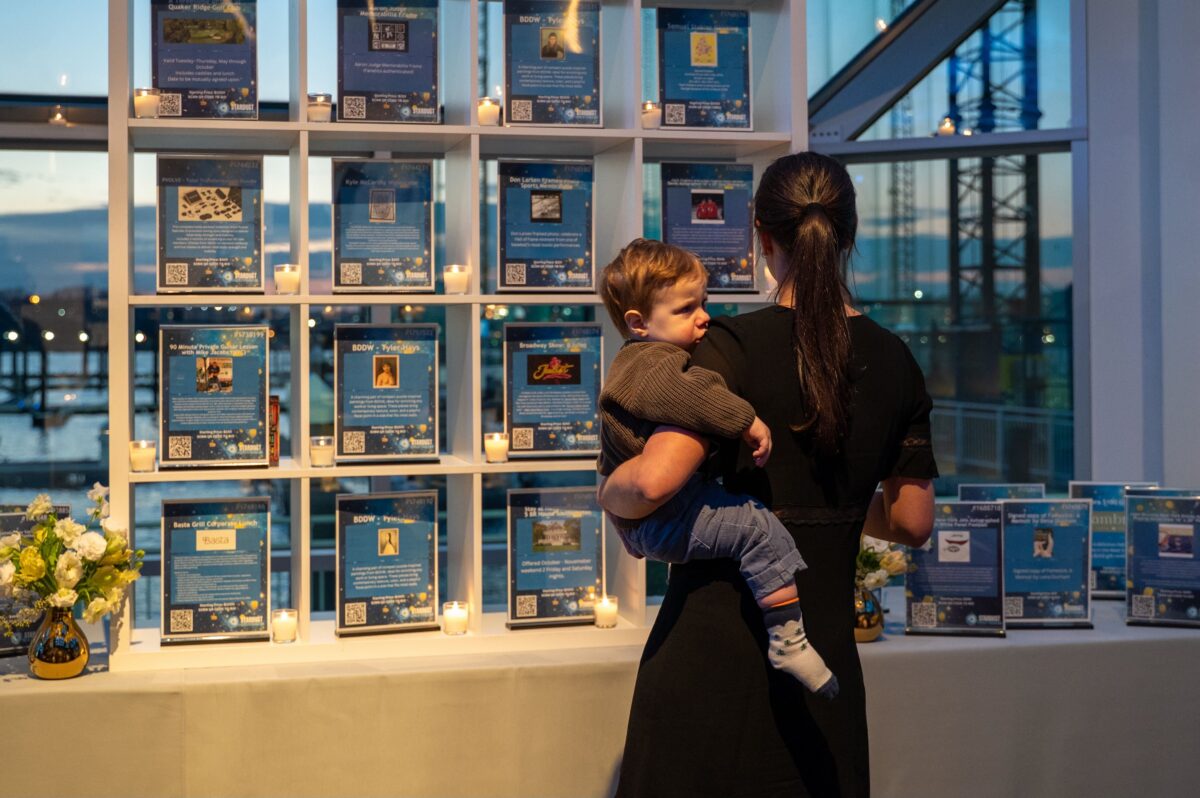
On Thursday night, four years — and 31 babies — later, Stardust hosted its fourth annual gala, drawing 300 well-turned-out people to Chelsea Piers for drinks and dinner. Unlike many Manhattan philanthropy galas, many of the attendees of this candlelit soirée were young children, including some born with the help of the foundation’s grants (the candles were kept to high surfaces).
Honored at the event with the foundation’s “Stardust Trailblazer Award” was Sandye Rosenbloom Rudnitsky, the first person in the United States to use a gestational surrogate, joined later on the stage by her daughter, Jill. Rudnitsky was also involved in the court case that led to “mother” being legally defined as the party that provides the genetic material, not necessarily the one that gives birth.
“Since Jill’s birth, thousands of families have realized their dream of having children by gestational surrogates. After making medical history, we made legal history when we petitioned the court challenging the definition of motherhood,” Rudnitsky said. “I am listed as ‘mother’ in Jill’s birth certificate. When I look at Jill, I remember the heartbreak, perseverance and struggle it took to have her, but I also see hope and joy. I remember. I see what can be accomplished with love. Science, faith and one beautiful egg.”
Since its inception, the foundation — whose name comes from blessings by God to make the Jewish people as numerous as the stars in the sky and the dust of the earth — has dispensed $2 million in grants to some 100 recipients. Those recipients range, said Leffel, from young straight couples needing IVF or IUI treatments, to LGBTQ couples seeking a surrogate, to women who haven’t “yet met Mr. Right” but want to raise a Jewish baby on their own, said Leffel.
“But with fertility in general, it doesn’t translate into a baby, right? Because, you know, there’s a 1 in 4 chance of miscarriage,” Leffel told eJP ahead of the event.
When researching the field of Jewish fertility philanthropy four years ago, said Leffel, she and her co-founders found several organizations within the niche, but few focused specifically in their area — New York, New Jersey and Connecticut, and providing financial support for surrogacy in addition to IVF treatments.
“There was nothing in our own backyard that existed that could help any type of Jew, whether you’re Reform, Conservative, Orthodox, gay, straight, single, married, bring a Jewish baby into the world,” she said.