
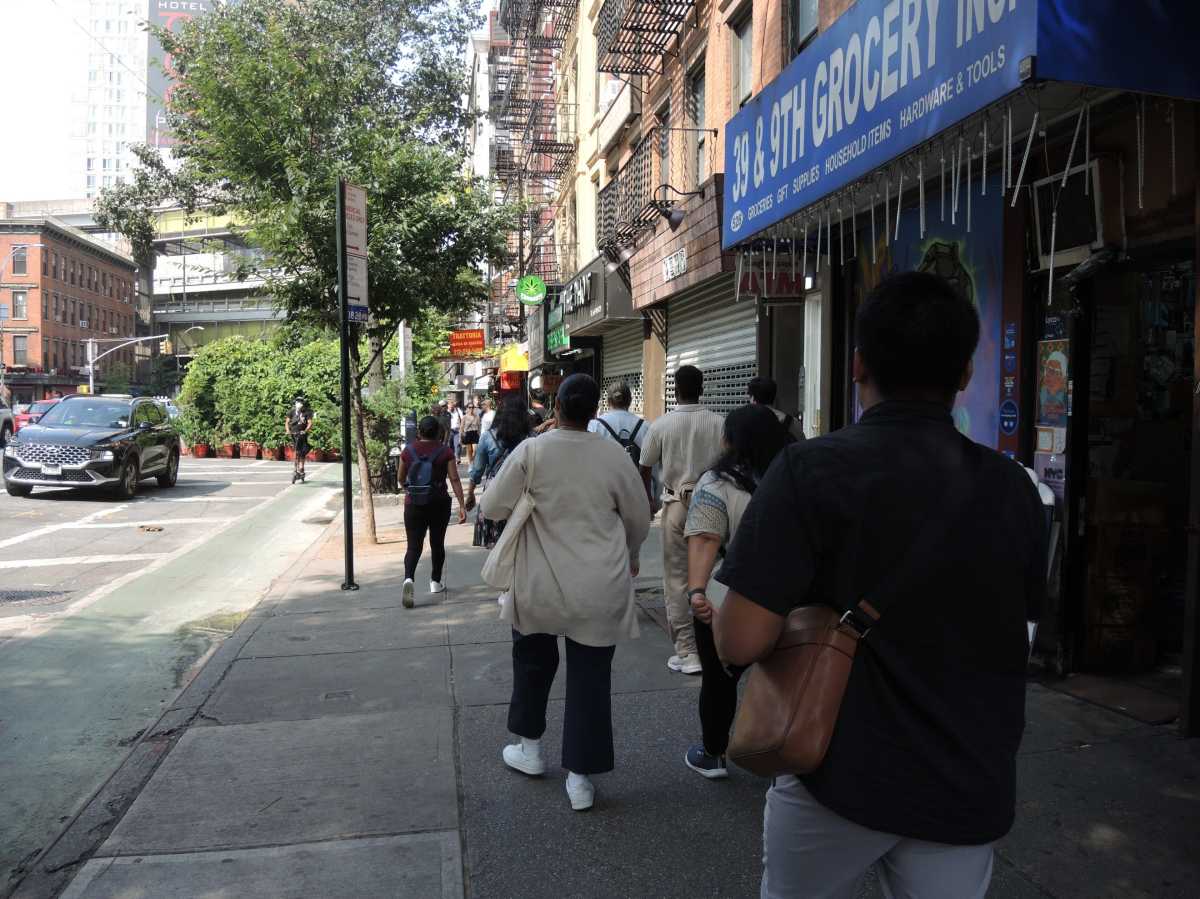
A crowded sidewalk on Ninth Avenue.
Photo courtesy of DOT
A 16-block stretch of Manhattan’s Ninth Avenue will be getting a facelift ahead of this summer’s FIFA World Cup, to accommodate large crowds expected to flood the city during the event, the city Department of Transportation (DOT) announced.
The DOT will redesign Ninth Avenue between 34th and 50th Streets, where it expects an influx of revelers to increase traffic as they enter Manhattan through the Lincoln Tunnel and the Port Authority Bus Terminal. The redesign promises to add more pedestrian space, widen the street’s protected bike lane, and extend its painted bus lane to 50th Street.
“Ninth Avenue will be a hub of activity during this summer’s World Cup, with visitors from around the world and increased traffic at the Lincoln Tunnel and the Port Authority Bus Terminal,” DOT Commissioner Mike Flynn said in a March 19 statement.
“Mayor Mamdani has told us to think big, so in order to be a welcoming and safer place for tourists and New Yorkers alike, we will immediately work to have Ninth Avenue better accommodate the vast majority of the street’s users who are on two feet, two wheels, or who are riding the bus,” he added.
The DOT has identified Ninth Avenue, the section of which it is redesigning runs through Hell’s Kitchen and Midtown, as a priority corridor under the city’s Vision Zero initiative to reduce traffic injuries and crashes. Over the past five years, one person has been killed, and 36 others have been seriously injured along the stretch, according to the agency.
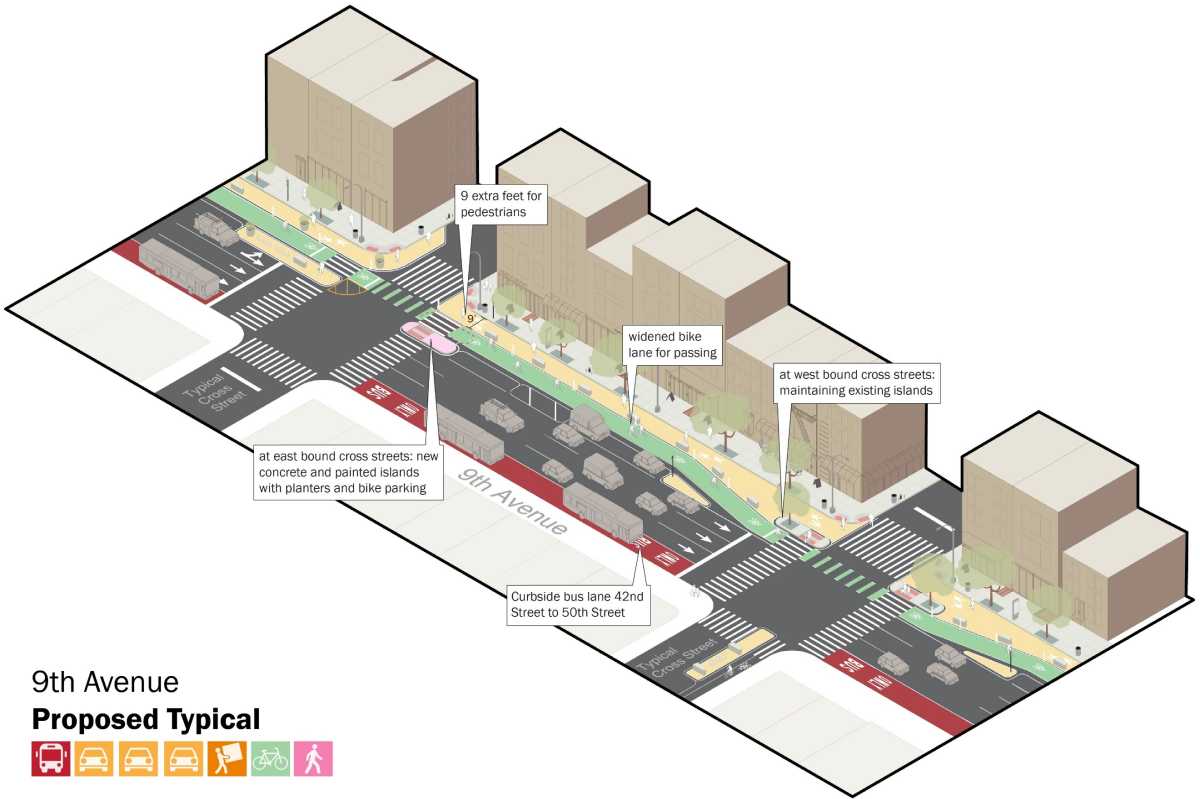 A rendering of the city Department of Transportation’s planned Ninth Avenue redesign.Image Courtesy of DOT
The thoroughfare’s design issues include overcrowding on its narrow sidewalks and its buses being slowed by increased traffic from the Lincoln Tunnel entrance.
DOT found that while pedestrians and cyclists account for 51% of the street’s usage, 64% of the space is currently afforded to car drivers.
The redesign includes widening the existing sidewalk into “super sidewalks” — adding 9 feet of pedestrian space along the corridor. DOT also plans to put in concrete and painted pedestrian islands at eastbound crosswalks and painted curb extensions at crowded corners.
Additionally, DOT will widen the existing protected bike lane from 5 to 9 feet, allowing enough space for cyclists to pass one another. It will also install new bike and microbility parking structures at cross streets.
DOT had previously applied the same treatment to four blocks of Ninth Avenue — between 17th and 21st Streets — in 2023. The Ninth Avenue protected bike lane was the first DOT-installed in the city’s current network, back in 2007.
Lastly, the scheme includes extending the red-painted portion of Ninth Avenue’s curbside bus lane — serving the M34A and M11 buses — by four blocks, from 46th to 50th Streets. Once work is completed, the bus lane will be painted red between 42nd and 50th Streets.
Red-painted bus lanes are intended to be easier for the NYPD to enforce against drivers who illegally occupy them during active hours.
The lane will be reserved for buses only between 7-10 a.m. and 4-7 p.m., seven days a week.
News of the redesign received a warm reception from safe streets advocates.
Alexa Sledge, spokesperson for the group Transportation Alternatives, in a statement called it a “positive step forward for anyone who walks, bikes, or rides a bike along the corridor, and it’s a great example of upgrading street space ahead of the World Cup.”
“Concrete capacity will also be key to transforming these into true super sidewalks,” she added.
Between mid-March and mid-June, DOT will repave Ninth Avenue, build the concrete islands, and paint new markings. During the World Cup, it will complete lane marking work on non-game days. And the project will be finished either by late summer or early fall.