
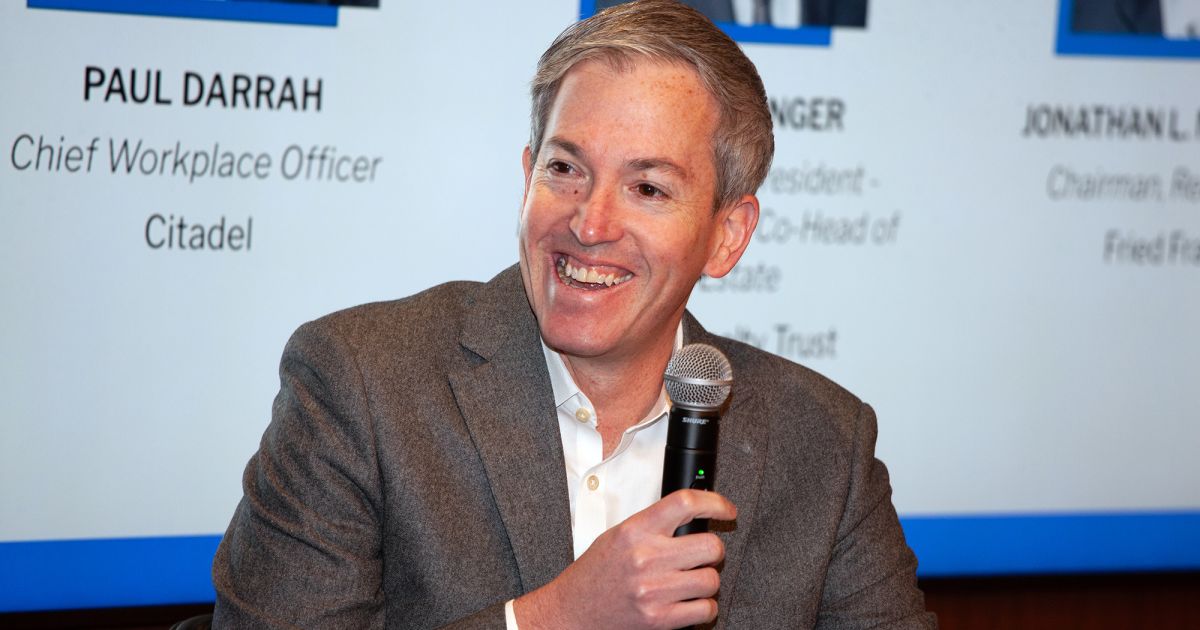
Some of the biggest names in and around New York City real estate gathered over coffee and croissants at Commercial Observer’s annual Future of New York event held March 19 at Marx Realty’s 10 Grand Central to discuss the impact of the new mayoral administration, shifting market trends, and the increasing importance of public-private partnerships in solving the housing crisis.
Hosted by CO’s Editor in Chief Max Gross, in collaboration with the Real Estate Board of New York (REBNY), this annual confab joined some of the city’s most prominent business and civic leaders.
SEE ALSO: Not My First Rodeo: Beverly Hills Sees Surging New Investment
“This event not only serves as a definitive State of the Union event for New York and its real estate industry, but offers very candid insights from the real estate executives and policymakers that are directing the future of New York,” Gross said in his opening remarks. “Today, you’ll hear from real estate and policy experts on everything from how the industry is working to build on momentum for economic growth in the new mayoral administration, to how many developments like 350 Park Avenue are transforming our New York City skyline.”
The event kicked off with welcoming remarks from James Whelan, president of REBNY, who noted the strong recovery in the real estate market post-COVID and the enormous need for more rental housing in a city with a vacancy rate at or below 2 percent. Whelan also noted the need for commercial real estate-specific policies from state and local elected officials.
 Adam Greene. PHOTO: Greg Morris
“The policies coming out of City Hall, as well as the policies coming out of Albany, will go a long way to determining how our commercial and residential sectors perform moving forward,” Whelan said. “Such policies will determine whether such sectors experience growth, attract investment, and generate increasing amounts of tax revenue to pay for vital government services.”
One particular policy that pretty much every speaker across the six panels agreed on was that the state’s 485x tax abatement program, developed to incentivize affordable housing development across the city, doesn’t work because of its strict construction wage rules for projects of 100 units or more. To get around the wage requirements, developers are building residential buildings with 99 or fewer units, speakers noted.
In one session — which featured speakers Ken Fisher of the law firm Cozen O’Connor; Leila Bozorg, New York’s deputy mayor for housing and planning; Jed Walentas, CEO of Two Trees Management and REBNY chair; and Lisa Gomez, CEO at L+M Development Partners — Walentas held nothing back when expressing his opinion that 485x won’t get the job done.
“The 485x program does not work. Generating a whole bunch of 99-unit projects and having the market decide that that’s what they’re willing to invest in is not a solution for New York City housing,” Walentas said. “Our industry, with City Hall, with the governor’s office, with the legislature, needs to fix that with organized labor, with all the other constituencies, whoever it is — we need to come up with a program that works.”
Adam Greene, executive vice president of development at owner RXR, agreed with Walentas’s take on 485x when he spoke on a panel later that morning. Greene was joined by Keith DeCoster, vice president of market data and policy at REBNY; Michael Hershman, CEO of owner Soloviev Group; Bruce Mosler, chairman of global brokerage at Cushman & Wakefield; and Mitch Korbey, partner and chair of the land use and zoning group at law firm Herrick, who moderated the talk.
Greene did note that the 467m tax program, which incentivizes office-to-residential conversions, has been a boon for the city. But he and the panelists agreed that conversions alone aren’t enough to solve the city’s housing supply issues.
 Shimon Shkury. PHOTO: Greg Morris
Later in the day, Shimon Shkury, president and founder of Ariel Property Advisors, reiterated those sentiments about 485x and 467m. Shkury was speaking on an affordability and talent pipeline in a New York-focused panel with Karen Hu, principal and head of development at Camber Property Group; Bryan Kelly, president of development at Gotham Organization; Christina Rausch, executive vice president of real estate transaction services for the New York City Economic Development Corporation (NYCEDC); and Marissa Schaffer, director at developer MSquared. David Shamshovich, a partner at law firm Belkin Burden Goldman, moderated.
“485x needs to be changed,” Shkury said. “The wage requirement that is there now [should be] moved away to allow for larger construction. 467m is a fantastic tool, and we saw a 60 percent increase in permits last year, which means people are utilizing it.”
One critical element in housing development is knowing that where you are building is a safe area. People often view their homes as a sanctuary, and safety then can be critical to attracting and retaining residents.
New York Police Commissioner Jessica Tisch spoke about the city’s overall safety during Thursday’s event, noting that last year the city had the lowest recorded number of shootings in its history, and that 2025 was the safest year on record for subway riders — excluding the pandemic years, when far fewer people rode the rails.
“The people in this room decide where and how the city grows across the five boroughs,” Tisch said. “People are asking what the next chapter of this city will look like, how our business districts will grow, how our neighborhoods will thrive, and how we make sure that New York remains the most dynamic and economically vibrant city in the world. And at the center of all of those conversations is something fundamental: whether people feel safe in this city.”
Residential development wasn’t the only topic at CO’s Future of New York event. Office development was also top of mind, particularly the development of the planned supertall tower coming to Midtown Manhattan at 350 Park Avenue. The building, a joint venture between Vornado Realty Trust and Rudin, in collaboration with Ken Griffin’s Citadel — which will anchor the building — is expected to be delivered in 2032.
 Jed Walentas (right). PHOTO: Greg Morris
Paul Darrah, chief workplace officer for Citadel, and Barry Langer, executive vice president of development and co-head of real estate at Vornado, spoke with Jonathan Mechanic, chairman of real estate at law firm Fried Frank, about the progress of the project and the importance of highly amenitized Class A office development in the post-COVID workplace.
“Workplaces have gotten denser,” Langer said. “The ability for you as an employee to get up from your desk, go to an amenity space, go outside to a terrace, and go down to a coffee shop — it is all about how the next generation really wants to work. Having outdoor spaces that are actually usable, shielded from the wind, shielded from the sun, and proper places to put down a laptop makes them much more usable than just having a beautiful landscaping plan.”
The day wrapped with a final session addressing the economic drivers that can support greater tourism in New York City. Moderated by CO’s Gross, the panel featured Steven Fulop, former Jersey City, N.J., mayor and now president and CEO of the Partnership for New York; Thomas Grech, president and CEO of the Queens Chamber of Commerce; Slater Traaen, senior director at owner Mitsui Fudosan America; and Jessica Walker, president and CEO of the Manhattan Chamber of Commerce.
The panel discussed the current state and future of tourism in New York City, highlighting the city’s desirability, while noting struggles to bring in international tourists due to economic and immigration policies like steeper tariffs and ICE raids. Still, the panel highlighted New York City’s resilience, and noted that the upcoming World Cup soccer matches happening in less than 100 days will be a boost to the city’s retail and hospitality sectors.
“We’re anticipated to hit 66 million tourists this year,” Walker said, “which is still a little bit below where we were in 2019, before COVID, but certainly good news.”
Amanda Schiavo can be reached at aschiavo@commercialobserver.com.