
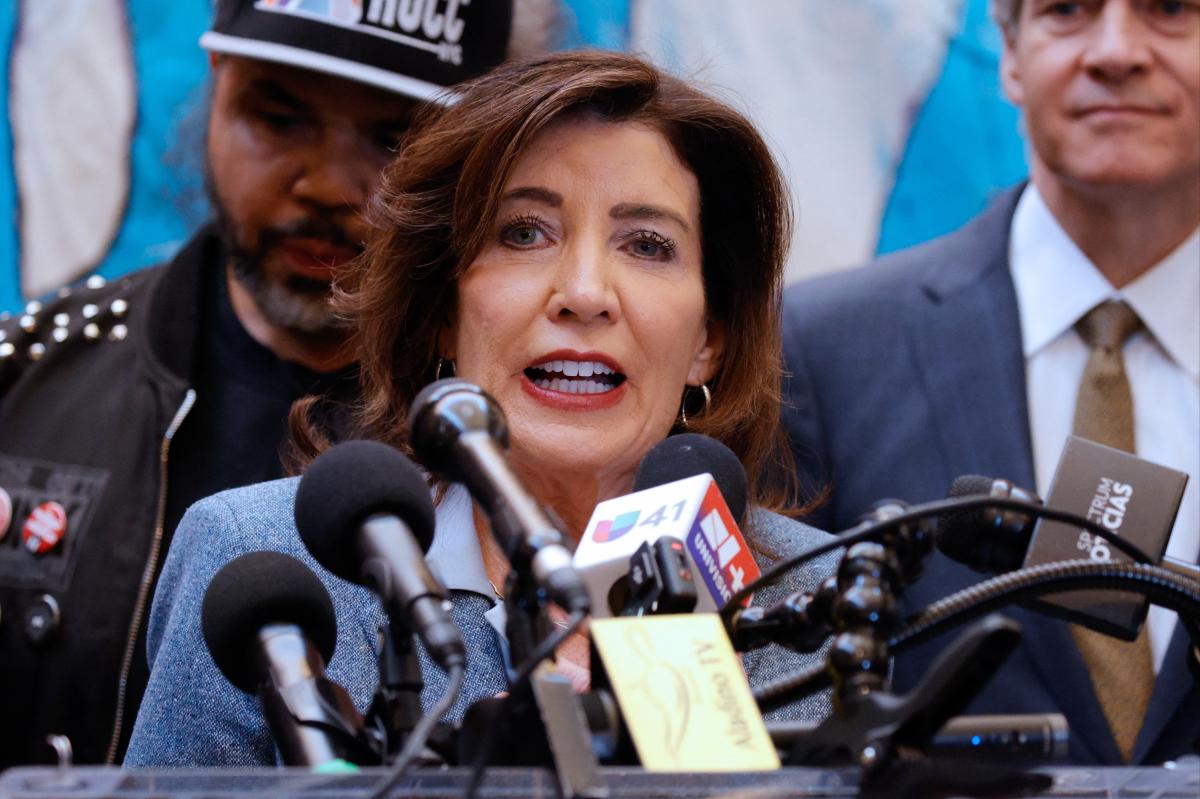
On Friday, Gov. Kathy Hochul finally started tiptoeing toward reality on New York’s climate law.
In a lengthy opinion column, she laid out her proposal to postpone by a decade the state’s stringent greenhouse-gas emissions rules, set by law to hit in 2030 — pointing fingers at everything from COVID-19 to upstate NIMBYism to President Donald Trump to justify waving the white flag.
But Albany legislators should never have imposed these draconian CO₂ emissions targets to begin with.
Even in 2019, when the Climate Leadership & Community Protection Act was passed, New York had among the lowest carbon emissions per capita of any state in the US, with 6% of the nation’s population but only 1% of its CO₂.
Forcing this law on New Yorkers is like imposing calorie restrictions on anorexics to solve America’s obesity problem.
And make no mistake, the Climate Act imposes severe restrictions in seeking a 40% reduction in gas emissions by 2030.
A New York State Energy Research and Development memo leaked this month predicted its mandates would force gas prices up by $2.26 per gallon and make upstate households spend upwards of $4,000 a year more for heating — just the tip of the iceberg of the costs New Yorkers would have to bear.
All of that should have been discussed and calculated back in 2019.
But the actual Climate Act bill barely mentioned the burdens it would impose — including practical considerations, like whether the technology existed to power all of New York without fossil fuels, as the law mandates must occur by 2040.
The “bill jacket” introduction was full of buzzwords about the Paris Agreement, the United Nations and global weather.
Meanwhile, the bill itself essentially admitted that legislators had no idea how much their decrees would cost.
Yet Albany’s “vote first, ask questions later” mentality prevailed.
Now, seven years later, Hochul is pleading with those legislators for an election-year reprieve — kicking the climate can a decade down the road.
The governor is right to note that even with her proposed timeline changes, New York would still have one of the most ambitious climate plans in the country.
Rethinking the Climate Act, she suggests, is not a move against the planet, but a reasonable exercise in light of new data.
In truth, though, while New York has spent $88.7 billion in the last five years to comply with the Climate Act’s mandates, the outlay has barely moved the needle.
Since 2019, New York’s CO₂ emissions from electricity generation have risen, not fallen.
Despite the renewable-energy hype, wind and solar amount to around 5% of the Empire State’s electricity production: After seven years of the Climate Act, New York still runs on fossil fuels.
And one thing the Climate Act did achieve was to deny permits for newer, cleaner natural-gas power plants.
Get opinions and commentary from our columnists
Subscribe to our daily Post Opinion newsletter!
Thanks for signing up!
That means New York’s electricity is being generated with increasingly outdated technology and equipment, risking failure and blackouts.
Even environmentalists should be concerned about the impacts.
Instead, the activists will spin the narrative that New Yorkers are absolutely on board with their aggressive climate agenda — and $6 gas.
But residents actually favor a reasonable climate policy, not a radical one.
A Siena Research poll last year found that 61% of us — including 54% of Democrats —agree that “Keeping energy costs affordable in New York is more important right now than reducing greenhouse gas emissions.”
An earlier Empire Center poll showed that 60% of New Yorkers want the state to find ways to reduce greenhouse-gas emissions without increasing the price of energy.
So give Hochul some credit for taking a small step in the right direction.
Unfortunately, perhaps to sweeten the deal for the Legislature’s leftists, her plans are paired with a series of proposals seemingly inspired by socialist regimes, like sending “affordability monitors” to spy on energy companies and other nonsense.
The right thing to do is to scrap the Climate Act entirely and create a better one.
Imagine a Climate Act 2.0 that learns from the mistakes of the past seven years, built on the truth about how high energy prices impact New Yorkers and the local economy.
We could make this state an energy powerhouse, based on modern no- or low-emissions sources like nuclear and natural gas.
Imagine a state law that concentrates on building new power plants and delivering cheap energy to consumers, rather than ripping out pipelines and imposing energy taxes.
Until that happens, relaxing New York’s self-imposed restrictions is the right thing to do.
Zilvinas Silenas is president of Empire Center for Public Policy.