
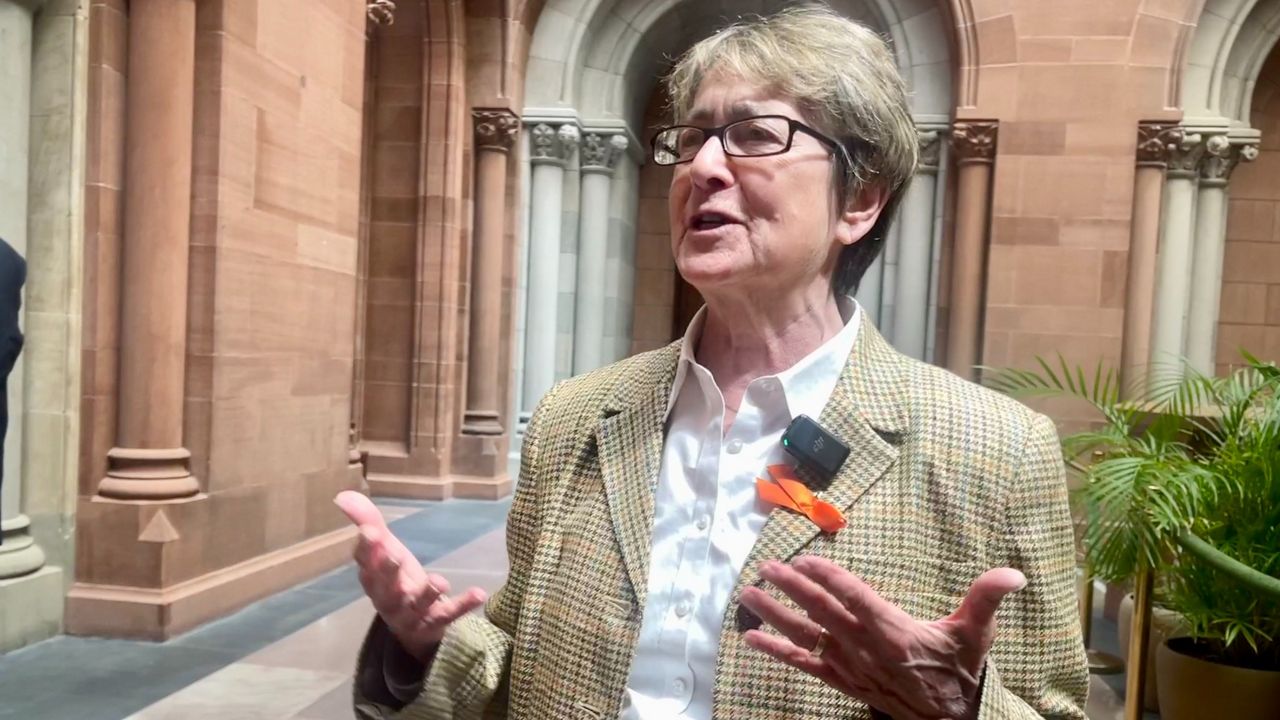
Gov. Kathy Hochul unveiled her preferred set of changes to the state’s landmark 2019 climate law Friday. The governor’s announcement came in a morning op-ed in the Empire Report, as state Assembly Environmental Conservation Chair Deborah Glick told Spectrum News 1 part of the governor’s proposal is a nonstarter.
The scope of the changes, if approved by the state Legislature, would represent a dramatic step back from one of the most ambitious emissions-reduction laws in the United States.
Hochul is making the pitch with 12 days out from the April 1 budget deadline, and legislative leaders will have to consider the changes — a concept they have shown resistance to — in the context of multiple other thorny issues on the path to a budget deal.
“While the Climate Act is not the driver of the high energy prices we are experiencing, the undeniable fact is we cannot meet the Climate Act’s 2030 targets without imposing new and additional crushing costs on New York businesses and residents,” Hochul wrote.
Key details of the proposal were first reported by Politico.
The governor is pushing to move the deadline by which the state must issue regulations that are key to how New York will reach an overall 85% emissions reduction target by 2050 to 2030. Those regulations were originally due in 2024 in the form of a cap-and-invest program.
The Hochul administration’s failure to release those regulations led environmental advocates to sue the state and Hochul argues court-ordered compliance with the law as written would lead to significant increased costs for consumers. While she did not propose materially changing the law’s 2030 goals, the absence of regulations to enforce them appears to have prompted a new 2040 interim deadline, a key element of the proposal.
Most troubling to lawmakers and environmental advocates is Hochul’s proposal to change how progress in reducing emissions is calculated. She says it’s necessary to put New York’s success in context and avoid wasting money on what she characterizes as an unwinnable battle.
“We need to change the accounting methodology we use to count emissions to align with the international standards used by the global community and nearly every other U.S. state,” Hochul said. “Otherwise, these impossible emission-reduction targets … only used by NY and one other state … will ensure our failure despite all of our efforts and billions of dollars spent.”
Glick told Spectrum News 1 that while lawmakers have not yet been provided formal budget language, she sees a path to agreement on changing deadlines in the context of challenges brought on by the COVID-19 pandemic and the Trump administration, but is strongly opposed to altering the accounting methodology.
“The art of compromise is the art of governing, so to some extent I think there is some change in our reality, so there is some rationale to revisit some of the deadlines,” she said. “But you don’t reevaluate the way in which you measure how close you are to meeting some of those goals.”
Glick, who chairs the Assembly’s Environmental Conservation Committee, said if the governor is going to get her way on adjusting dates, she needs to settle the lawsuit over cap-and-invest.
“The governor and her team should be negotiating a settlement,” she said. “At the same time, it shouldn’t be in the budget at all — but if there is an insistence, then we should be discussing the details of the timing change,” reiterating that the methodology should be off-limits.
Hochul doubled down on the lawsuit as a rationale behind her proposal in the op-ed, though the plaintiffs have disputed her reasoning.
“Despite all the headwinds and obstacles that could not have been foreseen when the law was enacted in 2019, advocates still took the extreme step of suing the state to force it to issue regulations to meet the Climate Act’s 2030 emission-reduction targets,” she wrote. A judge agreed and ruled that the state must swiftly issue regulations to achieve what would now be costly and unattainable targets unless the law is changed.
Glick will be one of the voices advising Assembly Speaker Carl Heastie as he negotiates the proposal with Hochul and Senate Majority Leader Andrea Stewart-Cousins. Glick said she has communicated to him that New York continuing to be a climate leader in the Trump era is “nonnegotiable.”
State Senate Environmental Conservation Committee Chair Pete Harckham told Spectrum News 1 on Thursday, ahead of the governor’s proposal, that he also expects some changes to make the final budget deal but has “lines in the sand.”
“I think the environmental community is very concerned that whatever happens, we maintain some sort of cap-and-invest structure with definitive dates, goals and metrics to measure the process of making progress,” he said. “That’s incredibly important because that’s how we’re going to get to where we need to be.”
Environmental advocates came out swinging Friday:
“The Senate and Assembly prioritized clean water, public health, reliability and affordability in their one-house budgets, demonstrating strong leadership for New Yorkers,” said Vanessa Fajans-Turner, executive director of Environmental Advocates NY. “Each chamber included $1 billion for the Sustainable Future Program — one of the environmental community’s ‘superbills’ — and $500 million for the Environmental Protection Fund, and increased investments in clean water and solutions to protect ratepayers while advancing climate progress.”
Liat Olenick, co-founder of Climate Families NYC, pointed to Hochul’s comments clarifying the changes would only impact future rate increases, not bring down current costs.
“The governor herself said this wouldn’t bring down costs, and there are so many other ways that we could be bringing down costs for families, including via renewable, reliable, affordable energy,” she said.
The proposal has gained the governor some praise from business leaders, but she also drew criticism from those generally supportive of changes to the climate act. Senate Minority Leader Rob Ortt, a frequent critic of the law, called the proposal election-year posturing.
“Today’s announcement by Governor Hochul attempting to amend the state’s costly and unrealistic Climate Act is the latest example of her effort to roll back a disastrous policy she previously championed simply because it is an election year,” he said. “She’s not proposing meaningful changes to Albany’s unaffordable energy policies, but meaningless delays that will do nothing to help lower New Yorkers’ utility costs today or in the near term. The only way to ensure affordable and reliable energy is to repeal the Climate Act and move forward with a new plan that is realistic.”
Ken Girardin, a fellow at the Manhattan Institute, said any reforms should address three issues: utility rates, strain on the electric grid, especially in New York City, and the fiscal consequences of noncompliance.
He argued Hochul’s proposal only addresses the latter.
“Adjusting the climate targets — what the targets are, what year you hit them or how you calculate them — avoids the state having to impose punitive carbon taxes,” he said. “You can avoid those by amending the CLCPA, but you can’t deal with the two other big problems by doing what the governor has proposed. You can’t fix the fact that electric rates around Syracuse have doubled in recent years, and you can’t immediately improve the reliability of electric grid in New York City which the climate act has contributed to weakening.”