
BY CARTER MYERS-BROWN
As suicide rates in the construction industry continue to outpace on-site fatalities, the Building and Construction Trades Council of Greater New York has launched a peer support initiative aimed at confronting what leaders describe as an “epidemic” within the workforce. Developed in partnership with Cornell University’s Worker Institute, the program seeks to embed mental health awareness and intervention directly into the culture of union job sites.
The initiative will train rank-and-file workers to recognize distress, offer support and connect their peers to professional help before a crisis escalates. In a conversation with The Chief, BCTC president Gary LaBarbera explained how the program came together, why peer-to-peer engagement is central to its design and what success might look like beyond the numbers.
This interview has been edited for length and clarity.
The Chief: To start, can you walk me through the mental health initiative the Building Trades are launching with Cornell?
Gary LaBarbera: Let me put this in context first, because the scope of the issue really matters.
This is all from the [Centers for Disease Control]: North America, about 1,000 construction workers are killed every year in job site accidents. Those are the traditional causes we all know—falls, struck-by incidents, electrocutions, crush injuries. But in that same time frame, about 5,000 construction workers take their own lives. So suicide in the construction industry is five times higher than fatal workplace accidents.
It tells you immediately that this is not just a problem—it’s an epidemic within the industry. And once we recognized that, we felt strongly that the New York City Building Trades had a responsibility to do something to help support our members in times of crisis.
Most of our local unions already have Member Assistance Programs, or MAPs, with directors who have different levels of certifications in substance abuse, mental wellness, and related issues. So the initial idea was to build something that could serve multiple purposes: an intervention program, a mental wellness awareness initiative and an educational effort to help destigmatize these issues.
As we started developing that concept, the MAP directors themselves made it clear that if we wanted to do this right, we needed to partner with an academic institution—someone who could help structure the program, develop the curriculum, and ground it in best practices. So I reached out to Cornell University’s Worker Institute, where we’ve had a long-standing relationship, and asked if they would be interested in collaborating. Fortunately, they were.
We were especially lucky to work with Arianna Schindle, who is not only an educator but also a clinician specializing in suicide prevention, along with Jeff Grabelski on the structural side. That combination—academic expertise and clinical experience—was critical.
It’s also important to note that this work required resources. The New York Building Congress Foundation subsidized the entirety of the cost, which was $130,000. That kind of support really shows that the broader industry understands the seriousness of the issue.
Over the course of a year, Cornell and our MAP directors met regularly and worked diligently to build the program. What we learned from clinicians is that the most effective tool in crisis intervention is peer-to-peer support.
So we created what we’re calling a peer assistance program. It’s voluntary and open to all union members, and I can tell you there’s no shortage of interest. The first step is a two-hour mental wellness and suicide prevention awareness training, which a large number of members are already signing up for.
From there, those who want to go further can participate in a seven-hour, more intensive training program developed with Cornell and the MAP directors. The goal is to train about 1 percent of the workforce—roughly 1,000 workers out of 105,000 union construction workers across the five boroughs—to serve as peer assistants.
Now, these individuals are not clinicians, and we’re very clear about that. But they are trained to recognize the signs of distress, understand different levels of crisis and respond appropriately. Most importantly, they act as a bridge—connecting someone in need to the right resources, typically their union’s MAP director, who can then assess and provide or coordinate professional help.
If someone is in immediate danger, of course, that escalates to emergency services. But in many cases, the first step is simply recognizing that someone is struggling and creating a pathway to support.
There’s a stigma around mental health. There’s a perception that asking for help is a sign of weakness. We want to change that.
There are a lot of factors in this industry that contribute to stress and mental health challenges—the dangerous nature of the work, the pressure to meet deadlines and the uncertainty of employment from job to job.
What makes this program unique is that it’s inter-trade. It doesn’t matter what union you belong to—carpenter, electrician, plumber. Peer assistants are there for everyone on the job site. It’s one unified Building Trades effort.
At its core, the program is about intervention, prevention, and education. It’s about creating a network where people feel supported and where someone is always willing to ask, “Are you okay?” Because the reality is, people don’t take their own lives because someone asked that question—they do it because no one did.

The new initiative trains workers to identify signs of distress and guide coworkers to support services.
Courtesy BCTC
TC: You mentioned the stigma around mental health in construction. If this program works, what changes—beyond statistics—will tell you that stigma is actually breaking down?
GL: That’s an important question, because cultural change doesn’t happen overnight, and it’s not always immediately reflected in the data.
I think one of the biggest indicators will be how these conversations start to become normalized on job sites. Right now, we have regular toolbox talks and safety meetings that focus on physical safety—what hazards are present, how to mitigate risk, how to work safely. What we’re doing is integrating mental wellness into those same conversations.
So instead of mental health being something that’s separate or avoided, it becomes part of the everyday culture of the job site.
We’re already seeing signs of that. There’s more open dialogue, especially among apprentices. Many of the apprenticeship programs are incorporating the two-hour awareness training, and training directors are telling us that younger workers are engaging in real discussions about mental health. They’re more willing to talk about personal challenges and support each other.
That’s significant, because this is still a predominantly male industry. We’re working to increase female participation—we’re around 7 percent now and aiming for 10 percent—but it remains heavily male. And historically, men have been less likely to talk openly about their emotions.
There’s also a generational component. Older workers often come from a time when you simply didn’t talk about these things. So part of what we’re seeing is a shift driven by younger workers who are more open to these conversations.
I often compare this to the evolution of physical safety practices. Years ago, people didn’t wear harnesses or consistently use personal protective equipment. Today, that’s just standard practice.
Mental health needs to follow that same trajectory. If we start to see more people checking in on each other, more willingness to ask for help and more openness in discussing these issues, that’s how we’ll know the culture is changing. And over time, that cultural shift will translate into improved outcomes.
TC: What qualities make someone effective as a MAP director or peer assistant?
GL: I think it comes down to a few key things.
First is empathy and compassion—the ability to genuinely care about someone else and to listen without judgment.
Second, many of the people who are stepping forward have been personally affected by these issues. When we ask groups if they know someone who has struggled with mental health or died by suicide, almost every hand goes up. It could be a family member, a friend, a coworker.
That personal connection is a powerful motivator. It drives people to want to help others and prevent similar tragedies.
Third is aptitude. Construction workers go through extensive training to become skilled in their trades. They have the ability to learn, to absorb information and to apply it. So there’s no question that they can handle this curriculum.
What we’re seeing in the pilot trainings is that when people are asked why they’re there, many share deeply personal stories—about losing a family member, a friend, even a child or parent. Those experiences create a strong sense of purpose.
And importantly, there’s no shortage of interest. A lot of people want to be part of this. They want to help their brothers and sisters on the job site, and that’s very encouraging.

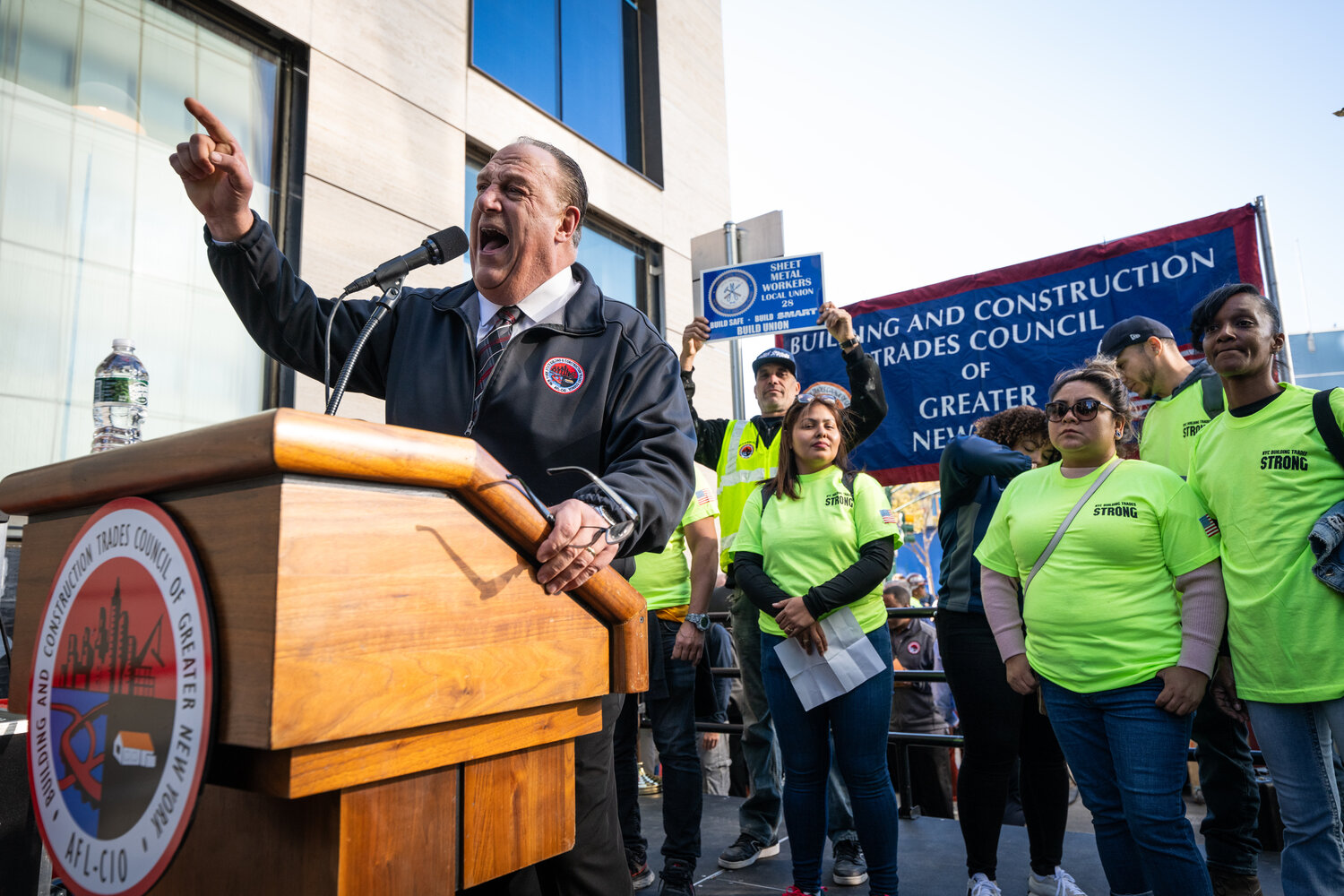
Many construction workers, LaBarbera says, have a “perception that asking for help is a sign of weakness.”
Ed Reed/ Mayoral Photography Office
TC: I’d like to talk about substance abuse, which is closely tied to mental health in the industry. How does this initiative address that?
GL: Substance abuse is definitely part of the conversation, and there’s a clear connection between substance use and suicide.
Construction work takes a significant physical toll over time. Workers deal with injuries, chronic pain and wear and tear on their bodies. At the same time, there’s a strong desire to keep working. People take pride in their trade, and if they’re not working, they’re not earning.
That dynamic can lead people to rely on substances—whether it’s prescription opioids to manage pain or alcohol and other substances to cope at the end of the day.
The training includes a component that addresses this directly, focusing on the relationship between substance use, mental health and crisis situations. It’s about helping people understand how these factors interact and how they can escalate.
What often happens is that over time, substances become less effective. The body builds tolerance, and the underlying pain—both physical and emotional—remains. That can lead to a sense of hopelessness.
These are not easy conversations to have, especially in a workplace setting. But when we’ve had these discussions in leadership forums, people have opened up in very real ways. They’ve shared personal stories about family members, children, parents. It can be emotional, but it’s also necessary.
TC: Is there anything else you’d want workers or the public to understand about this initiative?
GL: I’d emphasize that this is about building a support system within the workforce itself.
It’s not about replacing professionals—it’s about creating a first line of awareness and connection. Someone who can recognize when a coworker is struggling and help guide them to the right resources.
The fact that this is inter-trade is important. It reflects a unified effort across the Building Trades. No matter what your trade is, there’s someone there for you.
Ultimately, this is about prevention, intervention and education. It’s about changing the culture so that mental health is treated with the same seriousness as physical safety.
If we can get to a point where it’s normal to ask for help, and normal to offer it, then we’re moving in the right direction. And that’s how we begin to save lives.