
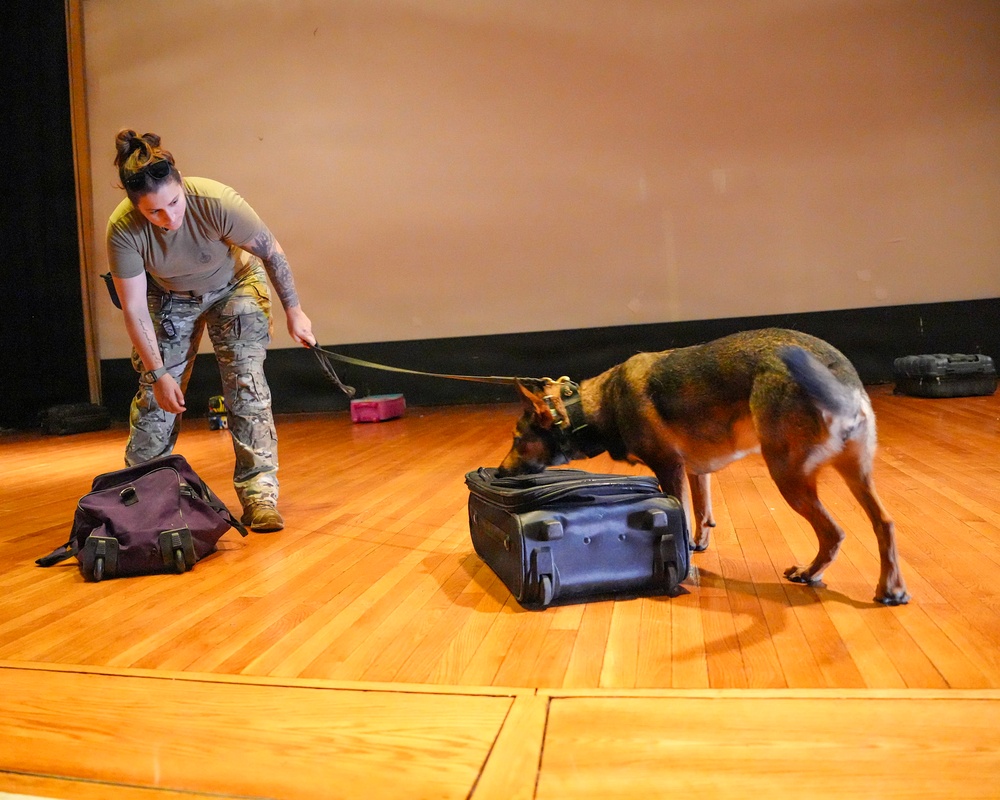
FORT HAMILTON, N.Y. — More than a dozen federal, state and local agencies trained together at Fort Hamilton on March 11, 2026, as Transportation Security Administration canine training instructors from John F. Kennedy International Airport led a large‑scale multi‑agency K‑9 readiness event designed to strengthen regional detection capabilities and interagency coordination.
Supported by canine instructors from Newark Liberty and LaGuardia airports, the training brought together more than 65 handlers and their K‑9s from 13 agencies across New York and New Jersey.
Participating organizations included the Port Authority Police Department, New York Police Department Transit Bureau K‑9 Unit, New York State Police, U.S. Coast Guard Police, U.S. Park Police, Federal Protective Service, United Nations Special Operations K‑9 Unit and the New York City Office of Chief Medical Examiner.
Teams rotated through detection and response scenarios across the installation, including the movie theater, Reserve Center, Directorate of Emergency Services vehicle lot and the 7th Avenue Gate vehicle inspection point. Transportation security explosive specialists from JFK also led booby‑trap and improvised explosive device lanes, giving teams exposure to realistic threat environments.
“Fort Hamilton provided an exceptional training environment that allowed every team to sharpen its operational readiness,” said Juan R. Diaz, TSA canine training instructor and event coordinator. “Working together in a joint setting helps us understand each other’s procedures and strengthens the partnerships we rely on during real‑world missions.”
The training expanded further with exposure to homemade explosives for imprinting and a large‑vehicle explosive hide provided by the FBI New York Field Office’s explosive ordnance disposal team. The Office of Chief Medical Examiner supported human remains detection scenarios at the Fort Hamilton Youth Center playground, where specially trained K‑9s quickly located planted scent sources.
Diaz said the timing underscored the importance of joint readiness. “New York never forgets,” he said. “Training together now ensures we are prepared for the major milestones ahead.”
The 24th Weapons of Mass Destruction–Civil Support Team, based at Fort Hamilton, enhanced the event by demonstrating its ability to detect and identify chemical, biological, radiological, nuclear and explosive hazards. “Having the K‑9s here was merging tech and teeth to master the mission,” said Staff Sgt. Tesshawn Cook, team chief.
This year’s training carries added significance for the New York City region. With the 25th anniversary of the Sept. 11 attacks approaching in September 2026, and the nation preparing for the 250th anniversary of the United States, including Freedom250 and Sail250/Sail4th250 commemorations, agencies across the region are increasing coordination to ensure public safety during high‑visibility events.
Staff Sgt. Ray Santos, also a team chief with the 24th CST, said the integration of canine teams and advanced detection equipment strengthened the team’s understanding of joint capabilities. “Having paws on the ground and tech in hand is the ultimate detection duo,” he said.
The training event directly supported Fort Hamilton’s mission as the Army’s only active‑duty installation in New York City, enabling readiness not only for Soldiers but for the federal, state and local partners who rely on the post’s unique urban training environment.
The Directorate of Plans, Training, Mobilization and Security and the Directorate of Emergency Services provided critical support to ensure the training met Army physical security and anti‑terrorism requirements, including random antiterrorism measures.
As overseas commitments continue, Fort Hamilton’s role in generating homeland readiness remains essential. The installation’s ability to host joint and interagency training contributes to the Army’s priority line of effort: Readiness, Deployability and Lethality.
The U.S. Army Installation Management Command supports Fort Hamilton by delivering base operations services, sustaining infrastructure and enabling readiness for a globally responsive Army. IMCOM’s mission ensures installations like Fort Hamilton remained capable platforms for training, mobilization and interagency cooperation.
Content contributions provided by Juan R. Diaz, TSA Canine Training Instructor and event coordinator.