
Jersey City Mayor James Solomon’s administration has released their after action report related to the January 25th blizzard, where he admitted that cleaned efforts were lackluster: “Residents deserved better.”
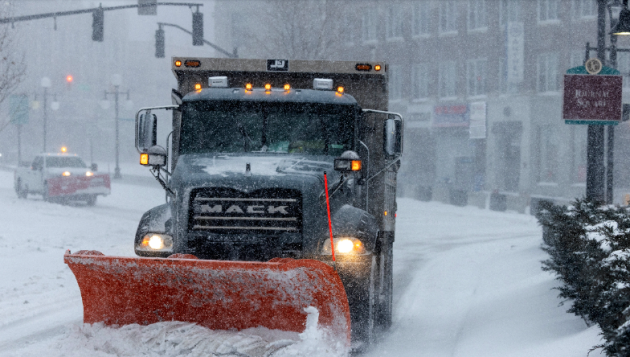 Photo via jerseycitynj.gov.
By John Heinis/Hudson County View
“Jersey City residents deserved better during the January storm, and they know it, and so do I. This report doesn’t make excuses. It tells the truth about what we found when we looked closely at storm operations: a department that had been neglected for a decade, left without the leadership, systems, and operational planning it needed to handle a major weather event,” Solomon said in a statement.
“Publishing this report is an act of accountability. And the reforms we’ve already put in place — tested during the February blizzard — show that rebuilding is possible and that it’s already underway.”
The January 25 storm dropped over nine inches of snow on Jersey City at rates reaching two inches per hour, prompting Governor Mikie Sherrill to declare a state of emergency. While the city deployed over 60 pieces of snow removal equipment and activated its Emergency Operations Center, the response fell well short of resident expectations – particularly in residential neighborhoods, at crosswalks, and along pedestrian corridors.
Specific failures highlighted included no shift work planning, no quality control mechanisms to verify that routes were being completed as reported, and paper-based systems from the 1990s and GPS tools that were never integrated into operations.
Other shortcomings cited are snow route maps decades out of date, a salt vendor failing to deliver 4,250 of 4,900 contracted tons before the storm, no functioning dispatch office, low staff morale stemming from underinvestment and unresolved union contracts, and no plan or equipment for bike lane clearance or prioritization of pedestrian infrastructure.
The Jersey City Council questioned what went wrong during their January 27th caucus meeting, which Department of Public Works Director Greg Kierce attributed to the salt shortage and lingering below freezing temperatures.
One week later, it was announced that Kierce would be stepping down as DPW chief, with a nationwide search for his successor, though he will remain head of the city’s Office of Emergency Management and Homeland Security. on April 15th, as HCV first reported.
Solomon noted that reforms are already in place and were implemented during the February 22nd blizzard.
Those initiatives include:
• Rotating shift schedules and pre-positioned auxiliary staff and contractors before the storm began
• Deployed supervisors in the field alongside GPS fleet tracking and CCTV integration to enable real-time quality control
• Replaced the city’s primary salt vendor after Morton Salt’s delivery failure and brought all storage sites to full capacity
• Established a functioning incident command structure with assigned leadership roles and defined areas of responsibility
• Instituted standard operating procedures for field-to-command communication
• Created a structured incident reporting process to keep elected officials informed throughout storm operations
• Identified and prioritized high-traffic intersections and crosswalks for rapid post-storm clearance
• Returned experienced operational leaders from administrative positions to frontline roles
The report also outlines a comprehensive set of short-, medium-, and long-term recommendations.
Those include a full overhaul of snow response protocols, complete redesign of snow routes to reflect the current city, technology modernization, a mandatory training program for DPW personnel, and modernization of the city’s dispatch and records management functions.
The report additionally calls for the acquisition of specialized equipment for bike lane clearance and the integration of bike lanes into the updated snow plan, as well as formal protocols to prioritize the clearance of pedestrian corridors — including intersections, crosswalks, and corner ramps.