
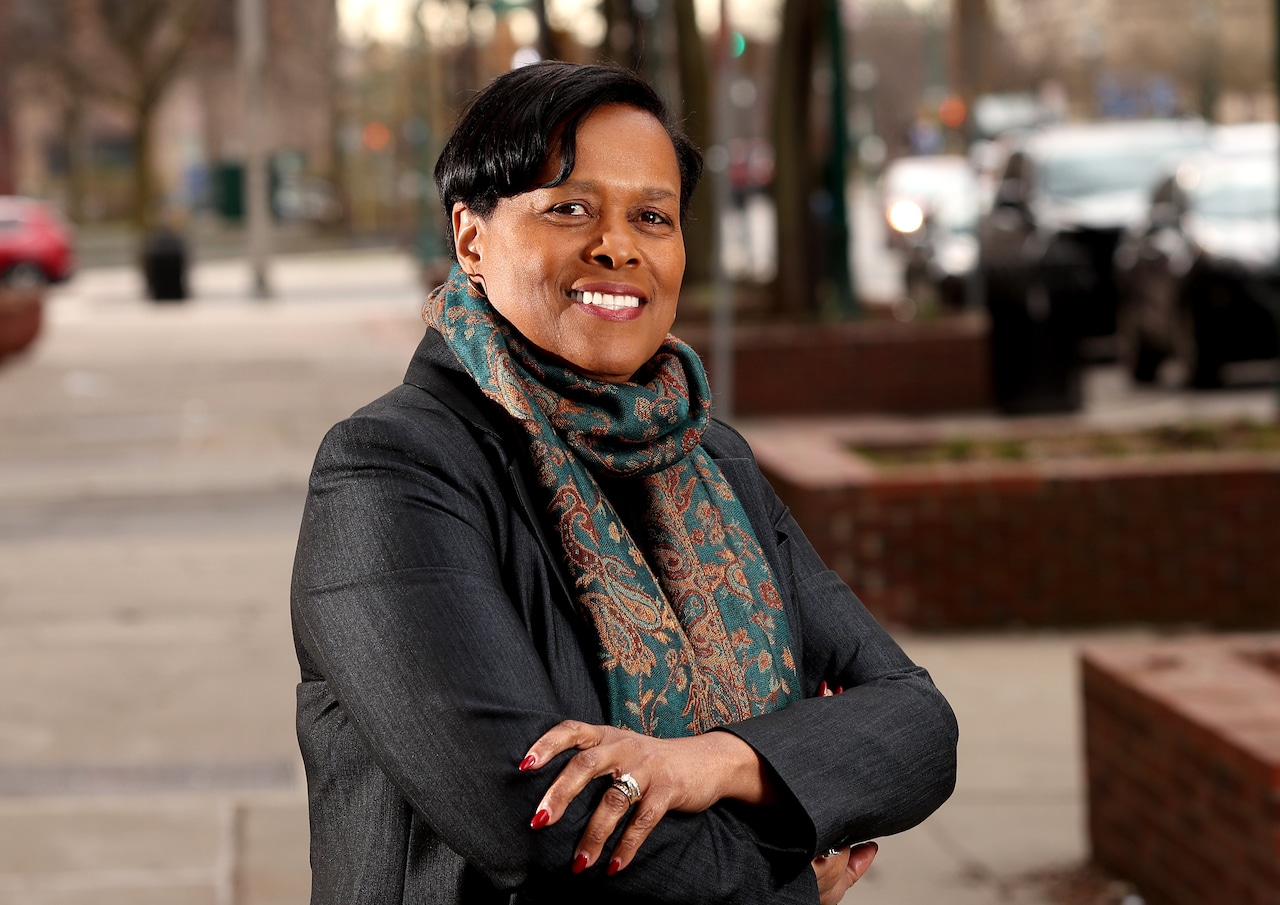
Sharon Owens’ eight years as the deputy mayor of Syracuse, and long career in community service before that, persuaded the editorial board in June that she was the best of the three candidates running in the Democratic mayoral primary to lead the city into the future.
The subsequent general election campaign featuring three opponents — Republican Tom Babilon and independents Alfonso Davis and Tim Rudd — has only confirmed that opinion.
The editorial board endorses Owens for mayor of Syracuse.
The challengers spent more energy attacking Owens for the real and perceived failings of Mayor Ben Walsh’s administration than they did advancing a fresh vision for the city.
To her credit, Owens stood by her record with Walsh. She is rightly proud of her work with the administration on police reform, gun violence prevention and neighborhood revitalization. She also acknowledges that the administration made mistakes, and that she would have done some things differently had she been calling the shots.
As mayor, she promises to be Sharon Owens 1.0 — her own person, with her own perspective as a Black woman and a passionate, no-nonsense temperament — and not Ben Walsh 2.0. We’re going to hold her to it.
Owens, a Geneva native, graduated from Syracuse University and stayed. For three decades, she worked in the trenches of nonprofit organizations and housing, with roles at the Dunbar Center, PEACE Inc., Jubilee Homes and Home Headquarters. She first joined City Hall as a deputy commissioner of neighborhood and economic development. As deputy mayor during Walsh’s two terms, Owens oversaw housing, neighborhood and business development, emergency services and public safety. Her background in housing is especially relevant now, as Micron begins building semiconductor fabs, to accommodate new arrivals without displacing current residents.
Owens has often been the face of the Walsh administration’s most controversial initiatives, such as recruiting at-risk young men to undergo anti-violence therapy, and thus a lightning rod for her opponents. This boiled over Thursday night at a public forum. In an ugly exchange, Babilon blew up at her.
In contrast to her opponents, Owens puts forth a positive and optimistic view of Syracuse — a city with forward momentum and wind in its sails from the massive infrastructure investments surrounding the Interstate 81 project, the STEAM school and Micron’s transformative chip fab in the suburbs. She sees them as opportunities to lift up every city neighborhood and resident and vows to “maximize the moment” as mayor.
Owens, who is a pastor, also possesses a genuine ability to connect with people. She understands what they want, what they fear, what they’re going through.
She is no Pollyanna. Syracuse has big problems: concentrated poverty, youth crime, a structural budget deficit, a shortage of affordable housing and lead in the water pipes. Over her career, Owens has put in the work and built the relationships across city, county and state government that position her the best out of the four candidates to chip away at these issues.
Babilon, the Republican nominee, is a lawyer who worked in the city’s law department for many years. Davis is a longtime community activist running for mayor for the fourth time. Rudd, a former member of the common council, was city budget director until Walsh fired him for making racist comments about Owens.
What the editorial board knows about Babilon, Davis and Rudd comes from syracuse.com’s coverage of the campaign, their published materials and appearances at public forums and debates. As a bloc, they declined the editorial board’s invitations to meet for a more in-depth conversation about their vision for the city. While that is their prerogative, we expected the candidates who say they want to be in the arena to take any opportunity to enter it.
So, we didn’t have the chance to ask pointed questions one-on-one about Babilon’s plan to consolidate the water department with Onondaga County’s and to use police to remove panhandlers and unhoused people from downtown streets. Or about Rudd’s ideas for encouraging housing construction and his dog-whistle comments. Or about Davis’ desire to disband the Greater Syracuse Land Bank and his belief that the assassination attempt against then-candidate Donald Trump was faked.
It’s not a close call. Owens didn’t just start cooking up some ideas to build traction for a half-hearted campaign. Over decades, she displayed the leadership skills, temperament, team building, common sense and empathy to run effectively something big and important. She could be a historic and impressive mayor. We’ll see, but she’s more ready, more tested than her opponents. We look forward to watching her make her own mark.
The editorial board endorses Owens to be the next mayor of Syracuse at this historic juncture when Interstate 81 is coming down, a new neighborhood around it goes up and the Micron boom arrives.
Why we endorse
The purpose of an editorial endorsement is to provide a thoughtful assessment of the choices voters face in an election. We offer editorial endorsements to stimulate the public conversation and promote civic engagement. Voting is a right and an obligation of citizenship. That part is up to you. Early voting runs from Saturday, Oct. 25, through Sunday, Nov. 2. Election Day is Tuesday, Nov. 4.
About Syracuse.com editorials
Editorials represent the collective opinion of the Advance Media New York editorial board. Our opinions are independent of news coverage. Read our mission statement. Members of the editorial board are Tim Kennedy, Trish LaMonte and Marie Morelli.
To respond to this editorial: Submit a letter or commentary to letters@syracuse.com. Read our submission guidelines.
If you have questions about the Opinions & Editorials section, contact Marie Morelli, editorial/opinion lead, at mmorelli@syracuse.com
If you purchase a product or register for an account through a link on our site, we may receive compensation. By using this site, you consent to our User Agreement and agree that your clicks, interactions, and personal information may be collected, recorded, and/or stored by us and social media and other third-party partners in accordance with our Privacy Policy.