
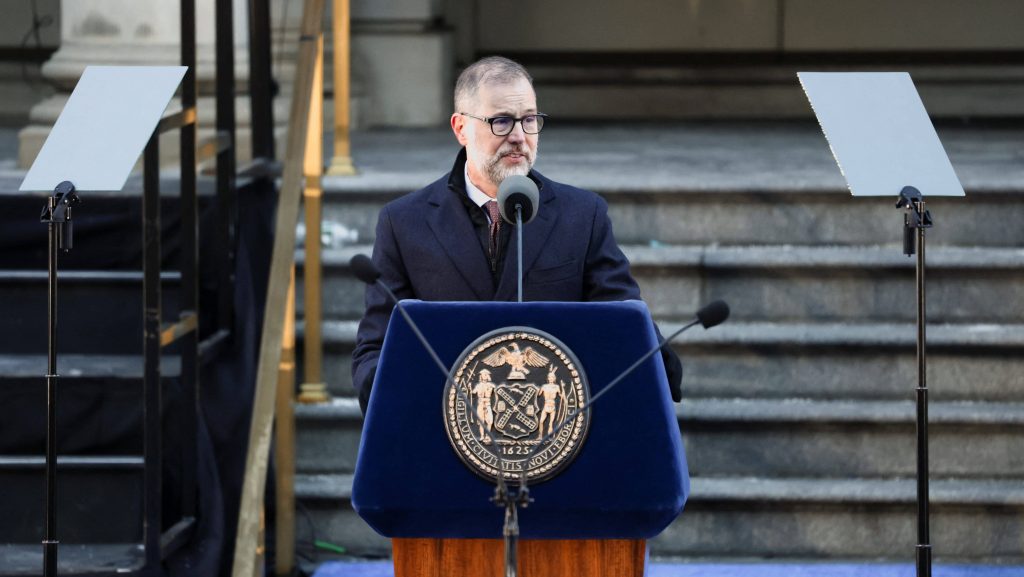
Comptroller Mark D. Levine speaks during New York City Mayor Zohran Mamdani’s inauguration ceremony in Lower Manhattan, January 1, 2026. REUTERS/Jeenah Moon
(New York, NY) – In recent days major credit agencies have taken official steps indicating they have concerns with the health of New York City’s finances. This includes Moody’s having recently changed its outlook from “neutral” (stable) to “negative” (investment risk) — adding to the financial challenges New York City faces under Mayor Zohran Mamdani and his desire for increased spending on social services programs.
That’s all while the city already faces a budget gap because it spends more than it takes in, as per tax revenue. Mayor Mamdani has proposed a $127 billion spending plan that could further stress the city’s financial standing. In addition to Moody’s downgrade, Fitch Ratings and Kroll Bond Rating Agency issued negative guidance for the Big Apple’s financial outlook.
Still, neither agency issued an immediate downgrade, but rather indicated caution. They each cited New York City’s strong reliance on the city’s “rainy day fund” and other reserves, such as retiree accounts. The credit ratings critically note that while the original plan was for up to $1.2 billion to be pulled from reserves, that number has now ballooned to $2.6 billion.
Mayor Mamdani has called on Governor Kathy Hochul to raise income taxes on some corporations and wealthy New Yorkers, saying he may be forced to raise property taxes 9.5% otherwise.
Big picture, the city is looking at a projected $5.4 billion revenue shortfall, which has been described as the largest since the Great Recession in 2008. And that’s despite robust wage growth (3%), record Wall Street bonuses (which mean more tax revenue), and other burgeoning sources of tax revenue.
Even tried and true lefty Democrat Comptroller Mark Levine has gone so far as to speak against the progressive orthodoxy, noting the city is spending more than it brings in, creating structural budget imbalances. He noted that a “negative outlook” such as what Moody’s issued is not a downgrade but serves as a clear warning.
With three of the four major rating agencies (Moody’s, Fitch, and Kroll) now issuing negative outlooks, Levine highlighted the urgent need for the city to address underlying structural budget issues rather than relying on short-term fixes like reserve drawdowns.