
If you or someone you know is experiencing domestic violence, help is available. Call the National Domestic Violence Hotline at 1-800-799-SAFE or text “START” to 887888. Free and confidential resources are available 24/7 in Spanish and 290 other languages.
In the heart of Bay Ridge, Brooklyn stands Bethlehem Lutheran Church, built in 1929. Featuring a Gothic-style stained-glass window, a cross at the very top of the church’s right-side tower, and an American flag mounted on a tall silver flagpole on the left side. Inside, sunlight filters through the windows, one of which reads: “God is Love.”
The chapel is frequented by the primarily white congregants who attend the 10:30 a.m. Sunday service. But each week, some visitors from a different background come to Bethlehem Lutheran for a different reason.
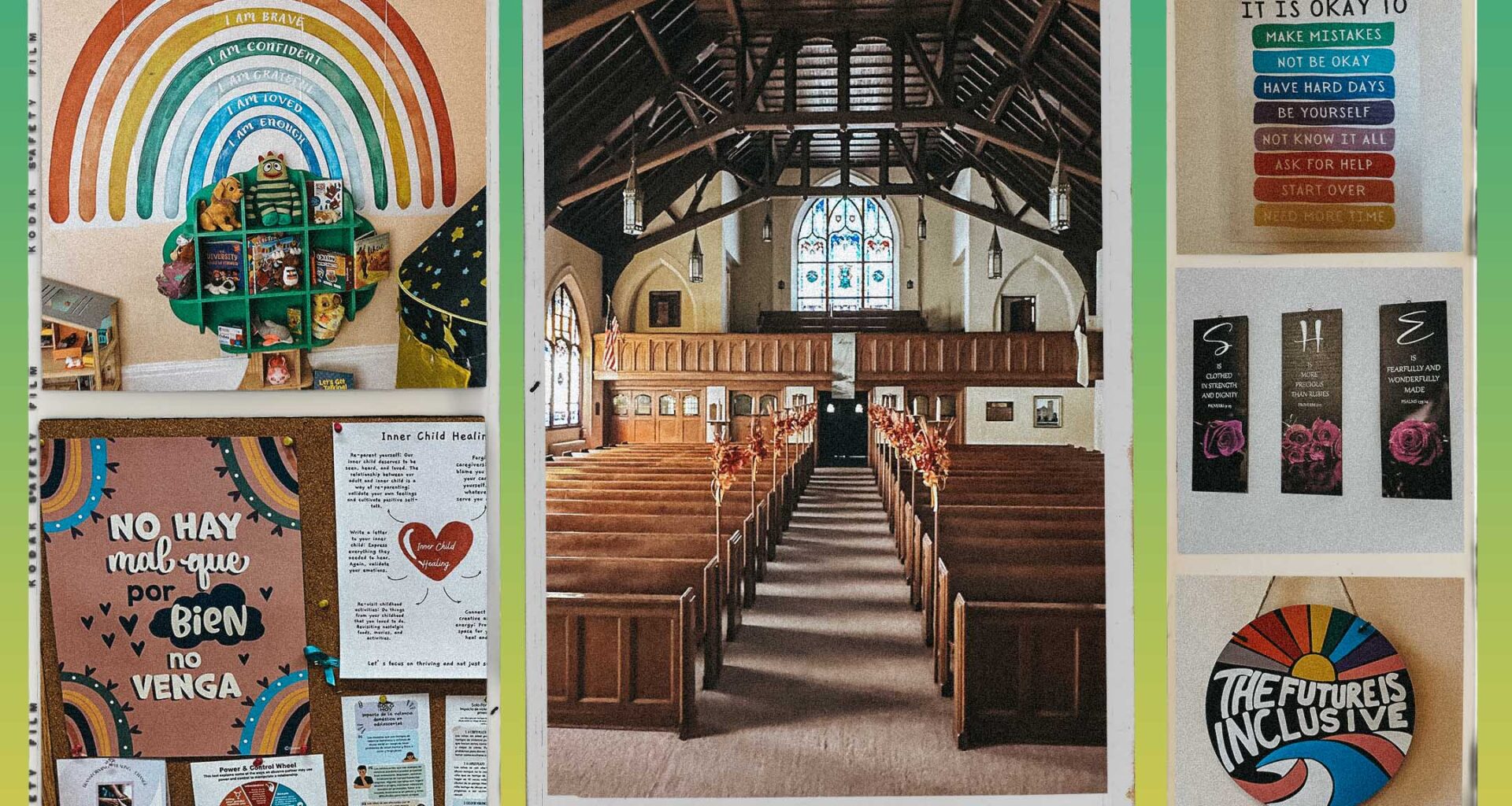
Adjacent to the church, behind an unmarked door, is the Healing Center. It has a gray sofa, purple curtains, and a frame with positive affirmations in Spanish: “Soy valiente. Soy inteligente. Yo merezco amor y felicidad.”
“I am brave. I am intelligent. I deserve love and happiness.”
The Trump administration’s aggressive immigration operations have been keeping people away from houses of worship nationwide. But this Brooklyn parish’s congregation isn’t afraid—and they’ve joined forces with a local organization to ensure a vulnerable population in their community—immigrant survivors of domestic violence and sexual assault—gets the support it needs.
Everyone is welcome
From the moment visitors step inside Bethlehem Lutheran, the church makes clear that its doors are open to everyone, regardless of race or background.
Pastor Paul Knudsen has led services for 30 years, and in 2014, Tony Clemente joined him as deacon. To see a white pastor and a Puerto Rican deacon leading the service is welcoming, Knudsen said.
“It doesn’t matter who comes through the door,” he added. “We’re going to welcome whoever they are.”
That philosophy of openness is what inspired the partnership between a domestic violence nonprofit and the church.
The Healing Center was founded in 2000 by activist Antonia Clemente, a 72-year resident of nearby Sunset Park and the wife of Deacon Clemente. The idea came from her experience doing work with a support group in a domestic violence shelter. She remembers a woman who would not lift her head to make direct eye contact during a discussion on empowerment, no matter how much Clemente encouraged her.
When she finally did, she saw a scar on the woman’s face.
“I think at that point is where I began to feel a sense of [a] call,” Clemente said.
The New York State Department of Health defines domestic violence as a pattern of behaviors used to establish and maintain power and control over an intimate partner. These can include physical, mental, financial, and verbal abuse, threats, and actions that may or may not constitute criminal acts such as isolation from family and friends, gaslighting, and controlling. Domestic violence can affect anyone—regardless of gender, sexual orientation, race, nationality, class, or religion.
“[Domestic violence is] about power and control over another person, where they lose their own autonomy,” Clemente said.
For immigrant women, it can be even more complex. Studies show that Latina immigrants often confront silence and stigma around domestic violence, which research suggests may derive from a patriarchal cultural belief that women should maintain their roles as wives and mothers and prioritize their children and husband over their well-being.
Latina immigrants who experience domestic violence frequently run up against multiple obstacles when seeking help, including economic dependency on their partner, language barriers in courts and police stations, and other systemic failures.
Religion is known for being a key player in shaping values, social norms, and community life. According to the Pew Research Center, nearly 70 percent of Latino adults identify with a religion. In some of these traditions, religious interpretations reflect patriarchal views limiting women.
That is not the image of God promoted at Bethlehem Lutheran, Knudsen said.
“We believe in a God who wants us to be our own people, that everybody’s on the same level together,” he said. “No one is to be lording it over anybody else here in this world.”
A study conducted at DePaul University in Chicago found that faith leaders’ approach to domestic violence is shaped by their religious beliefs. Psychologist Jaclyn Houston-Kolnik surveyed 20 Protestant religious leaders and learned that many had no training in the topic. That created uncertainty in responding, and they often referred cases to more experienced professionals, such as counselors.
New York State Assemblywoman Maritza Davila, who represents Brooklyn’s 53rd district, believes more churches should engage their communities in these kinds of difficult—and at times, dangerous—conversations.
“The church needs to do more in opening up the door and allowing professionals to come in and have this discussion with the parishioners,” Davila said. “Just giving them the information can be enough.”
Between 2015 and 2024, Hispanic women represented nearly 30 percent of New York City intimate partner homicides despite accounting for just under 15 percent of the city’s population.
Davila was instrumental in passing a 2018 state law requiring telephone and cable television companies to allow domestic violence victims to cancel contracts when a police report, protection order, or sworn affidavit is provided—without penalty. The National Network to End Domestic Violence found that 97 percent of survivors have been harassed, monitored, or threatened by perpetrators misusing technology.
‘You need to be doing God’s work seven days a week’
It took Clemente more than a year to bring her idea for the Healing Center to fruition.
When she first proposed the idea of opening a center to provide services and resources to Spanish-speaking survivors of domestic violence, both church leadership at Bethlehem Lutheran—then located in nearby Sunset Park—and the congregation had been skeptical.
People asked, “Who are the people that are coming? Was this going to be a shelter? What happens if a man comes? What happens? What are the things that we needed to have in place?” Clemente said. “They were, they were valid questions.”
By 2000, the congregation had come around. The church’s then-pastor at that time offered a small space in the church’s kitchen, and within months, the space was too small.
After struggling to navigate rising neighborhood rents in the search of a larger, more suitable location, Clemente eventually found a new home for the center at a fundraising event at her son’s Lutheran Elementary School. There, she spoke to Knudsen, who suggested an available space adjacent to the church.
In 2008, the center officially moved into its new home. The Healing Center is a social ministry—one of very few ministries in the country addressing gender-based violence affiliated with the Evangelical Lutheran Church in America.
That really shouldn’t be so rare, said Dr. Gina Foster, a professor at John Jay College of Criminal Justice who has provided cross-cultural crisis counseling for survivors of domestic violence.
“A faith-based organization that understands community and the importance of embracing the whole human being … can work really well with a nonprofit,” Foster said.
Knudsen agreed.
“Any church that just worships on a Sunday morning and then doesn’t do anything all week long is completely off track,” he said. “Yes, worship is important for us, but you need to be doing God’s work seven days a week.”
Children witness domestic violence in nearly 1 in 4 cases filed in state courts, according to the National Domestic Violence Hotline.
That knowledge informs the Center, which provides help for all family members affected by domestic abuse, as well as its holistic support system—which starts with Cafecito, a Tuesday program where mothers come together to support one another over coffee and pan dulce, or sweet bread.
“I take off work to go to Cafecito, after Cafecito I take the day for myself,” Fortaleza, a domestic abuse survivor and single mother whose name has been withheld for her safety, said in Spanish.
Fortaleza came across the Healing Center at a street fair one Sunday afternoon. She had sought support before, but hit so many barriers: transportation, time, and having to end her therapy sessions when her insurance became inactive.
Today, the Healing Center is a meaningful, “empowering” part of her life, and a source of friendship.
“Being heard is the most beautiful thing,” Fortaleza said.
The church also hosts the Hi-5 program, which provides therapy for children who have experienced and witnessed domestic violence. The program Daughters of the Lotus offers support to teenage girls.
“It’s [an] intergenerational approach,” Healing Center Executive Director Noeline Maldonado said. “We’re gonna continue to take care of the whole family, the unit, for however long it takes.”
The Center is also thoughtfully intercultural, as it serves a Brooklyn neighborhood where many residents come from Mexico and Central America.
“Culture plays a big part,” Maldonado said.
Faith and healing shape the relationship between the church and the center, she said.
“The congregation is so committed to the work that we’re doing … they put their money where their mouth is,” Maldonado said.
Davila pointed out that with comprehensive assistance, survivors can pursue new paths.
“Addressing domestic violence holistically can really make a difference,” Davila said. “We know women with doctorates right now who were once abused and helped this way.”
The Center is active on social media, participates in community tables, and receives referrals from schools, hospitals, precincts, nonprofits, and community organizations. For many survivors, these networks are often how they first learn that help exists.
Churches under ICE threat
Fear of deportation can prevent undocumented immigrants in violent situations from reporting the abuse to law enforcement.
Officially, abuse victims qualify for federal protection from deportation through the T and U visa programs. But in practice, schools and churches are frequent sources of refuge because of their longstanding status as government-free asylum spaces.
Since the Trump administration began aggressively abducting people on the streets of major U.S. cities and removed asylum protections from schools and churches in January 2025, however, church attendance nationwide has declined markedly. Dozens of religious groups are suing the government, saying the raids infringe on their religious freedom to minister to all their congregants—including undocumented migrants.
Still, Maldonado finds that even in this climate of fear, more people actually come to the Center for services.
“They’re relying on us even more, especially since we’ve pivoted and worked with local legislators,” Maldonado said. “They trust us, and … we help them know their rights.”
Today, some research, including a recent study from the Hunter College School of Social Work, suggests that immigration status—more than cultural or language barriers—is the biggest factor in whether and how domestic violence is responded to in immigrant households.
Despite ICE threats and cultural pressures within religious communities, the Latino immigrant community of South Brooklyn has a safe space to tell their stories and prioritize their well-being. Fortaleza wants every woman in a difficult situation who needs to hear that message of hope.
“If I can do it,” she said, “so can they.”