
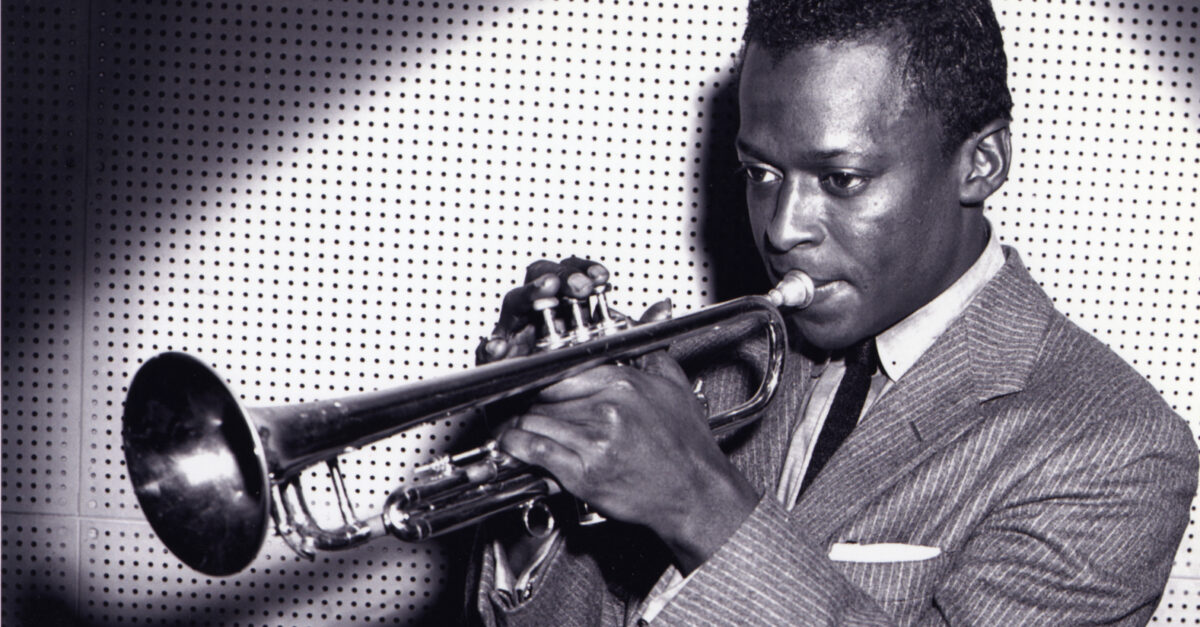
One of the most innovative musicians of the 20th century, Miles Davis contributed to the art of jazz in myriad ways. His classic 1959 album, A Kind of Blue, is the best-selling jazz record of all time, and his stylistic diversity made him a huge influence on generations of performers and composers.
The Juilliard Jazz Orchestra honors Davis on his birth year centenary with a concert, The Musings of Miles Davis at 100, April 4 at Alice Tully Hall. Tatum Greenblatt, the Juilliard jazz faculty member who will conduct the performance, discussed why Davis remains such a giant in the world of jazz. “He serves as the archetype of what jazz is in the eyes of a lot of people,” Greenblatt explains. “He not only worked in but also defined so many sub-genres of jazz in his lifetime. He always pushed the music forward—he was at the forefront of jazz’s evolution.”
Davis was a restless artist who never was pigeonholed as a purveyor of one type of music. Born in Alton, Illinois, and raised in nearby East St. Louis, Davis went to New York in 1944, earning a scholarship to Juilliard. Although he left school the following year, he began immersing himself in the New York music scene, and soon he was performing with bebop founder Charlie Parker. “Miles starts right at the forefront of the modern jazz movement, and everything he does helps define what modern jazz is considered to be at that time,” Greenblatt says. “He really is the figurehead for the unrelenting progression through his music.”
Since Davis went through so many stylistic changes—including cool jazz, post-bop, and electric jazz, along with his finding inspiration in funk and rock, and even Spanish and African music, to create a brand new typeof jazz fusion—he alienated some fans while inspiring so many others.“ He was always at the vanguard of what was new, but not just for newness’ sake,” Greenblatt notes. “His move into the electronic realm was controversial, but he wanted to create music that was accessible to younger people who liked rock’n’roll. He never shied away from that as an artist.”
That multifaceted creativity will be on display in the April 4 concert. “What we’re trying to do is represent an overview of the phases of his career, have some sort of progression through his development as an artist—but putting together a comprehensive overview is difficult,” Greenblatt admits. The flexibility of the jazz student ensemble will be a great help, since Davis wrote music for big bands as well as smaller groups of players. “We’ll have more than just the big band—we’ll have different sizes and combinations of instruments, including the smaller groups,” Greenblatt continues. “His album with Gil Evans, The Birth of the Cool, included an influential nine-piece band that was very unique, very modern.”
Greenblatt is also looking forward to collaborating with Juilliard students who are classical, not jazz, musicians. “Some of Davis’ most popular records from the 1950s were recorded with Gil Evans writing for a studio orchestra—a jazz big band that expanded even further to include more players and instruments,” he says. “The music from those collaborations is so beautiful, and we’re planning to expand our orchestra onstage to include Juilliard classical musicians when we perform it.”
As a fellow Juilliard alum and trumpet player, Greenblatt humbly acknowledges Davis’ impact. “I don’t think there’s a jazz trumpet player who hasn’t been influenced by Miles,” he says. “What made him so unique is that he bucked the trend of playing so many notes in the bebop era and then went on to establish a new style of simplicity and minimalism. He’s in everybody’s pantheon of the greats.”
Although Davis’ influence has only grown since his death at age 65 in 1991, what would the master think of this centenary concert honoring his legacy? “Some colleagues and I have been joking about whether he would approve of this retrospective,” Greenblatt responds. “It’s because he never wanted to look back—he always pushed forward.”