
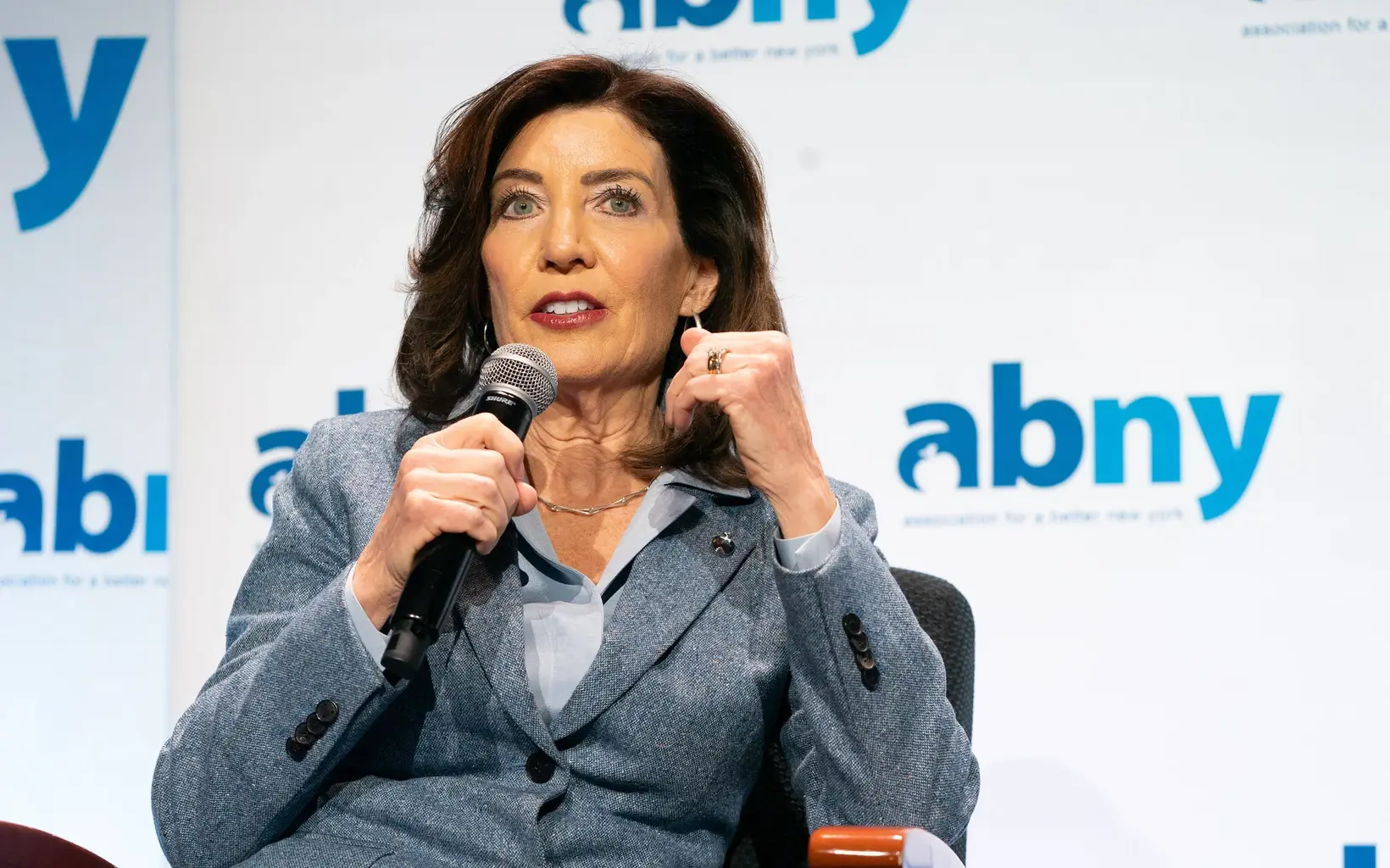
The core of the governor’s proposal is to push back New York’s first big deadline for emissions reductions mandated by its landmark 2019 climate law. In an op-ed outlining her proposed changes, Hochul said she considers that original target out of reach.
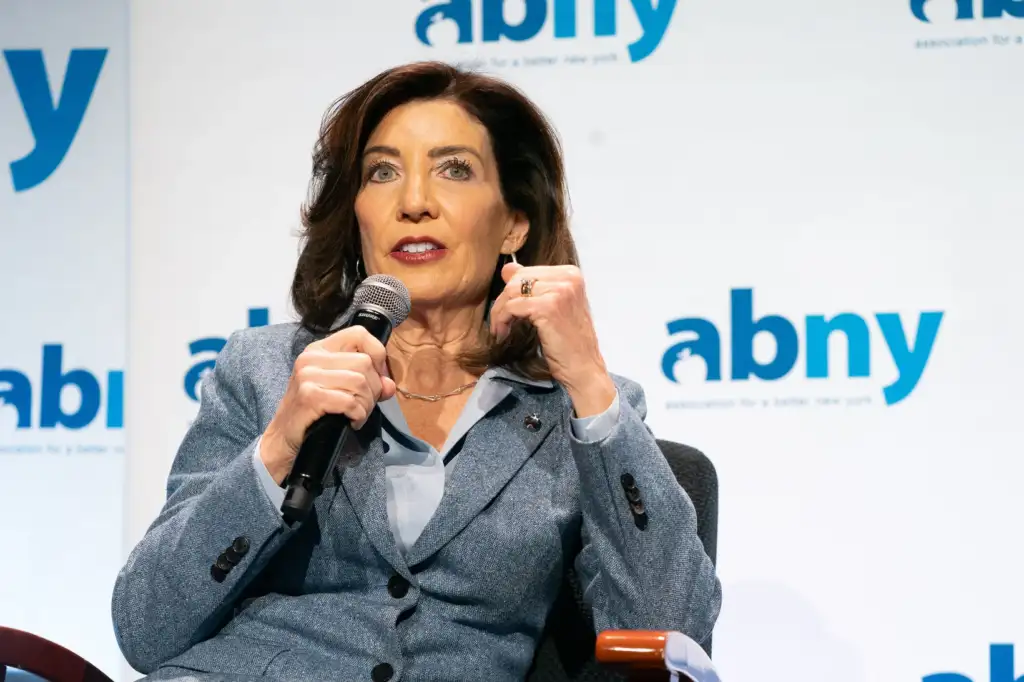 Gov. Hochul at an event on March 19. (Office of Governor Kathy Hochul)
This story originally appeared in New York Focus, a nonprofit news publication investigating power in New York. Sign up for their newsletter here.
On Friday, Gov. Kathy Hochul finally unveiled the changes she wants to make to New York’s flagship climate law, after months of waffling.
The core of Hochul’s proposal is to push back the law’s first big deadlines for emissions reductions. The 2019 law, dubbed the Climate Leadership and Community Protection Act (CLCPA), requires New York to cut emissions 40 percent from 1990 levels by 2030. And it required the state environmental agency to issue regulations by the start of 2024 to achieve those cuts.
Hochul’s administration failed to do so, and was given an ultimatum of sorts by a judge last October: Issue the rules, or change the law.
Hochul has chosen the latter. She wants a seven-year extension on the 2024 deadline—pushing it to the end of 2030—and wants to link the rules to a new, as yet unspecified emissions target in 2040. She also wants to revise how the state counts emissions, effectively allowing homes and businesses to burn more gas for longer.
The governor doesn’t want to change the original 2030 emissions target in the law, according to a spokesperson. But without rules to enforce it, it would be rendered largely toothless. In an op-ed outlining her proposed changes, Hochul underlined that she considers that original target out of reach.
“We will be dealing with a White House outright hostile toward renewable energy for at least another three years, making it impossible for us to meet our targets without imposing higher costs on homeowners, renters, and businesses,” she wrote.
Under Hochul’s proposal, the law’s most concrete deadline for action would be pushed out to the end of her potential second term as governor.
“This is an attempt to evade accountability for the state to do what is needed to implement the climate law and have some real solutions for New Yorkers,” said Rachel Spector, deputy managing attorney at the environmental law nonprofit Earthjustice.
Business groups have broadly supported Hochul’s push to change the law. Influential labor leaders have also come on board in recent weeks as the governor pressed her case.
“These are reasonable and necessary corrections that will avoid onerous and costly mandates based on impractical emission-reduction targets,” said Heather Mulligan, president of the Business Council of New York State, in a statement on Friday.
Hochul is seeking to push the climate law amendments through the state’s budget process, which has an April 1 deadline and is Hochul’s main opportunity to advance her legislative agenda.
Lawmakers in the State Assembly and Senate initially rebuffed Hochul’s push to change the law in this year’s budget, but some have softened their tone in recent days. The leaders of the two chambers declined to comment before seeing the details of Hochul’s proposal.
Senate environmental committee chair Pete Harckham, who earlier this month railed against what he called “fabricated” numbers Hochul was using to justify climate law changes, is now signaling that he expects a budget deal to go through. A spokesperson for Harckham declined to comment further on Friday, saying that the senator would defer to Democratic caucus leaders.
Assemblymember Al Stirpe told reporters Friday that he was open to “adjustments” to deadlines in the law, possibly in exchange for climate funds in the budget, but rejected the idea of changing how the state counts emissions.
State Senate Finance Committee Chair Liz Krueger, however, remained withering in her assessment of Hochul’s push.
“I can only comment on what I can confirm, which isn’t much since nobody seems to have an actual written proposal beyond an op-ed that came out this morning … this is a strange way to go about the business of government,” she said in a statement to New York Focus.
“Those of us living in reality know that if we do what the governor is proposing and roll back CLCPA, it will do absolutely nothing to reduce energy costs for New Yorkers,” Krueger continued. “The only problem it would solve is the manufactured political crisis that the governor has created for herself. But it will absolutely deepen and lengthen our reliance on fossil fuels in the middle of yet another oil crisis draining New Yorkers’ wallets.”
Climate advocates remain adamantly opposed to rolling back the law in the budget.
“What the governor is trying to do is jam in major changes to the climate law behind closed doors at the eleventh hour with no public input,” said Meg Ahearn, executive director of the New York Public Interest Research Group (NYPIRG). “The climate law in 2019 was not passed by placing a guest editorial in the press. And this is an issue of such great, great consequence, it cannot be done in secret.”