
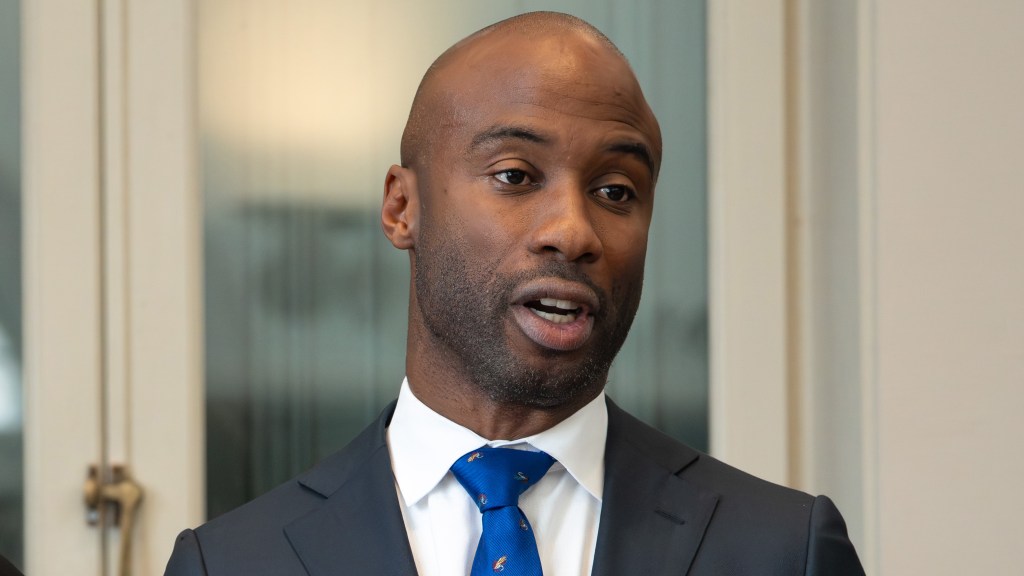
New York City’s public school system on Tuesday is set to release highly anticipated guidance on artificial intelligence in the classroom, Chancellor Kamar Samuels said during a City Council hearing Monday.
The forthcoming guide, which education officials have described as a first step toward a more comprehensive handbook to be issued at a later date, is coming as families and teachers are deeply divided and anxious about the potential — and pitfalls — of the new technology.
“Our work to leverage technology responsibly continues with our foundational AI guidance, which will be released tomorrow and will include opportunities for community input,” Schools Chancellor Kamar Samuels told the City Council’s Education Committee.
The chancellor’s comments at the hearing, which focused on the school system’s proposed 2026-27 academic year budget, followed weeks of teasing the guidance at forums across the city, where he spoke of the pros and cons of integrating AI in schools.
“Some of us, as educators, recognize that there’s some potential in AI to accelerate some learning,” Samuels said at a recent town hall in Manhattan. “There are opportunities that we can take advantage of.”
“But simultaneously, this needs to be done [responsibly]. We cannot do this without the safeguards that are necessary,” the schools chief added.
After the release, Miatheresa Pate, chief academic officer of the public schools, said during the town hall the system will open a 45-day window for feedback, before finalizing what they’re calling a “playbook” for schools and AI.
Pate said it will be presented as a “traffic-light” system. Old drafts obtained by the Daily News, which predate the Mamdani administration, are broken down by green, yellow and red lights: Allowed uses, uses that will require approval, and uses that will not be permitted.
Students and teachers are increasingly using AI since the school system lifted a 2023 ban on ChatGPT — but citywide policy has not kept up. In the absence of that guidance, several school and community boards across the city have passed resolutions calling for an “AI moratorium,” with some calling for a pause of up to two years.
Michael Mulgrew, president of the United Federation of Teachers, said AI “must be used wisely” and cannot replace the “human connection between educators and students.” Where he has concerns, he said, is related to how education officials could use AI without proper oversight.
“School communities want common-sense guardrails to protect their students and their students’ data,” the teachers union boss said in a statement.
Jennifer Watters, a third-grade teacher at Public School 229 in Woodside, Queens, said she uses AI in grading and lesson planning, such as working the hit animated movie “KPop Demon Hunters” into her classes. She’s also turned to the new technology to help specific students, such as translation services for those learning English or audiovisual supplements to math tests for struggling readers.
Watters welcomed the guidance but asked that teachers be given a seat at the table.
“It’s kind of late in the game for the Department of Education already,” she said. For example, personally identifiable information should be “off limits” for AI use, she assumed, based on student privacy trainings. “I know that. But does everybody know that? The city is a big system.”
Linda Noble, a social studies teacher at Brooklyn College Academy, created her own GPT-like large-language model about a year ago, which she named “Alice,” and trained it to interact with her in specific ways and to have a particular knowledge base.
“I’m very clear that I am the creator, and AI is the tool in my hand,” Noble said. “So, I will use it to co-plan [lessons] with me. Also, when I get student work, it provides some qualitative feedback. It’s not giving the grades. I can look at that individually to customize the next lesson, and I can look at it in aggregate,” she continued. “So AI, in that sense, is making me a better teacher.”
Noble’s students do not interact with her GPT.
“It is based on existing data, and there are biases in existing data. It gives probable answers that are not always accurate answers. So, there needs to be a critical consciousness around the use of it,” she said.
The guidance comes as the local debate over AI in education has hit a fever pitch with a proposal for an AI-focused public school, as first reported by Chalkbeat and Gothamist. As of Monday afternoon, an online petition against the creation of Next Generation Technology High School in FiDi had amassed close to 1,300 signatures.
“The thing that’s infuriating to me is that they continue to not only use AI, but expand AI,” said Leonie Haimson, co-chair of the Parent Coalition for Student Privacy. “There’s additional research put out [that] AI is spreading falsehoods, undermining skills development and creativity.”
“All of these things are really seriously potential harms to kids’ education, not to mention the privacy issue,” said Haimson, who also sits on the school system’s AI working group. “Whatever the playbook has or doesn’t have, it’s not gonna allay the concerns of parents, teachers and others who really want a human-centered education.”