
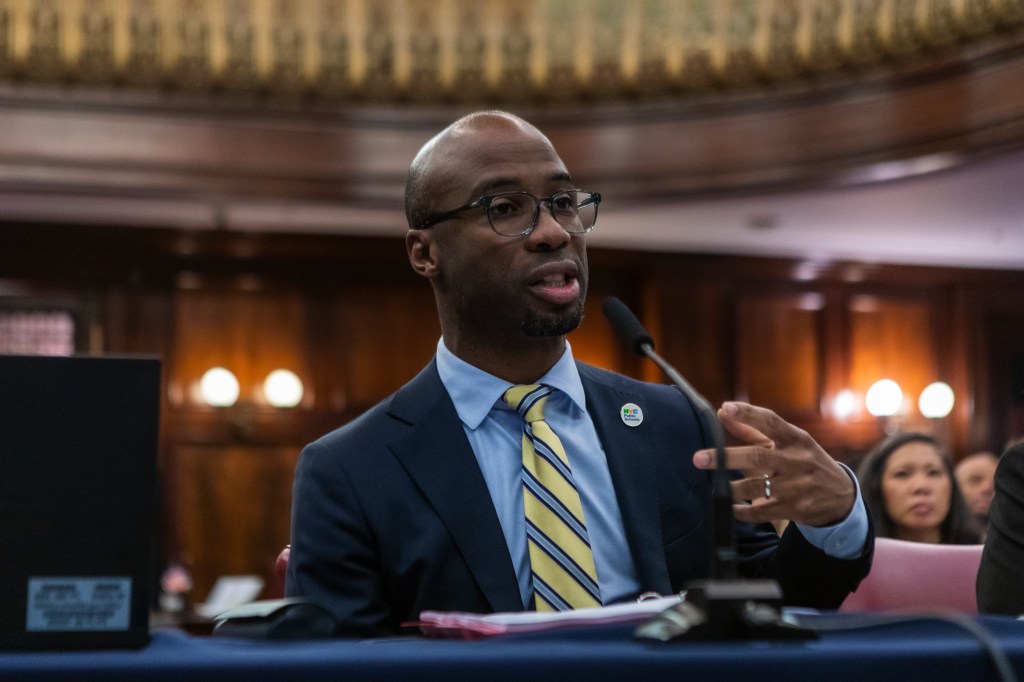
The New York City Council on Monday challenged Chancellor Kamar Samuels to find savings in the Department of Education’s $38 billion proposed budget — the largest of all city agencies.
Mayor Mamdani in January ordered the school system, like the rest of local government, to appoint a “chief savings officer” tasked with making their department more efficient. Plans were due on Friday as agency heads face a tall order: Dig New York City out of a multibillion-dollar budget hole, with limited impacts to city services.
The education budget in a typical year is about a third of the city’s total financial plan, which has historically failed to account for actual spending. To right that wrong and still balance the budget, school officials said their submission included a “wide range of options,” such as adjusting noninstructional programs or cutting duplicative spending.
“Those are conversations that we are having now — not sure how much we had those conversations before,” Samuels said.
One of the areas where school officials hope to bring down costs is private special education spending by serving more students with disabilities inside the public school system. Those costs are reflected more accurately in Mamdani’s proposed budget plan than they were in years past.
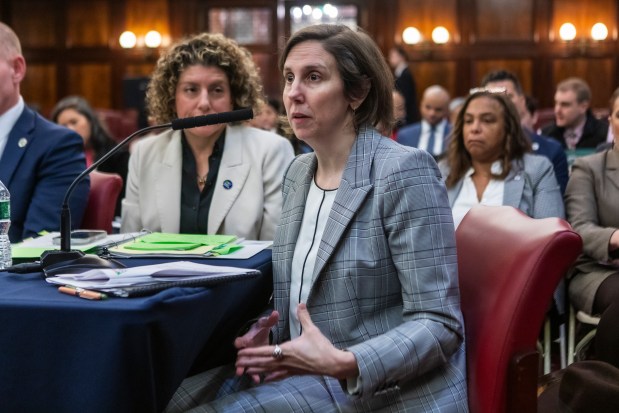 General Counsel Liz Vladeck photographed during the Committee On Education Hold Preliminary Budget Hearing For FY2027. (Emil Cohen/NYC Council Media Unit)
“We’ve identified a tremendous amount of fraud and abuse and simple misunderstanding that this is not just, you know, free money,” said Liz Vladeck, general counsel for the public schools. “And so, we’ve taken, extensive steps to tighten up the process. We’ve made numerous criminal referrals.”
Council members pointed to areas of the education budget where they hoped to find savings.
“The DOE’s budget continues to have areas that appear to be overbudgeted. For example, the budget for books has been consistently overbudgeted when comparing actual spending to the adopted budget,” said Councilman Eric Dinowitz (D-Bronx), chairman of the Education Committee.
On average, the system has underspent $43 million on books each year, according to Dinowitz.
“We are definitely looking — I would say actually turning over all the couch cushions — to see where there’s underspend, especially now that we are under the executive order to achieve savings,” said Seritta Scott, chief financial officer of the public schools.
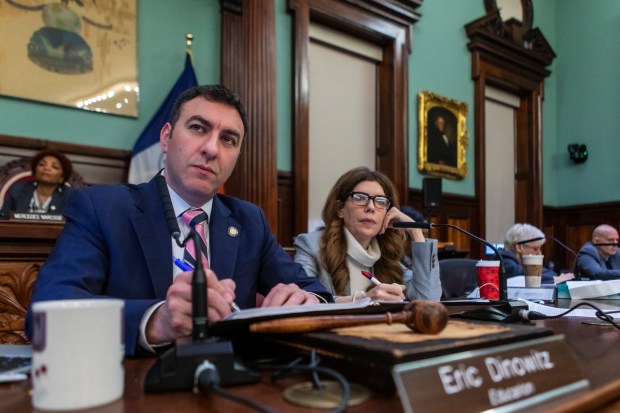 Eric Dinowitz, left, and Julie Menin photographed during the Committee On Education Hold Preliminary Budget Hearing For FY2027. (Emil Cohen/NYC Council Media Unit)
Council Speaker Julie Menin (D-Manhattan) pressed officials on the system’s whopping contracting budget, including agreements with outside consultants and technology firms.
There are roughly 3,000 active contracts with annual spending of $7 billion, according to Elisheba Lewi, chief procurement officer of the public schools. Of all awarded contracts, 6% are considered noncompetitive, commonly referred to as “no-bid.”
But the Council was split on a politically toxic issue of cutting school budgets, in response to enrollment declines.
Since the COVID-19 pandemic, mayors have largely funded schools at the same levels, recognizing the need for stability. But without federal aid that was provided during the public health crisis, city leaders have struggled with what to do now, with student enrollment projected to keep falling.
The enrollment declines, paired with the funding cushion, has also helped public schools lower class sizes in accordance with a new state law.
“We are seeing shifts in enrollments in our schools, and there comes a time where we’re going to have to reflect that in our in our budgets,” said Councilman Lincoln Restler (D-Brooklyn). “Are conversations happening now around gradually shifting funding?”
“There are not many individual issues that we will discuss at any of these hearings that impact our collective vote on the entire $127 billion budget. That’s how important this is,” Restler added. “I really want to make sure we’re not in a situation where we’re seeing school budgets a day before the vote and … we need to vote ‘no’ on a budget because our schools are getting screwed.”
Councilman Phil Wong, a conservative Democrat from Queens, was more negative in his assessment: “At what point do we acknowledge, are we funding empty seats?”
Education officials said no final decision has been made on the funding policy for the upcoming school year.
“Nobody wants to think about removing funds, if you will, from a school,” Samuels said.
“So, we’re continuing to have those difficult conversations within DOE, and no decision has been made.”