1
lifestyle
Not too long ago, if we measure time in the life of a city, Hoboken was a gritty blue-collar town teeming with cheap buildings just begging for creative types to take up their wilder inclinations and let their imaginations fly. That golden era for creatives in Hoboken lives on in honeyed hues in the memories of the Mile Square’s artists of a certain age. Today’s Hoboken is not that Hoboken. The lively, vibrant little city on the Hudson is too popular and far too pricey a place to play that kind of role these days. Yet and still, artists live and work here, some in situations they fear looking at directly, dreading any change to their charmed but precarious studio situations. Read on to learn about the past, present, and possible futures that Hoboken visual artists describe as they reflect on their experience of living and working in our ever-changing municipality.
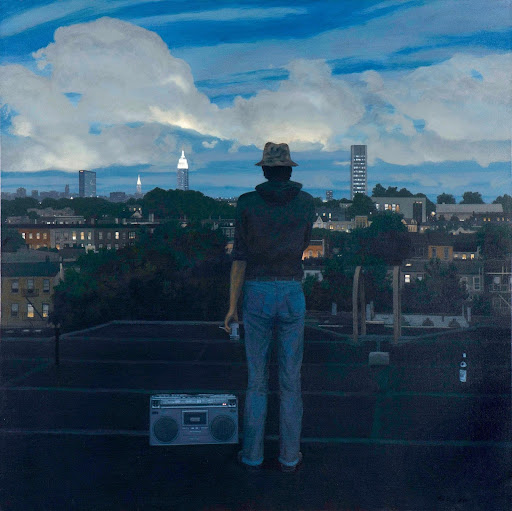
The Roof, Hoboken by Tim Daly
Hoboken, from an Artist’s Vantage
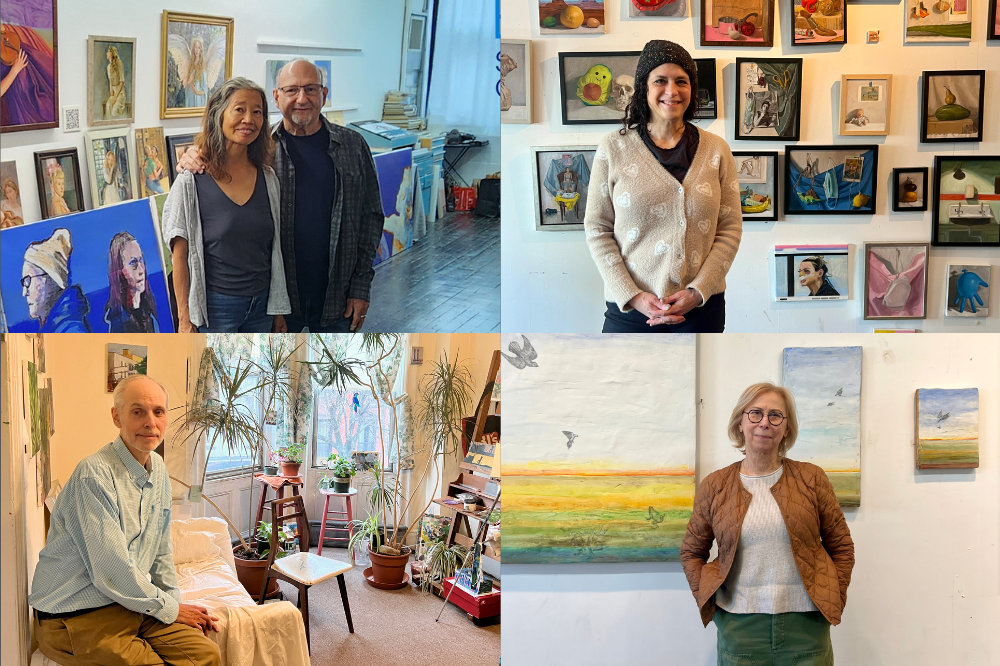
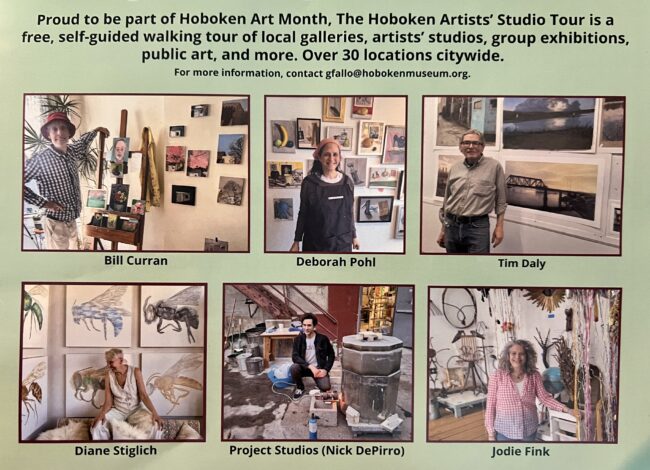
Tim Daly has lived and painted in Hoboken since the 1970s. He has often painted the people and places here, incidentally documenting the changing times. Tim’s masterful paintings provide an archly nuanced view of the world he sees. He rooted his art practice here in the 1970s and remembers it as funky in all the ways that art hubs have to be to thrive. Art thrived, music thrived, but he feels that the Hoboken he called home then could not have dreamt it might someday become the rather upscale city of beautiful accessible riverfront, swanky bakeries, and bespoke shops that it has become. There was a period, he remembers, when the elementary schools were shutting down, one after another. Families with young children were not moving into Hoboken. So the artists and musicians discussed which of them they might turn into an arts building. That didn’t happen, and today, thankfully, Hoboken is an attractive home for families, but that window of opportunity for artists to grab some space and hold on to it is one Tim thinks about when he looks at the high-rises going up all over town.
Winifred McNeill returned to New Jersey in 1985 — after working as a teaching artist in Rome — to find that the atmosphere in Hoboken was electric. Like many Hoboken artists, she has fond memories of hanging out with other local artists at Maxwell’s, the legendary music venue run by Steve Fallon. She is the keeper of a rich Hoboken history that includes Paul Drexel and Susan Shaftan’s Oroe Electric Art Space, a once-beloved gallery that has no digital footprint to celebrate it. Winifred’s memory runs deep because she was part of the action. She still is, though she worries that it is increasingly difficult for young artists to build a career in the city that so welcomed her.
Read More: This Union City Furniture Store Turns Into a Cozy Cafe on Weekends


Geri Fallo has been central to much of what goes on in Hoboken’s art scene since long before she moved into town from North Bergen in 1990. In 1986, she launched the Projected Images of Hudson County weekly film series at Maxwell’s and Shannon’s Lounge. Before that, in 1981, Geri helped push for the Hoboken Artists’ Studio Tour that continues to bring new audiences into the workspaces of Hoboken artists. Until recently, she served as Hoboken’s Cultural Affairs Administrator. That role allowed her to put in place numerous programs and annual events that let Hoboken artists shine. Hers is a legacy other local artists treasure as her energetic support has long been critical to the success of the larger art community.
Painter and Hoboken Historical Museum manager Bill Curran has resided in Hoboken for 42 years and for 40 years in the lovely, low-rent second-floor apartment where he lives and paints. From 1980 to 2003, he drew old school advertisements for Lord & Taylor and then designed ads for Yellow Pages. Today, he paints tranquil still lifes and serene, intimate scenes. Bill has watched as the rising cost-of-living caused the exodus of artists less lucky than he. He boasts a great landlord whom he trusts to keep providing the stable home he’s thrived in all these years. Bill is a true Hoboken booster, promoting local artists both living and long deceased. He leads a “Famous Artists of Hoboken Walking Tour” that includes Dorothea Lange, Willem de Kooning, and Alfred Stieglitz. He remembers when Hobokeners regularly sat outside on the stoop, when nearly all the shops were mom-and-pop owned, and everything shut down at 11:00 PM.

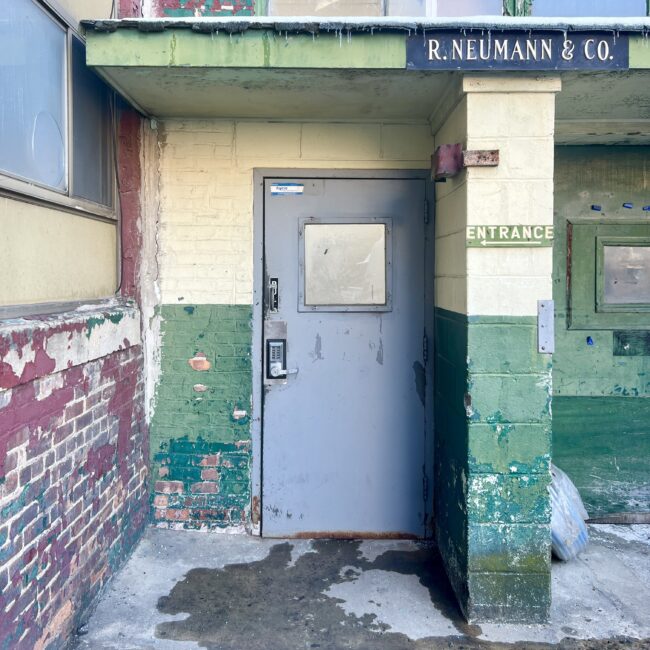
(The Neumann Leather Building, 300 Observer Highway)

Affordability? Yes, Please!
For Hoboken artists who maintain studios in the fabled Neumann Leather building, the future has long felt precarious. Neumann Leather artists know they have a good thing going on. Rents are generally affordable and are much less than what’s available locally elsewhere. Questions around the building’s uncertain future are a sore subject for this crowd. No one wants to see the good times there end.
Deborah Pohl has lived and painted in Hoboken since 1998, a newcomer by some standards. She shares a small sunlit studio in the Neumann Leather building with her musician husband. Deborah calls herself a community artist and is proud to hold studio space in a building that has long served as home to so many of Hoboken’s great creatives. She has received two New Jersey artists’ grants throughout her career and enjoys the attention her art receives from being on the Hoboken Artists Studio Tour. She could not maintain her studio space if her rent was increased, and tries not to take for granted the opportunities for connection that come from mere proximity.
Geri Fallo looks back to her time working for the Jersey Journal’s Gold Coast Magazine and sees that magazine as both an asset to artists and a harbinger of the real estate inflation to come. Throughout the 1980s and early 1990s, the special pull-out newspaper section focused on local music and culture in Hudson County, particularly in Hoboken and Jersey City. Gold Coast Magazine highlighted the local arts scene, including studio tours and music venues like Maxwell’s. Then, Gold Coast Magazine took over the promotion of the Hoboken Artists’ Studio Tour and helped grow the tour and attract more artists to Hoboken. But, Geri notes, it also brought more development. Raw warehouse space was torn down to build condo buildings. Rents increased, and many artists were priced out.
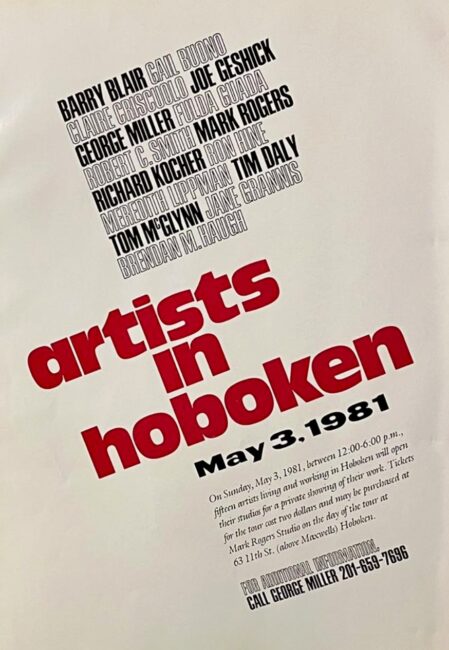
(The first Hoboken Artists Studio Tour)
Memories of a Bygone Hoboken
There was a time when several gritty Hoboken buildings held artists and their projects. At one point, on Eighth Street and Adams, a storage facility served as a center for artists. This group moved to the Monroe Center, which is not at all what it once was. It’s the rents that are to blame. Artists who have left the Center look back with sadness and nostalgia at the years when the building teamed with artists, many of whom commuted in for open house events and exhibitions.
It has not been so long since the Monroe Center was swarming with artists. Many artists recall Hob’art, a co-operative gallery established in 2002 by artist Liz Ndoye that closed after rent became impossible to meet in 2018. Edward Tadiello and Gloria Pacis of EDG Studio Gallery are two of the few artist studios still in the complex. They miss the old days when they were surrounded by other artists, but are grateful to have the community and clientele they’ve built for themselves.
Nick De Pirro, who runs the very efficient and inviting Project Studios in the Neumann Leather Building today, previously ran PROTO Gallery in Hoboken. He recalls Field Colony, Roig, and Rexer among the galleries that have come and gone. Other shuttered art ventures around town include Hand Made, a gallery shop that Maxwell’s Steve Fallon developed to feature work by local artists. Geri Fallo remembers when artist Joe Borzotta founded Hoboken Creative Alliance, a multidisciplinary arts group with over 250 members. The Alliance lasted from 1990 to 1994. Everyone remembers with great affection the curatorial leadership of Cynthia Sanford at the — RIP — Jersey City Museum.
Barsky Gallery is still in operation, though it lost its original space in the Chamboard Building fire. That fire scattered a number of Hoboken artists. Many found a home with Project Studios in the Neumann Leather Building; others sought space in Jersey City.
Nick De Pirro considers the period between 2010 and 2020 to have been a bit of a boom for Hoboken art gallerists. The city was getting hot, but still held more affordable space than Manhattan or even Brooklyn. The tiny physical outline of Hoboken has meant that the cost of space has skyrocketed since then, and that’s not a good situation for working artists.
Do Artists Dream of a New Golden Era?
Hoboken is, as it has been since it was given its name, a city shared with new immigrants. It is a vibrant little city where many languages are spoken in the streets, many religions are practiced in its sacred places, and diverse ideas on most subjects can be found. That will, hopefully, never change. But it is unlikely to again become a place where housing is cheap, a fundamental basic requirement for up-and-coming artists looking for workspace.
Other cities in the United States and around the world have countered unattainable art studio rental rates with municipal programs that allot areas for artists as subsidized, rent-controlled, and free art residency spaces. Models exist for scaffolding infrastructure that creatives can rely upon.
Hoboken artists speak of their current and past mayoral administrations as being sensitive to their needs. They are, as a group, optimistic about Mayor Emily Jabbour’s administration’s role in securing a role for artists within the city despite a lack of a plan to address the increasing unaffordability problem faced by local creatives.
The future is not clear for artists, but Hoboken City Hall has several points of pride established to support the arts generally and, at least, a few artists individually. The City of Hoboken established an Arts Advisory Committee on May 10, 2019, through an executive order signed by Mayor Ravi Bhalla. The committee was created to select and recommend public art projects funded by a 1% bond dedication for the arts. Some aspects of this fund — like the memorial restoration project — are great for city improvement, but less critical to the well-being of local artists.
Other programs, like the Play Hoboken kids’ art classes, provide jobs for teaching artists. The Public Art fund projects include: the Utility Box murals, the murals at Tom Oliveri Park, the 7th and Jackson Resiliency Park Community Mural, Jason Sagat’s “Layers” on display at City Hall, a new mural planned for the Jubilee Center, public art at the new Maritime Park, and the restoration of the 100 Years of Hoboken mural. The Hoboken Cultural Affairs office works with sister institutions like the Hoboken Business Alliance and the Historical Museum on endeavors like Art Month every October, and they provide paid opportunities for local performing artists at festivals.
There are good things afoot even in this period of financial crunch. “Art Through the Windows” is an annual, six-week Hoboken arts initiative curated by Main Street Pops and Barsky Gallery and sponsored by the Hoboken Business Alliance that transforms local business storefronts into gallery spaces. The Hoboken Historical Museum’s Upper Gallery does a fabulous job of showing local artists’ work and hosting them for recorded interviews and artist talks.
Carmen Rusu, herself an immigrant from Romania, has pieced together a life in Hoboken focused on building community with as much support for creativity in her neighbors as she can muster. Carmen is the founding director of Symposia Books and of Puppetonia, a delightful project that she operates within her bookstore. She and her husband have hosted exhibitions and art vendor fairs throughout the tenure of the store. She thanks her angel of a landlord for the opportunity to do all of it.
It is not uncommon for Hoboken artists to express thanks to their individual landlords. Building owners who live in the city and have no corporate investors to answer to are sometimes driven to make community dreams feasible. Will these independent landowners exist in a decade, or will every Hoboken property be part of a money-making venture for a board of investors to whom real estate is dividends, not a neighborhood? The terms of that future will likely depend upon the political pressures applied or not applied now, to the brave fight of our local arts advocates or the silence of the satisfied. No one in Hoboken City Hall today seems to have a clear path to establish affordable art spaces in perpetuity, but no artists — despite widespread concern — seem to be making a case for that future.
See More: 11 Must-Visit Art Galleries at The Jersey Shore
Follow @thehobokengirl on Instagram + TikTok for the latest Hoboken and Jersey City updates, sign up for our weekly newsletter here that shares everything you missed each week, and check out our events calendar, which has over 100+ events weekly to peruse.