
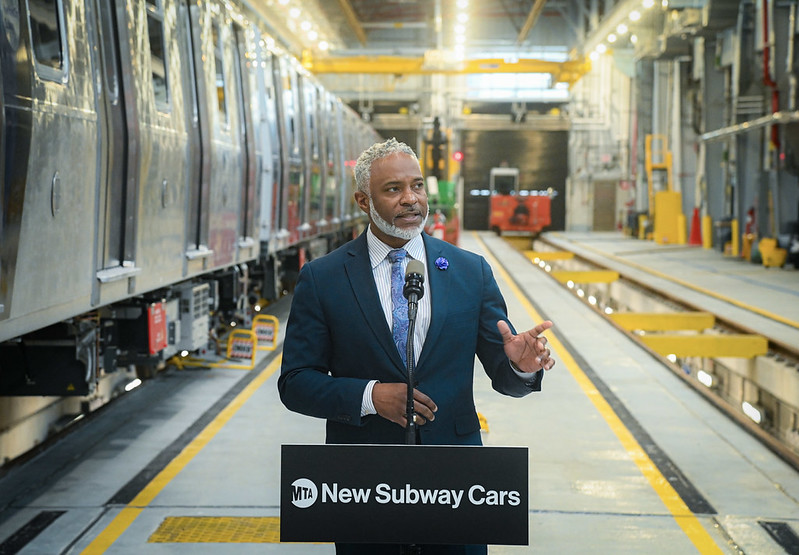
NYC Transit President Demetrius Crichlow.
Marc A. Hermann / MTA
New York City Transit President Demetrius Crichlow on Monday slammed the Transport Workers Union (TWU) for its renewed push for legislation that would require the MTA to maintain two-person crews on all subway trains that currently have them.
Crichlow, during the MTA board’s March 23 New York City Transit Committee meeting, said the TWU International-supported legislation would prevent the MTA from expanding one-person train operation (OTPO) technology to more of the city’s train lines. TWU’s Local 100 represents all of the city’s subway workers — including its roughly 36,000 conductors, who could be impacted by the MTA’s move to OPTO.
For generations, conductors have opened and closed train doors, and made announcements regarding service changes, among other matters. Union reps say conductors also play a critical role in guiding passengers during emergencies.
The NYC Transit president’s comments came after the union recently revived its effort to mandate the MTA maintain a two-person crew — consisting of a driver and conductor — on every train that currently has one.
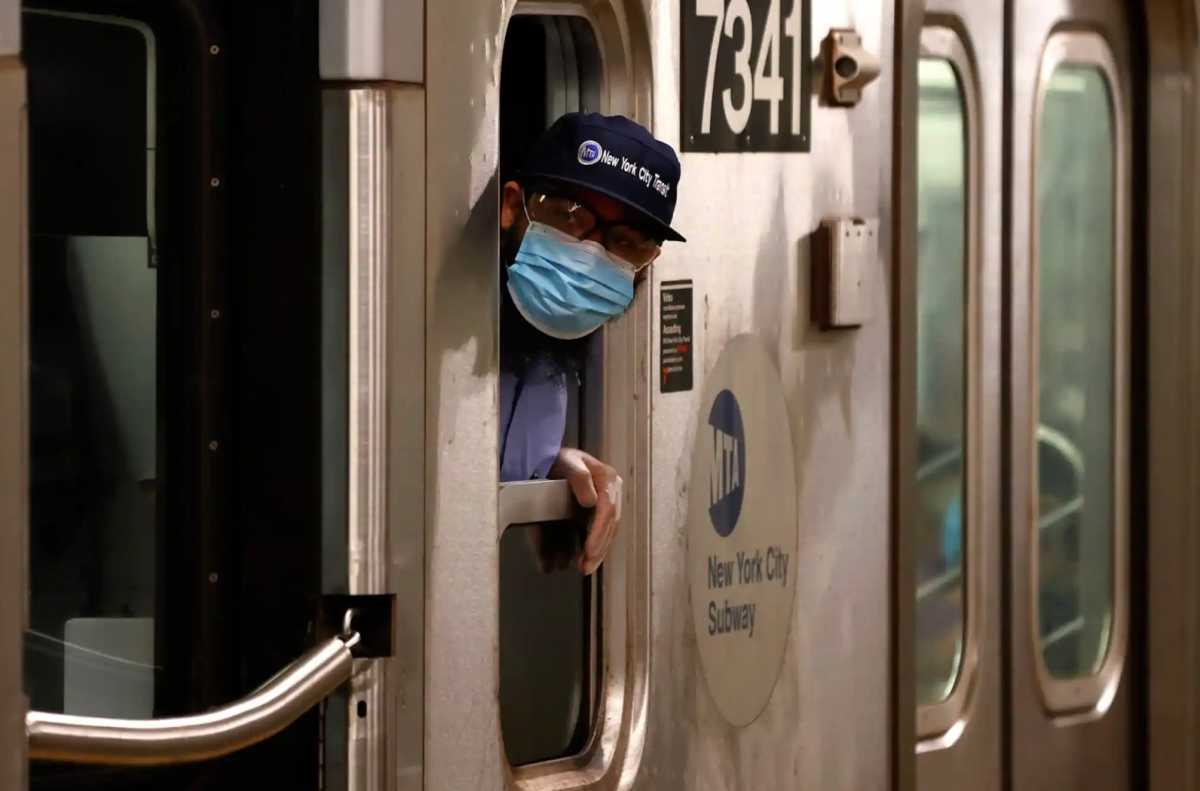 FILE – An MTA New York City Transit conductor on board a subway train.
“Legislating details of New York City Transit’s daily operation, of its trains and its stations, is unwise generally,” Crichlow said. “Here it will…prevent New York City Transit from safely taking advantage of new technology that could save the public millions of dollars.”
Crichlow added that OPTO has become the “industry standard that high performing organizations, high performing transportation networks, are implementing.”
“It is their operating strategy,” he continued. “This is not an area that New York needs to take steps backwards, not an area that New York needs to be last.”
John Chiarello, the president of TWU Local 100, rejected Critchlow’s comments in a statement to amNewYork, in which he portrayed conductors as crucial to keeping the subway system safe.
“What’s unwise is doing away with a set of eyes and ears on trains that prevents perilous situations from happening during operation and allows for our members to be first on the scene when an emergency situation occurs,” Chiarello said. “Other transit systems around the world are just that—other transit systems. Not New York’s. Our system serves more people 24/7 than any other system in existence.”
Union disputes Crichlow’s cost claims
Presently, while most train lines still operate with two-person crews, the agency has introduced OPTO on its shuttles and some low-ridership lines over the weekends. But just implementing it across those lines is already saving the agency $9 million annually, Crichlow said.
“That’s money that’s reinvested back into employees, that’s reinvested back into service,” he said.
Crichlow also contended the legislation would increase costs, though it appeared he was referencing a previous version of the bill that would have required two-person crews on every train line, including those that already have OPTO. The new legislation would require two crew members on all lines that currently have them, but not those with OPTO.
“He’s factually wrong; it’s not going to cost the MTA a dime more than what they’re laying out right now,” said John Samuelson, TWU International’s president, in an interview.
Gov. Kathy Hochul vetoed that version of the bill last year, after it was advanced by both houses of the state legislature. In her veto message, Hochul said it would cost the state an additional $10 million-a-year.
Samuelson said the new version of the bill was crafted with Hochul’s veto message in mind.
“The bill’s cost-neutral, all it does is cement the status quo,” he said. “So she’s gonna have to show her true colors. She’s not going to be able to hide behind a budget line.”
Simmering tension as contract talks loom
The union is pursuing the legislation, sponsored by state Sen. Kevin Parker (D-Brooklyn) and Assembly Member Monique Chandler-Waterman (D-Brooklyn), to protect conductors’ jobs as it heads into its latest round of contract negotiations with the MTA over the next couple of months. Their current contract expires on May 15.
“Every time I bargain a contract, they try to take the conductor away,” Samuelson said. “Our effort is to enshrine it into state law so it stops the every three-year attack on the conductor title.”
Earlier this month, TWU released a poll, conducted on its behalf by the Honan Strategy Group, that found 87% of its 1,517 respondents support its legislation. However, nearly half of those interviewed for the survey — 48% — live in Northern New Jersey and on Long Island.
TWU is pushing for the legislation along with disability advocates, such as the Brooklyn Center for Independence of the Disabled, and the transit advocacy group Riders Alliance.