
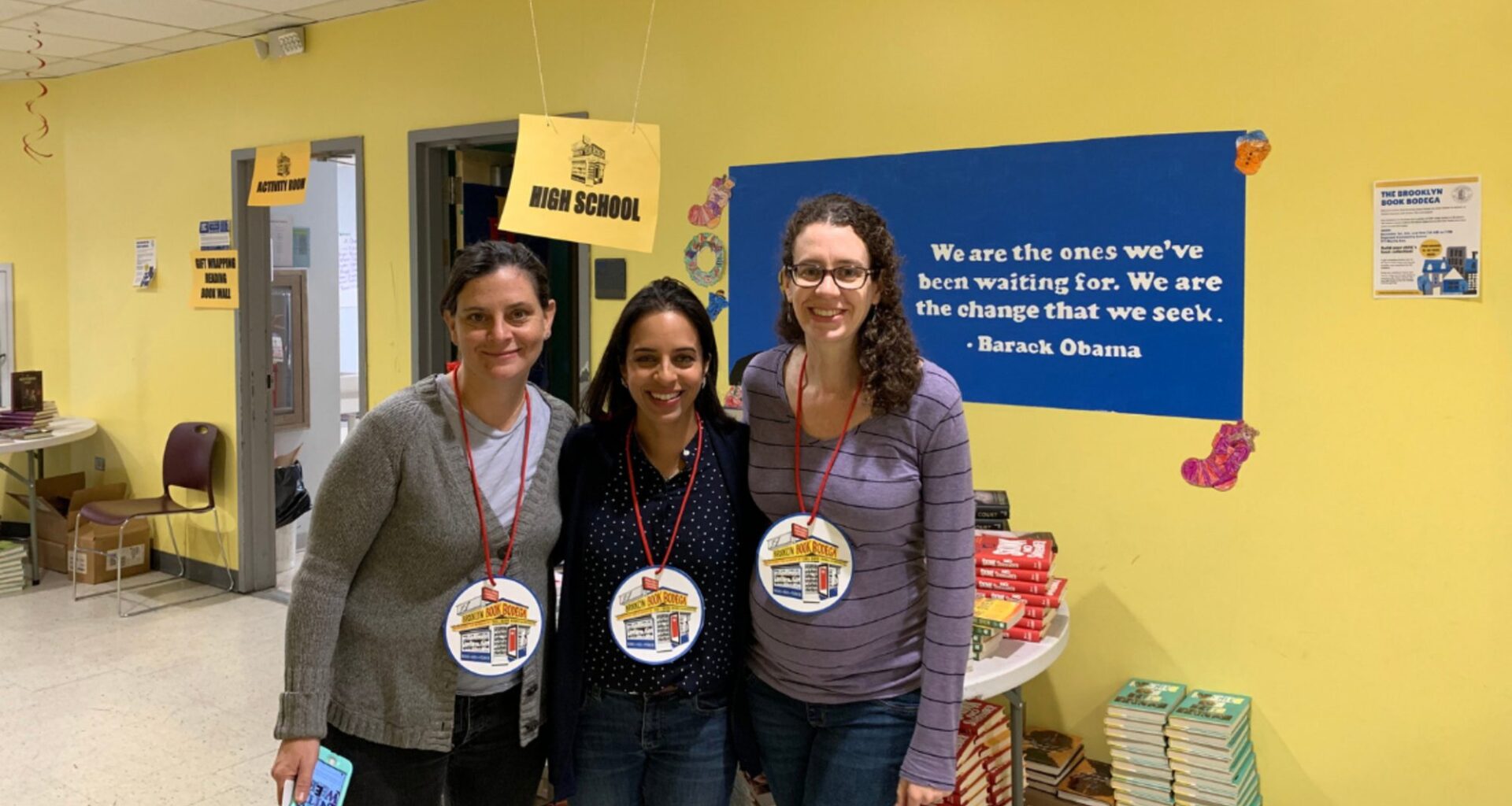
It started as a conversation among three friends about how having more books at home could shape young people’s futures. What it’s grown into is a nonprofit, Brooklyn Book Bodega, that has helped more than 260,000 children and families across the city own books and attend events that foster a love of reading.
The friends, Rebecca Cohen, Seema Agarra and Tamara Jachimowicz, weren’t just thinking of books in terms of cognitive and academic skills. They felt, Cohen said in an interview, that books often shine a light into friendship, family dynamics, other people’s lives and your own emotions — skills they thought kids need now more than ever.
“When you come out on the other side of having read like 10 Katherine Paterson books,” Cohen said, citing a favorite children’s book author, “you know more about how humans are, about what it means to be a child growing up.”
Giveaways and book parties
 Credit: Brooklyn Book Bodega
Cohen, a teacher, Agarra, an engineer and Jachimowicz, a child psychologist, first talked about the problem of providing books to students shortly after the start of school in 2018. Other parents and teachers contributed to the idea, including a Spanish teacher who suggested calling it Brooklyn Book Bodega. Just as “a bodega is your corner store,” Cohen recalled, “books should be as accessible as your bodega.” An art teacher drew the logo that now graces its merch.
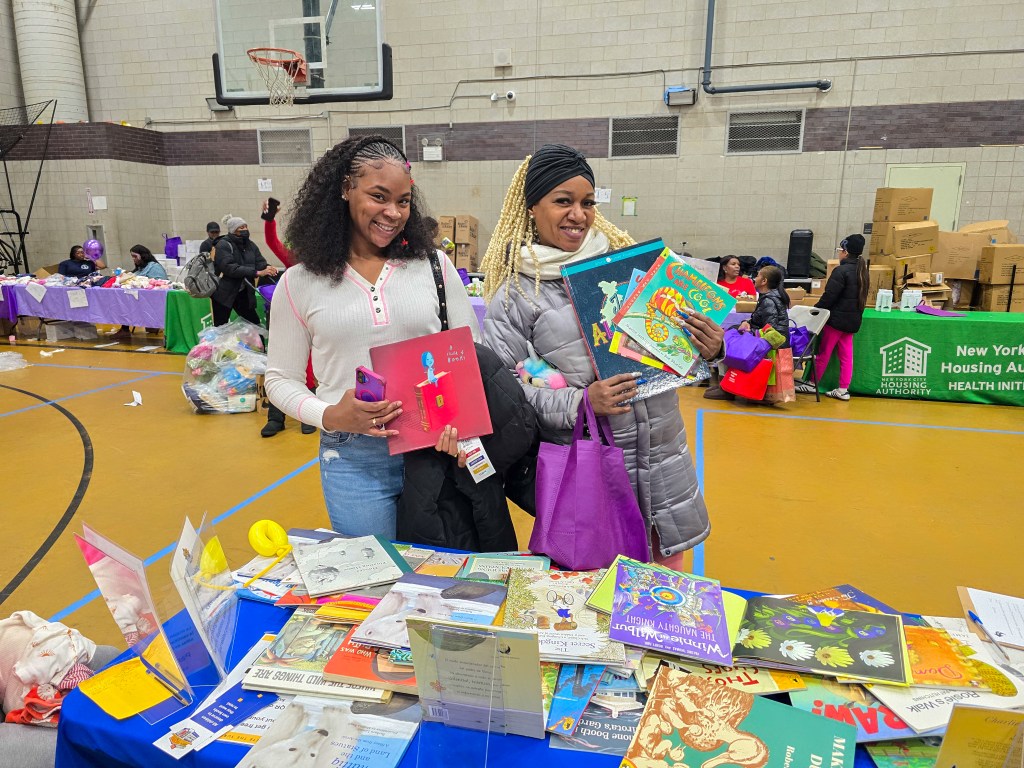
Their first book giveaway that December also came about through the involvement of a fellow parent. Cohen, Agarra and Jachimowicz were discussing the idea at school when a parent offered a lead. He was a gym supervisor at a NYCHA community center in Fort Greene that had just received a large infusion of books.
The giveaway was held at the center. The best part, Cohen said, was “neighbors who wouldn’t have necessarily talked to neighbors were talking to each other.” Suddenly, NYCHA tenants and renters at high rises across Flushing Avenue were communing around the free books. These people from different walks of life reflected a microcosm of New York itself, Cohen said.
“Parents, caregivers, family members, they are rooting for not only their children, but all of our children,” she said. “We had this real joy in community, joy in knowledge building and literacy and [feeling] we can do good by our kids.”
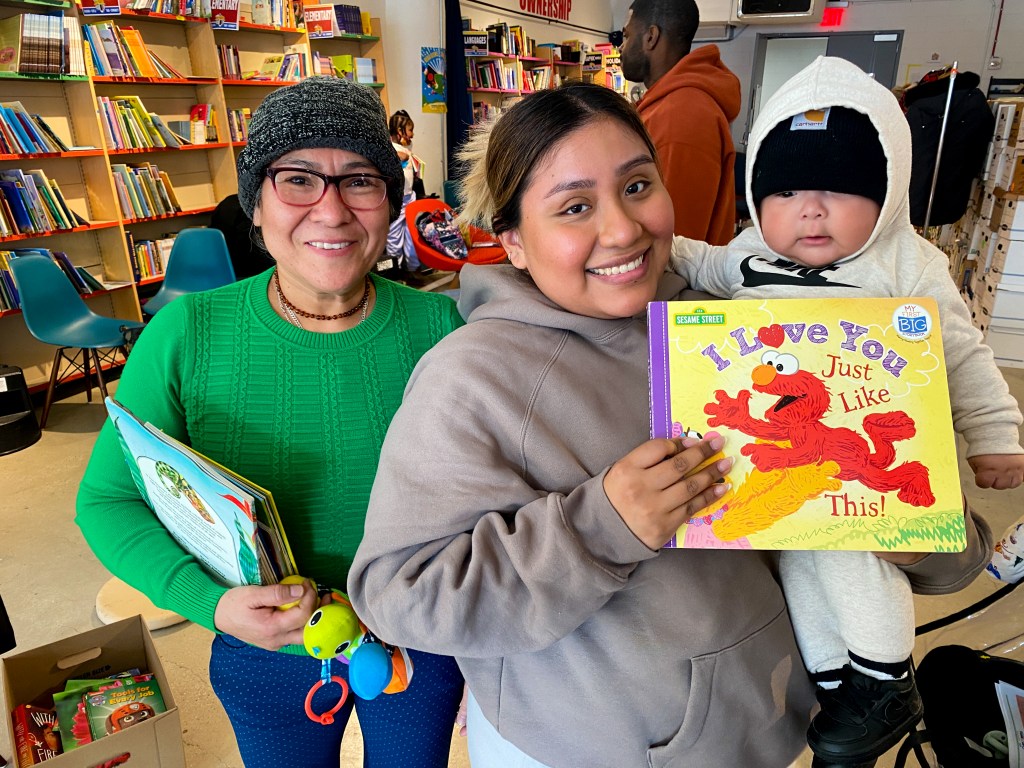
Over the next few months, the Brooklyn Book Bodega held more literacy events. Giveaways, paired with activities, felt more like parties. Families received tickets they could exchange for books, as at a fair. There were also performers who sang with the children or a special education expert to speak with parents.
Sorting out the operations
 Credit: Brooklyn Book Bodega
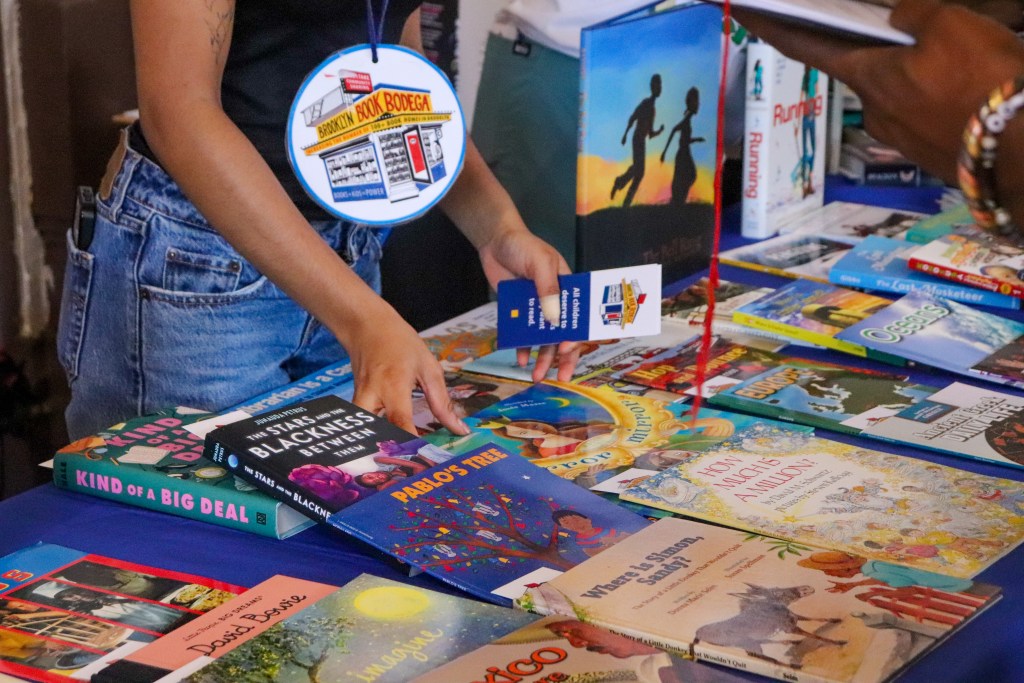
As the giveaways turned into community events, neighbors began bringing bags of books their kids had outgrown. With pro bono legal support, Brooklyn Book Bodega became an official nonprofit in 2019. The operation shifted from a purely volunteer effort to a structured organization that required fundraising, grant writing and forming a board. Their funding comes from a wide range of supporters that include philanthropic foundations, health systems such as NewYork-Presbyterian and a bevy of banks, colleges and other corporate sponsors.
Agarra became its first part-time staffer; she and Cohen later joined full-time. Jachimowicz is on the board. The team branched out to pilot programs with schools and other local partners, such as the Department of Homeless Services.
When the pandemic hit, the team had just started a series of events with the Brooklyn Navy Yard, which eventually became the group’s home base, with shelves donated by a Barnes and Noble that was closing.
The team started receiving letters from kids saying their eyes were hurting from looking at screens. They wanted books. And “people were lonely, people were bored, people were frightened,” Cohen said. “Books are friends in those situations.” The team reached out to contacts in those families’ neighborhoods to ask if they had extra books.
At that point, Agarra (now the chief operating officer)spearheaded the organization’s book distribution system. People could put in a book request through an online form on their website that the team would process, then pick up or drop off.
Soon masked neighbors were leaving books at others’ doors, and teachers were picking up books from their students’ homes. At the time, mutual aid groups were also reaching out to Brooklyn Book Bodega. So the team, including a cadre of volunteers, started giving out books outside alongside masks and food being distributed.
Back to regular book programming and beyond
 Credit: Brooklyn Book Bodega
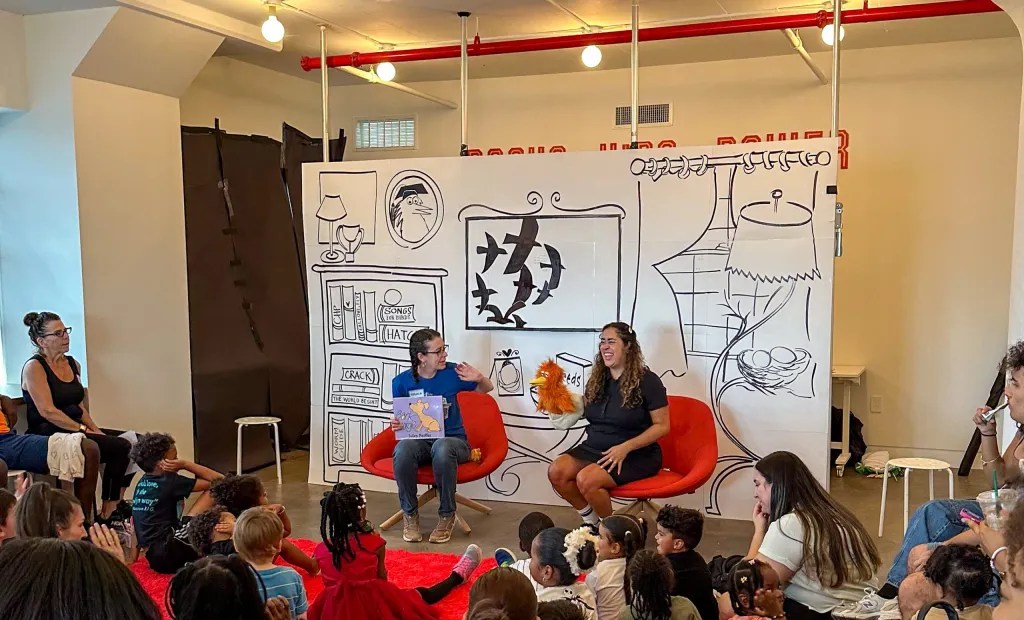
After the pandemic, Brooklyn Book Bodega leased new space in the Navy Yard with a book processing area and program area. There, the organization returned to its bread-and-butter events – big book parties. The team also helped interested neighbors build their own community-based libraries and started educational programming, such as “I Love My Bodega,” an early childhood literacy workshop.
Volunteers have remained a vital force in sorting and distributing books and keeping programming going. They range from high schoolers and parents who drop by with their child on a Saturday to worker groups and neighbors who have been laid off. Still, the team is always looking for more volunteers, either directly with the organization or in starting a book giveaway in their own community.
The nonprofit’s goal this year is a big jump: to distribute 250,000 books. They hope to do that piecemeal, largely through a monthly Community Day, at which families can take as many books as they like. The next one is April 11.
Cohen’s tips for other nonprofit leaders or entrepreneurs
 Credit: Brooklyn Book Bodega
Be as visionary as you can be, and as cautious as you need to be: “You can put a lot of energy into something for a limited amount of time. But to put a lot of energy into something for an extended time, you really have to have a plan for fundraising, for who’s going to be the [first] employee, for setting up backend operations.”
Grow slow: “I don’t want to grow too fast and then not be able to sustain or support it. If I have a head count of 10 people this year, I don’t want to drop to eight next year. If you’re building the plane while you’re flying it, then you also need to make sure you’re taking care of the people [you’re hiring] and responsible for.”
Stick to your priorities: “Figure out what your priorities are and make sure they align with your bigger picture and goal. Don’t get as lost in the details, in the back and forth.”
You can join Brooklyn Book Bodega at a New York Liberty game, for which it was selected as “Nonprofit of the Game,” on May 27. Tickets start at $35.
—
Learn about upcoming events.
Follow on Instagram at @brooklynbookbodega.
Follow on TikTok at @brooklynbookbodega.