
New York City officials are shutting down the old entry point for homeless women entering the shelter system and opening a new, state-of-the-art site in East New York.
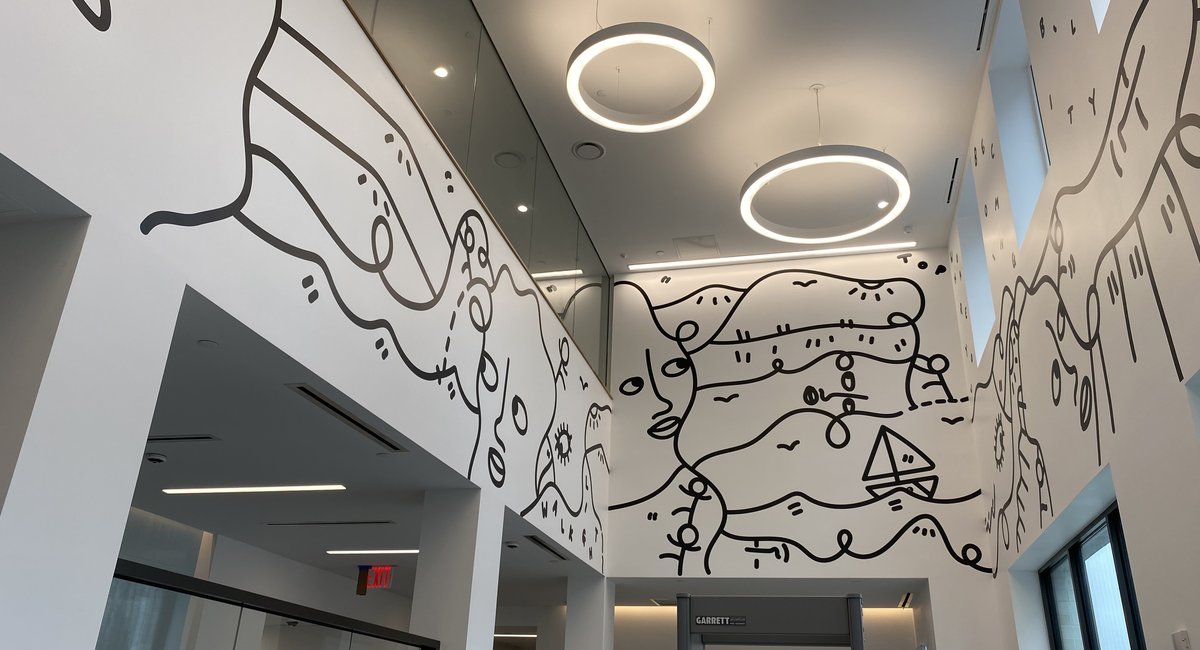
The 60,000 square foot intake center at 114 Snediker Ave. will be the first in the city designed specifically for women experiencing trauma. A giant mural adorns its spacious entryway, and each floor of the building is ribboned with muted pastel colors. The rooms, which for the first time include a handful of private bedrooms, are complemented by natural light. The facility also includes 200 beds for women to temporarily sleep before they are relocated to other shelters.
”That woman coming in the moment of crisis, comes in and can take a deep breath and say, ‘I’m going to be taken care of.’ That is the message. We want to make sure that every woman that walks through our intake feels like we got them,” said Helen Arteaga, the city’s deputy mayor for health and human services, in an interview.
A large mural decorates the entryway to the new women’s intake center at 114 Snediker Ave. in East New York.
Karen Yi / Gothamist
The project is part of the city’s efforts to modernize its aging shelter system and was also prompted by a court settlement requiring the city to ensure its facilities are ADA compliant. The Mamdani administration also sped up plans to empty out the decrepit men’s intake shelter earlier this month and fast-tracked new shelter sites offering private rooms and no curfews.
Though the project predated Mayor Zohran Mamdani, officials in his administration say it aligns with his vision for creating more welcoming spaces for homeless New Yorkers and convincing more people living on the street to accept a temporary bed.
“ We’re showing from the front door the kind of services we want to be providing and the way we want to be treating people,” Department of Social Services Commissioner Erin Dalton said in an interview.
The $89.5 million facility will be managed by the nonprofit HELP USA, which has handled the city’s intake services for single women since 2005. The organization says about 4,000 women ask for a shelter bed at the Brooklyn intake facility every year; they also operate a women’s intake in the Bronx. Women are temporarily housed there before they’re sent to shelters across the city. The five-floor shelter will be able to accommodate 200 women, who will stay an average of three weeks before they’re placed in a more permanent shelter location.
The shelter rooms inside the new intake facility offer women more privacy with taller dividers.
Karen Yi / Gothamist
“It will give women in New York City a place to begin their recovery from homelessness in a setting built to reduce trauma, restore dignity and support stability,” said Dan Lehman, president and CEO of HELP USA. The organization operates supportive housing and 28 homeless shelters.
“In the long term, that kind of environment can help shorten shelter stays and accelerate the path to permanent housing for thousands,” Lehman added.
HELP USA will relocate from the former intake facility a few blocks down on Williams Street, that was housed inside a former public school. The city’s Economic Development Corporation will redevelop the old property.
The old women’s intake center on Williams Avenue was in a retrofitted school and will close at the end of the month
Karen Yi / Gothamist
Inside the new site — which is open around the clock — no more than five women will sleep in a room, down from as many as 13. The rooms also have taller dividers to give each woman privacy. There will also be a medical clinic on site, a lactation room, an art therapy room, a courtyard for gardening and a fully operating professional kitchen, where staff can prepare fresh meals.
“ When you’re in the biggest trauma, in a crisis, the first thing people say is take a breath. But if you could take a breath in a space that is calm with natural light, taking that breath is an easier thing to do,” Arteaga said.
The project was developed using a city tool that allows nonprofit developers to use city contracts to convince private banks to give them money to build.