
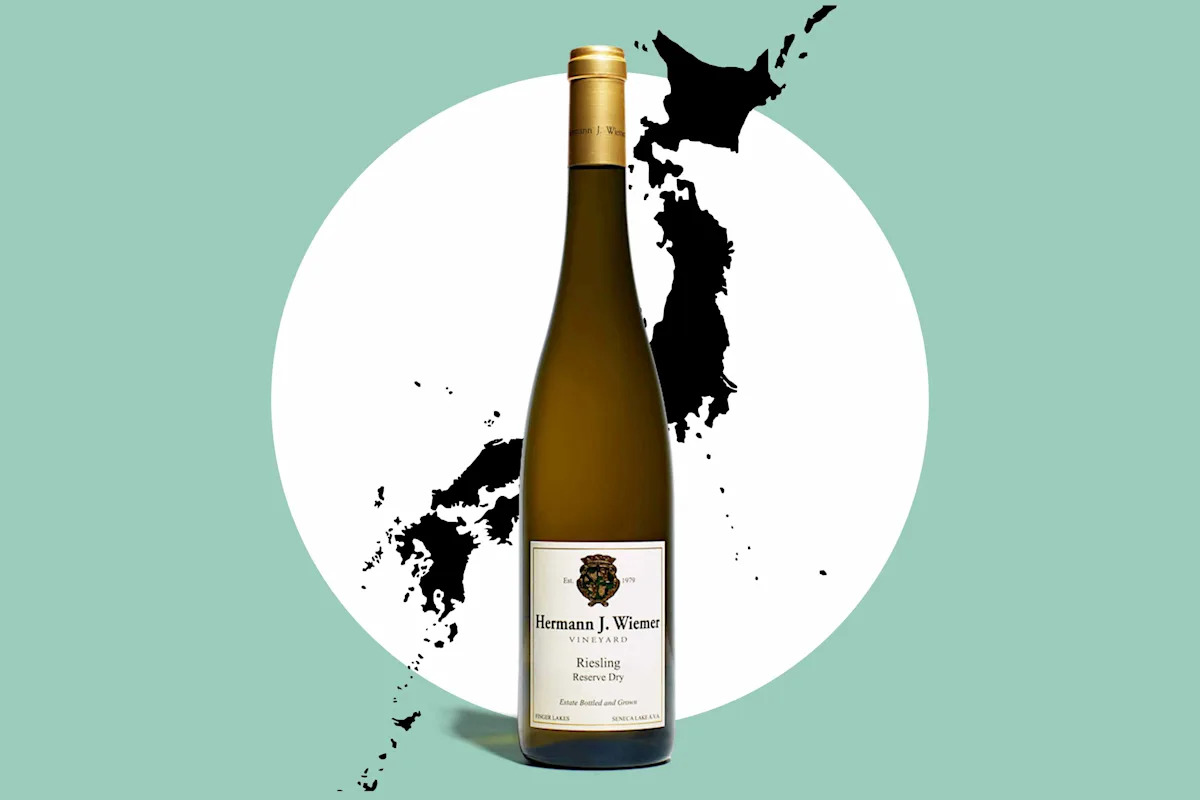
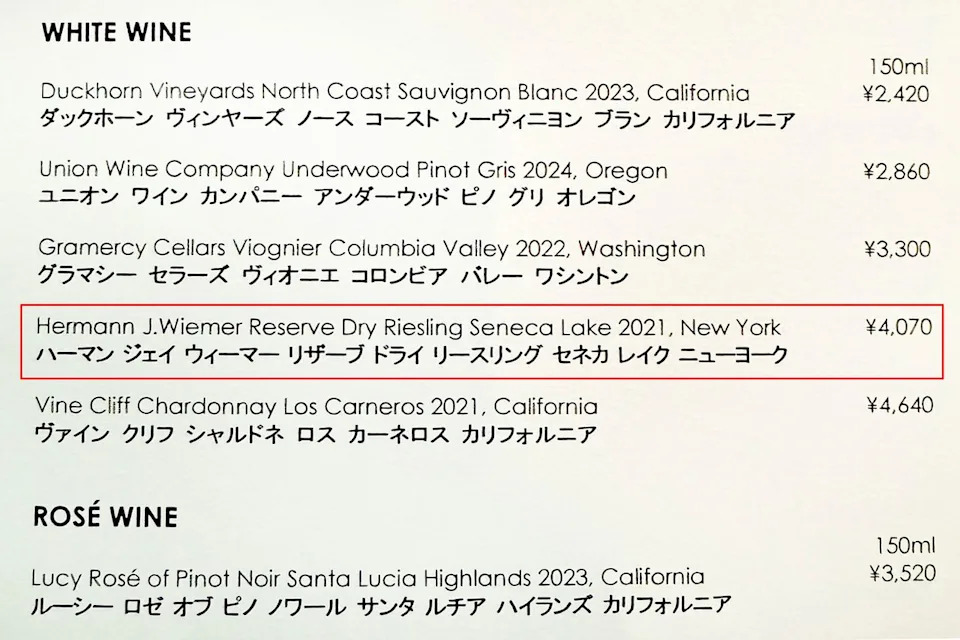
I squealed when I saw the glass of wine on the menu. “They pour Finger Lakes by the glass in Tokyo?!” I said to my dining partner. As I watched the sunset from the 52nd floor of Tokyo’s Park Hyatt Hotel, and listened to jazz at the New York Bar, I ordered one of my favorite wines — one that felt like a taste of home: Hermann J. Wiemer Reserve Dry Riesling.
My surprise wasn’t because Hermann J. Wiemer, located on Seneca Lake in New York’s Finger Lakes region, is a lesser-known winery — though it is widely respected for producing some of the finest Rieslings since 1979 — but because I was halfway around the world drinking wine made in my home state. After a mother-daughter trip to New York’s Finger Lakes region in the fall of 2024, Hermann J. Wiemer Reserve Dry Riesling — an elegant wine with racy citrus acidity and floral undertones — has become my mom’s house wine. She buys it by the case from her local wine shop along the Connecticut shoreline and serves it with everything from summer lobster rolls to winter minestrone.
Related: The Finger Lakes Region, Once Famous for Their Bubbly, Is Now Making Excellent Pét-Nats
A by-the-glass position at any restaurant is coveted, but especially at the New York Bar, one of the most beautiful spots in Tokyo to grab a drink and best known for its role in Sofia Coppola’s 2003 film Lost in Translation. By-the-glass wines, especially whites, move quickly. They need to be crowd-pleasing, affordable bottles that punch well above their weight — yet still interesting enough to entice guests. The New York Bar pours exclusively American wine by the glass, but other than Hermann J. Wiemer, the selections are all West Coast wines, which contributed to my excitement to see New York state’s presence on the concise menu.
Credit: Food & Wine / Lucy Simon
Even so, production remains relatively small. Hermann J. Wiemer makes around 20,000 cases of wine a year. Those bottles end up on wine lists in the United States, but the winery also exports to nine (soon 10) countries, including Denmark, the Netherlands, the U.K., Mexico, and Japan.
“Exports are only about 5-8% of our total production,” says Hermann J. Wiemer’s co-owner, Oskar Bynke. “There’s still a lot of low-hanging fruit closer to home. We’re still working on convincing restaurants in New Jersey, for example, but the international presence is growing.” Wiemer’s Rieslings are beloved by New York City sommeliers and can be found on wine lists at places like Gramercy Tavern and Eleven Madison Park.
While Japan is best known for sake, wine is a rapidly growing category in the country. During my trip in January, I made it my mission to explore as many of Japan’s wine bars as possible. I tried a fair share of Japanese wines (yes, Japan makes wine! Its growing wine regions show real promise), as well as a range of international wines from well-curated lists.
“In Japan, our presence is rooted in a decades-long relationship with an importer who built deep connections between New York wines and Japanese cuisine, where our lighter, fresher styles — particularly dry Riesling — pair naturally,” says Bynke.
Related: Yes, Japan Makes Wine—Here’s Why You Should Be Paying Attention
For years, the Finger Lakes has been steadily proving itself as one of the most exciting wine regions in the country, producing bottles that are expressive and precise with every vintage. Warmer average temperatures have played a meaningful role in that evolution, helping growers achieve more consistent ripeness while still embracing the racy acidity and freshness that define the region. While the praise may be more established in the U.S., it’s especially compelling to see the Finger Lakes draw wider global attention — the kind of recognition that feels not only deserved but long overdue.
“The Finger Lakes has a critical mass of attention now,” says Bynke. And that sense of discovery is spurring global recognition of wines like the Reserve Riesling — bottles that offer strong value and a real sense of place. “Sommeliers and buyers love to put a stake in the ground for a wine from somewhere you wouldn’t expect. They want to be the person who found it first. That’s a much easier conversation to have now than it was 15 years ago.”
That night at the New York Bar, I sipped my Riesling and snacked on sweet-and-salty puffed rice crackers and, after glass two, beef-fat fries, and thought about my home state from halfway around the world.
Read the original article on Food & Wine