
The NYPD is not constitutionally required to help a person being attacked by an angry mob, lawyers for the city argued in a recent court filing.
The argument came in response to a claim filed by Amanda Luci, who alleged NYPD officers failed to protect her from a mob of young men and boys who she said attacked her in Crown Heights, Brooklyn, in 2025.
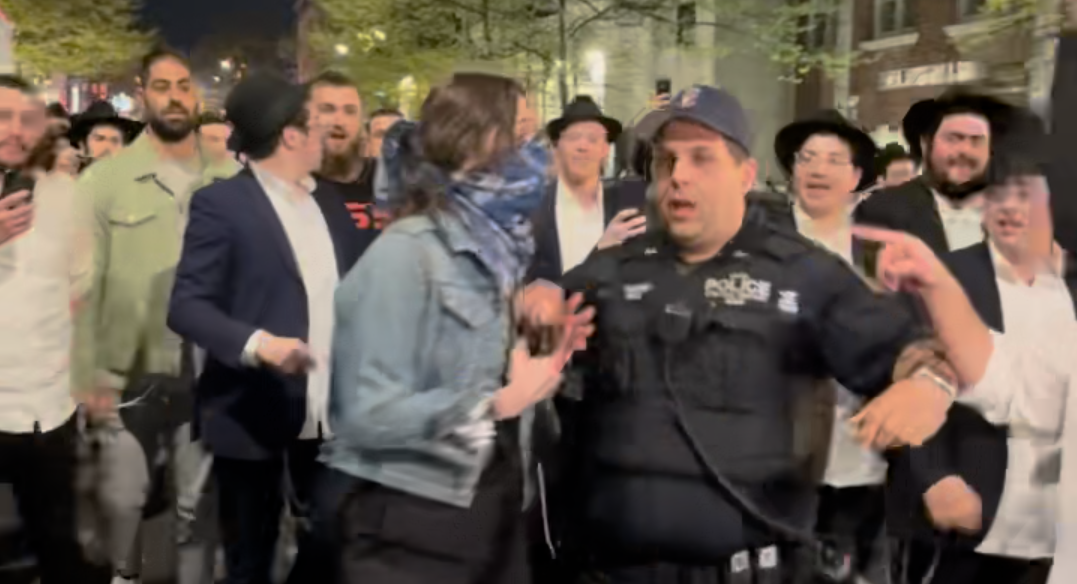
In her lawsuit, Luci said she was surrounded, kicked and threatened by the large group of people, most of whom were wearing traditional Orthodox Jewish garb, after they mistook her for a pro-Palestinian protester in front of a historic synagogue. Her lawsuit claims the NYPD officers who responded to the scene emboldened the mob by doing nothing to quell the situation, in part because they also believed Luci was expressing pro-Palestinian views.
Attorneys for the city wrote last week that they will ask a judge to dismiss the lawsuit for a number of legal reasons. Among their arguments is one that the NYPD has no constitutional requirement to protect someone from being attacked. It’s an argument that may surprise most people. But the attorneys cited a number of prior cases they say back up their defense and show judges may agree with their view.
Legal experts who spoke to Gothamist agreed that the Constitution generally does not require officers to protect people. But they said there are exceptions, and they may apply to Luci’s case.
The NYPD did not comment on the recent filing, but a spokesperson said previously that the department’s hate crimes task force is investigating the incident. The spokesperson also noted an officer drove Luci to her home that night after a single police officer escorted her through the group to safety.
Surrounded and threatened
The incident that led to Luci’s federal lawsuit happened on April 24, 2025 outside of the Chabad-Lubavitch headquarters on Eastern Parkway. That night, a small group of demonstrators gathered on the street outside the building to protest an appearance by Itamar Ben-Gvir, Israel’s far-right security minister.
Luci went to the scene to observe the commotion after she heard a helicopter over her apartment, her lawsuit states. She did not go to attend the protest, she said.
A group of counterprotesters gathered at the scene and assaulted at least one pro-Palestinian protester, according to the lawsuit. During the ordeal, a large group of young men and boys mistook Luci for a pro-Palestinian protester, surrounded her, threatened her with sexual assault and threw objects at her, according to video of the incident and the lawsuit.
One police officer came to her aid and escorted her through the mob to a police vehicle, according to video from the scene that later gained significant attention online.
Luci’s lawsuit alleges that the NYPD’s inaction that night violated her constitutional rights in a variety of ways, including encouraging the attacks by not quelling the scene.
The city’s response
Attorneys for the city said in their legal papers that the police can’t violate someone’s constitutional rights by failing to protect them.
“Plaintiff does nothing more than state that she was attacked by protestors and that the officers did not stop them,” their papers say, adding that’s not grounds to sue and the lawsuit should be dismissed.
Attorneys for the city used an example of a lawsuit brought by a man who had helped police in a sting against a suspected Queens drug dealer. When the dealer later slashed the man in the face with a box cutter, the city argued that the police had no obligation to protect him. An appeals court sided with the city in that case, finding that even though the man was attacked after participating in the sting, the police were not responsible for putting him in danger.
No right to be protected
In general, the Constitution doesn’t require public employees to protect people, and that includes the police, several legal experts said.
Though that may seem surprising, Alex Reinert, a legal scholar and professor at Cardozo Law School, said it’s because in general the Constitution does not create what he called affirmative rights for people.
“Most of what the Constitution does is create rights to be free of certain conduct by the state,” he said. “In general, we don’t have a right to be protected by the state from assault by private individuals.”
But Reinert and other legal scholars said there are exceptions to that — and how the police acted during the group’s attack on Luci may be one.
Leah Litman, a law professor at the University of Michigan, said persuading a judge that police failed to protect Luci because they thought she was a pro-Palestinian protester could be key.
“Even if you have no free-standing obligation to protect everyone, you can’t decide who you protect and who you don’t on the basis of race, religion and freedom of speech,” Litman said. “That’s just right.”
Reinert added that there is a good argument for the lawsuit not to be dismissed until the city is required to provide information about what happened that night.
He said if there is evidence to show that the NYPD’s actions created a situation that increased the risk to Luci, it could be a good argument for the lawsuit to move forward.
“There are some facts we need to know about what was happening on the ground and any actions the officers may have taken that might have increased the danger to the plaintiff here,” he said.
Luci’s attorney, Leo Glickman, said he is confident the lawsuit will survive the city’s efforts to have it dismissed.
“We look forward to litigating this issue before Judge [Frederic] Block and are confident that the case will survive this motion,” Glickman said in a statement.