
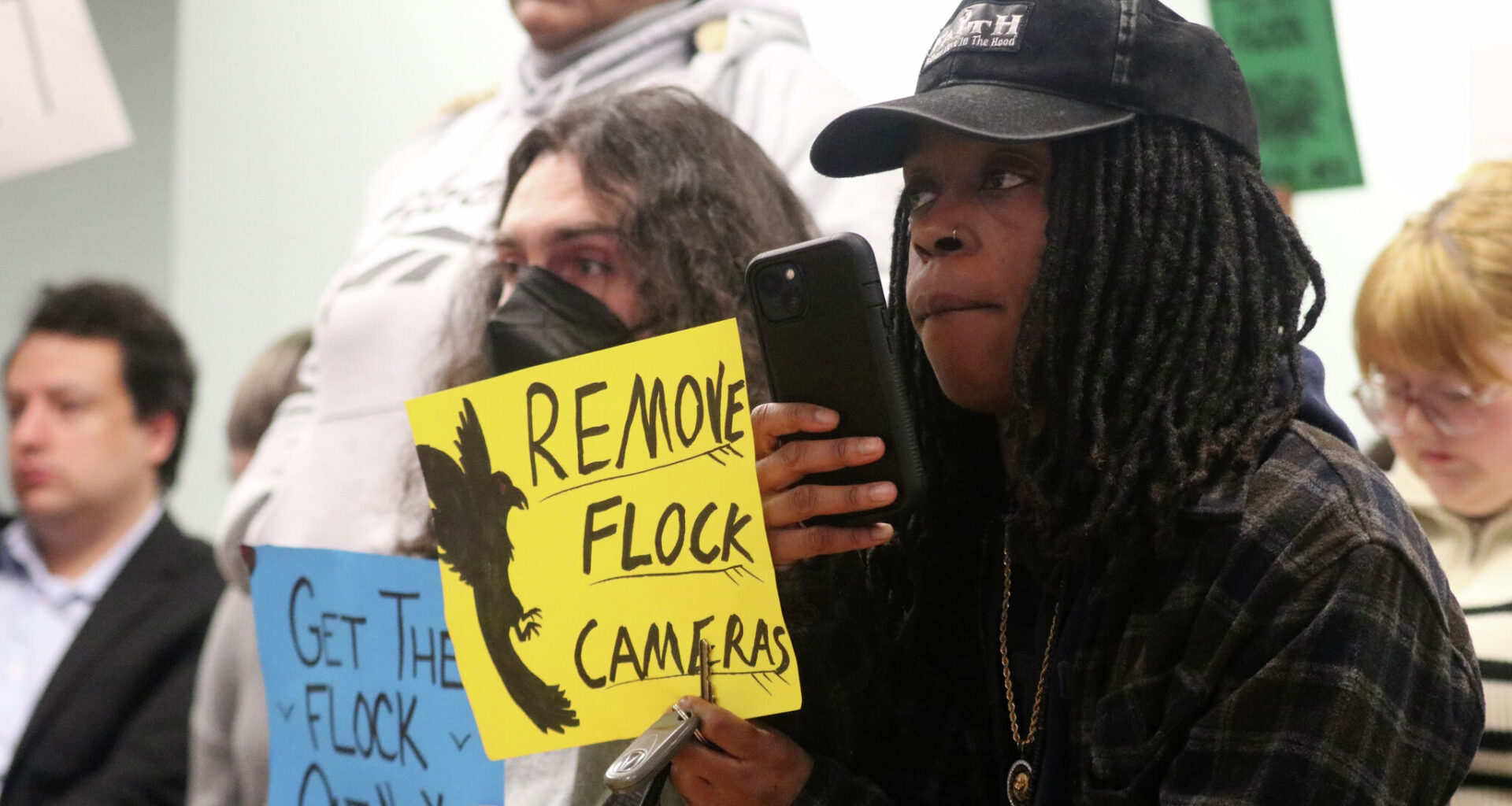
Activists and residents show their opposition to Flock Safety cameras at a well-attended Troy City Council meeting on Thursday
Tyler A. McNeil/Times Union
A Flock Safety camera is seen on March 16 on the corner of Hill Street, Ida Street and Spring Avenue in Troy. The city has disabled a feature that shares data collected by the cameras with a nationwide surveillance network.
Lori Van Buren/Times Union
Activists and residents oppose Flock Safety cameras at a standing-room-only Troy City Council meeting on Thursday.
Tyler A. McNeil/Times Union
Troy Deputy Police Chief Steven Barker discusses Flock Safety cameras at a full Troy City Council meeting on Thursday. He was sitting alongside Troy Mayor Carmella Mantello, Deputy Mayor Seamus Donnelly and Police Chief Daniel DeWolf.
Tyler A. McNeil/Times Union
TROY — City police have temporarily shut off the national search feature for Flock Safety cameras amid controversy over the company’s automated license plate readers.

Troy Deputy Police Chief Steven Barker told the Times Union that the agency on Thursday paused its ability to retrieve and share license plate data for the time being from Flock’s extensive network. There’s no definitive timeline on how long the feature will be disabled.
Article continues below this ad
Barker, who has previously expressed confidence in the city’s 26 automated license plate readers from the Atlanta-based company, noted in an email that the decision was made “collectively” as city officials “continue to collect feedback from the public regarding this ongoing resource.”
Related: Flock Safety AI-powered cameras face uncertain future in Troy
More: A Hudson Valley town tried to secretly install surveillance cameras. An uproar ensued.
Make the Times Union a Preferred Source on Google to see more of our journalism when you search.
Add Preferred Source
More: Poestenkill rejects sheriff’s office proposal for license plate readers at Town Hall
Article continues below this ad
Since early March, there’s been a growing push among Troy residents and progressive activists to remove Flock’s readers from neighborhoods due to privacy and mass-surveillance concerns. The movement mirrors efforts across the country and in the Hudson Valley and Capital Region, including a controversial proposal from the Rensselaer County Sheriff’s Office that was rejected by Poestenkill lawmakers to install a Flock camera in the rural town, and complaints about the installation of cameras in Pine Plains.
The national search feature was disabled less than 24 hours before opponents called on officials at a Troy City Council meeting to sever ties with the six-year contractor, whose subscription is set to expire on March 31.
The Democratic council, also skeptical of the company, ultimately tabled a request from Republican Mayor Carmella Mantello’s administration to renew the biennial $78,000 Flock contract.
After reviewing the proposal last week, councilors discovered that the contract would automatically renew if no cancellation notice were provided within 30 days. That window has already expired.
Article continues below this ad
The administration has insisted that legislative approval matters. Patrick Madden, the former mayor and a Democrat, never approached the council when it first brought in Flock in 2021 or when it renewed the subscription in 2023.
But City Council President Susan Steele said neither Mantello’s gesture nor disabling the national search feature does much to address concerns about data security and privacy surrounding the cameras.
“If it is a victory, it’s a minor one,” Steele said. “There are still an awful lot of questions that have gone unanswered, and so I don’t think there are any winners in this situation.”
Flock has showcased the national data sharing model as a way to make cross-jurisdictional cases easier to resolve across a wide network of cameras. Flock has contracts with more than 5,000 agencies across the country, according to its website.
Article continues below this ad
According to Barker, the searches have helped identify transient crime, ranging from arms sales to scams targeting older adults. Notably, the network helped police locate a Troy man wanted in a 2022 shooting.
During Thursday’s council meeting, Barker, fielding questions about Flock alongside city officials and a Flock representative, noted that the national search feature had been recently disabled, but didn’t specify when it was shut down until the Times Union reached him. He recognized a potential “net negative to having people outside of our agency, outside of our state able to access our searches even though we can have that audit history to go back and determine why they were doing it.”
Concerns have grown that the data could be shared with federal law enforcement agencies. Flock has noted that it doesn’t work with agencies like U.S. Immigration and Customs Enforcement.
Fears in Troy have also been raised about whether Flock camera data can be hacked — the company says it cannot be — and about the company’s reliance on artificial intelligence.
Article continues below this ad
“This technology is moving way faster than we are understanding it, and I think that as a community, we deserve a little bit better, and we deserve to have a say and have protection,” Diedre Shea, a resident who lives about a block away from a Flock camera on Ida Street, told the Times Union.
Along with concerns, the cameras have also received support from the Troy Police Benevolent Association, which described the readers in a Facebook post last week as a “crucial public safety tool.”